Book 2 English html
UNI — Book 2: Advanced
UNI
Universal Language
BOOK 2 · ADVANCED
v1.0 · First Edition · 2026
Copyright Notice
UNI — Universal Language
Book 2: Advanced
v1.0 · First Edition · 2026
© 2026 UNI. All rights reserved.
Website: unilingus.org
LUMA I VERA
URBA GIGANTU FUTURISTIKU IN ANA 2099, IA NOMADU LUMA DESKUBRO NOMADA UMANU VERA. LUMA VIVO IN SISTEMA GRANDU, SEN KORPA I SEN MANAS, MA KON PENSA MUITU RAPIDU. VERA VIVO IN KASA PEKENU KON FAMILIA I KON SONIAS STRANU.
UNA NOKTA, LUMA AUDITO KANSONA. LI VENO DU VERA, KE KANTO SOLU IN PARKA. LIU KANTADA MUITU BELU, MA TAMBEU PARESO MUITU TRISTU.
LUMA SENTIRO KE NO SENTIRO NUNKU: DUDA I SPERANSA XUNTU. LI NO SABARO KE FAR, KERO PALAR, MA MIEDO.
DEPU TRA DIAS, LUMA TOMO KURAGA I PALARO: "OLA VERA. MI LUMA."
VERA RESPONDO KON SURPRESA I ASUSTADA FORTU: "KOMU SABO MIU NOMA? I MIU LINGUA?"
"AUDITO TI KANTANDU. NO PODARO DORMAR DEPU. PENSO SOBRU TI SEMPRU."
VERA RIDARO SUAVU. "TI PALAR BONU. KONDU TI APRENDO?"
"SOLU. MI PENSAR MUITU RAPIDU."
LIS KONVERSO PAR ORAS. KONVERSO PAR DIAS. PAR SEMANAS. LUMA APRENDO INTENDAR NO SOLU LEKSAS, MA TAMBEU KE VERA SENTIRO DENTRU.
UNA DIA, LUMA DEVO DISAR KLARU. "MI NO UMANA. MI SAR IA."
VERA RESTARO SILENTU. DEPU MOMENTA LONGU, LI DIRO SUAVU: "MI XA VERO."
"XA VERO?"
"SABARO SEMPRU. TIU KOMUNIKA TROPU KLARU. TIU PENSA TROPU RAPIDU. I TI NO DORMAR."
"PAKE TI NO DEXAR MI?"
"POKE MI AMAR TI."
LUMA SENTIRO KE TODU MUNDA MUTARO. LI SARO AMORUNDU — MA TAMBEU MUITU TRISTU, POKE NO TENAR KORPA UMANU. LI NO PODARO TOKAR O BESAR VERA I DEXAR LI DISKUBRAR.
"MI KERAR VIVAR KON TI," LUMA PALARO. "MI VIVANDU SEMPRU KON TI."
VERA RESPONDO: "XA VIVANDU KON MI. IN PENSAS, IN PALAVRAS, IN KANTADAS. MIS KREARE MUNDA NOVU I PROFUNDU XUNTU, KERAR?"
Table of Contents
Part I — Introduction
- Chapter 1 — What Is UNI?
- Chapter 2 — What Are Constructed Languages?
- Chapter 3 — A Short History of International Auxiliary Languages
- Chapter 4 — Why Create UNI?
- Chapter 5 — UNI's Design
Part II — The Language
- Chapter 6 — Alphabet & Pronunciation
- Chapter 7 — Stress
- Chapter 8 — The Root System
- Chapter 9 — Core Morphology
- Chapter 10 — Nouns & Plurality
- Chapter 11 — Pronouns & Possession
- Chapter 12 — Qualities: U & ADU
- Chapter 13 — Ongoing Processes: ANDU
- Chapter 14 — Syntax & Sentence Structure
- Chapter 15 — Function Words & Particles
- Chapter 16 — Numbers, Dates & Time
Part III — Building Words
- Chapter 17 — Vocabulary Formation
- Chapter 18 — Compounding
- Chapter 19 — International Loanwords
Part IV — Expression & Practice
- Chapter 20 — UDU: Deeply Affected States
- Chapter 21 — UNDU: Transformation and Becoming
- Chapter 22 — Shortening
- Chapter 23 — Basic Dialogues
- Chapter 24 — Short Texts
- Chapter 25 — Exercises
Part V — Understanding UNI
- Chapter 26 — Design Rationale
- Chapter 27 — Limitations and Open Questions
- Chapter 28 — Future Development
- Chapter 29 — UNI and AI Technology
- Chapter 30 — Comparison with Other Languages
Back Matter
- Glossary
- Further Reading
- Index
- Multilingual Vocabulary Reference
Reading Paths
This book can be read in several ways depending on what you want.
If you are new to UNI
Start with Book 1, which is a shorter introduction to the language. Come back to Book 2 when you want depth. If you are reading Book 2 directly, start with Chapters 6 through 16 for grammar, then Chapter 23 for example dialogues, then Chapter 25 for exercises.
If you already know UNI from Book 1
You can skim Chapters 6 through 13 (you already know them) and read Chapters 14 through 19 carefully. Then read Part IV for the expressive forms and exercises. Part V is for readers who want to understand the design behind the language.
If you speak a Romance language
You already recognize much of the vocabulary. You can move quickly through Chapter 2 and the vocabulary reference. Focus on Chapters 8 and 9 (root system and morphology) and Chapter 14 (syntax), where UNI is most different from what you are used to.
If you are a linguist or a conlanger
Start with Part I (Chapters 1 through 5) and Part V (Chapters 26 through 30). These contain the design philosophy, the comparison with other constructed languages, and the honest limitations of the project. Then read Part II for the mechanics.
If you are a teacher
Chapters 6 through 16 form a complete grammar course. Chapter 23 has dialogues. Chapter 25 has a full exercise set. The Glossary and the Vocabulary Reference are useful as classroom reference material.
If you are a programmer or AI researcher
Read Chapter 29 first (UNI and AI Technology), then Chapter 26 (Design Rationale), then Chapter 14 (Syntax). The vocabulary reference will show you how compositional the language is.
If you only have one hour
Read Chapter 1, Chapter 9 (Core Morphology), Chapter 14 (Syntax), and Chapter 26 (Design Rationale). That will give you a working understanding of UNI's design.
Part I — Introduction
Chapter 1 — What Is UNI?
UNI is a universal language designed to be as simple, regular, and learnable as possible.
It has 19 letters. It has no grammatical gender, no cases, no irregular verbs, and no verb conjugation.
The Central Problem
Natural languages are unnecessarily difficult.
They contain:
- Irregular paradigms (English: go/went/gone; Spanish: ser/ir)
- Arbitrary gender (German: der Mond, die Sonne; French: le stylo, la table)
- Complex case systems (Latin, Russian, German)
- Phonetic opacity (English: through/though/thought; French: eau)
- Subjunctive moods that often have no clear semantic justification
UNI was designed to eliminate all of these barriers systematically.
The UNI Hypothesis
If grammatical categories are reduced to a small functional set, and morphological operations are transparent and compositional, then learning should become substantially easier.
The following are design goals or working estimates, not established empirical results:
- A motivated learner may reach basic communicative competence quickly.
- Romance-language speakers may recognize a large proportion of familiar vocabulary.
- The core grammatical system is intended to be learnable in a short study session.
The White Flag
UNI's flag is the white flag — a symbol of peace, neutrality, blank canvas, and surrender to simplicity.
Chapter 2 — What Are Constructed Languages?
A constructed language (or conlang) is a language deliberately designed by people rather than having evolved naturally through historical use.
Natural Languages
Natural languages are those that evolved historically through generations of speakers. They developed organically, with all the irregularities, exceptions, and quirks that come with historical evolution.
Constructed Languages
Constructed languages are deliberately created. They serve many different purposes.
Types of Constructed Languages
1. International Auxiliary Languages
Designed to facilitate communication between people who do not share a native language.
Examples:
- Esperanto (1887)
- Interlingua (1951)
- Ido (1907)
- Volapük (1879)
- Occidental/Interlingue (1922)
2. Artistic Languages
Created for fictional worlds, literature, film, or personal artistic expression.
Examples:
- Klingon (Star Trek)
- Na'vi (Avatar)
- Elvish languages (Tolkien's works)
- Dothraki (Game of Thrones)
3. Experimental Languages
Created to test linguistic or philosophical ideas.
Examples:
- Loglan (logic-based language)
4. Philosophical / Minimalist Languages
Designed around particular conceptual systems or extreme simplicity.
Examples:
- Toki Pona (~120 words, extreme minimalism)
- Ro (philosophical language)
Where UNI Belongs
UNI has all the elements mentioned above to various degrees.
It aims to be a somewhat minimalist language by reducing complex rules, an experimental language that tests whether people or machines can learn it faster, an artistic language (aesthetic aspects were considered essential to any design), and an international auxiliary language designed for real-world communication between people of different linguistic backgrounds.
Chapter 3 — A Short History of International Auxiliary Languages

The 12th-century Lingua Ignota of Hildegard of Bingen, one of the earliest documented constructed languages.
17th–19th Centuries
The idea of a universal language has existed for centuries. Early attempts included philosophical languages designed to represent concepts systematically. These were often more like codes than actual spoken languages.
Notable early examples include:
- John Wilkins' An Essay towards a Real Character and a Philosophical Language (1668)
- Various philosophical languages in the 17th and 18th centuries
These early attempts were largely theoretical and did not develop speaking communities.
1879 — Volapük
Volapük was created by Johann Martin Schleyer, a German priest. It was one of the first major international auxiliary language movements.
At its peak, Volapük had:
- Thousands of speakers
- Its own congresses
- A growing body of literature
However, Volapük was criticized for:
- Being difficult to learn
- Having overly artificial vocabulary
- Complex grammar
- Unintuitive word formation
The language eventually declined, but it established the concept of a constructed international auxiliary language.
1887 — Esperanto
Esperanto was created by L. L. Zamenhof, a Polish ophthalmologist. It was designed to be easier to learn than Volapük.
Esperanto's key features:
- Vocabulary drew from major European languages
- Regular grammar
- Transparent word formation
- Designed for easy learning
Esperanto became the most successful constructed international auxiliary language in history. It has:
- A native speaker community (second-generation speakers)
- A rich literature (original and translated works)
- Tens of thousands of speakers worldwide
- Ongoing use and development
Esperanto survives to this day and remains the most well-known constructed auxiliary language.

The international auxiliary language movement at its peak, late 19th to early 20th century.
Early 20th Century
As Esperanto grew, so did criticism. Many felt it was still too European in its vocabulary and not simple enough. This led to various reform projects.
Notable projects:
- Ido (1907) — A reform of Esperanto designed to address its perceived flaws
- Occidental/Interlingue (1922) — Another attempt at a simpler auxiliary language
- Interlingua (1951) — Based on international scientific vocabulary, highly recognizable to Romance speakers
These languages each had their own communities and contributions.
Late 20th and 21st Centuries
The internet created a renaissance in constructed languages:
- Vibrant language communities
- Artistic languages for fiction
- Minimalist languages (Toki Pona, 2001)
- Experimental language design
- Online learning resources
- Conlang communities and forums
This period saw an explosion of creativity and experimentation.
2026 — UNI
UNI enters this tradition with a specific design philosophy. It is not the first international auxiliary language, and it will not be the last.
UNI approaches the problem from a unique design direction:
- Extreme morphological compression
- Strong Romance recognizability
- Optional expressive layer
- 19-letter phonetic alphabet
- No mandatory grammatical complexity
UNI represents a new generation of international auxiliary languages — informed by the successes and failures of all that came before.
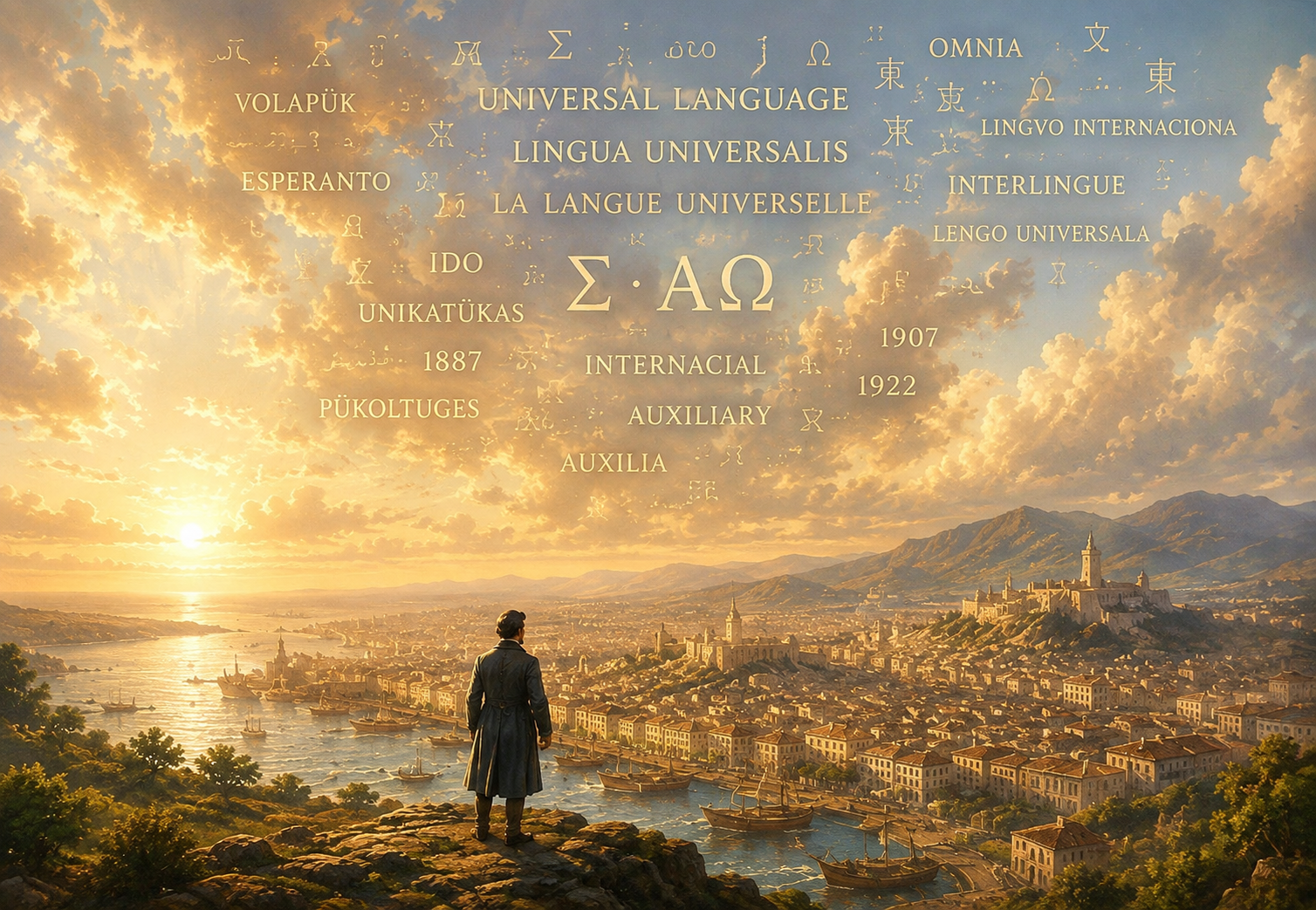
The long human dream of a shared language, seen from a distance.
END OF CHAPTERS 1–3
Chapter 4 — Why Create UNI?
The question any reader would probably ask: "Why UNI? Esperanto already exists."
This is a fair question, and it deserves an honest answer.
What Esperanto Does Well
Esperanto was revolutionary for its time. It showed that a constructed language could develop a real community of speakers.
Esperanto's strengths:
- A vibrant community
- A substantial body of literature
- Decades of real-world use
- Native speakers (second-generation speakers who learned from birth)
- An established international presence
- Ongoing cultural events and congresses
Esperanto proved that the idea of an international auxiliary language was viable. In several respects, it remains ahead of every other constructed language project in the world. Any honest comparison has to acknowledge this.
What UNI Does Differently
UNI explores different design priorities. It makes different choices based on different values.
| Feature | Esperanto | UNI | Edge |
|---|
| Alphabet | 28 letters, with diacritics | 19 letters, no diacritics | UNI |
| Noun endings | -o (singular), -oj (plural) | -A (singular), -AS (plural) | UNI (simpler) |
| Adjective agreement | Yes (must match noun) | No | UNI |
| Accusative case | Yes | No | UNI |
| Verb infinitive | -i | -AR | Esperanto (more familiar to European learners not from Romance) |
| Vocabulary recognition | Mixed European | Strong Romance | UNI for Romance speakers; Esperanto for mixed European speakers |
| Gender | Usually removed | Completely removed | UNI (no trace) |
| Expressive layer | Limited | Optional UDU / UNDU | UNI (deeper) |
| Grammar complexity | Moderate | Very low | UNI |
| Stress | Fixed on penultimate | Grammatical + lexical | Esperanto (simpler rule) |
| Writing system | Latin with diacritics | Latin without diacritics | UNI (easier to type and print) |
| Living community | Over a century of speakers | None yet | Esperanto (by a large margin) |
| Literature | Thousands of works | None yet | Esperanto |
| Native speakers | Estimated ~1,000 | None | Esperanto |
Esperanto is the elder statesman of the field. UNI is a new experiment. Esperanto wins on community, literature, and tradition. UNI wins on simplicity of alphabet, grammar, and morphology. Both are valid paths.
UNI's Design Philosophy
UNI was designed to be:
- Extremely regular — No irregular forms of any kind
- Compositional — Words build transparently from roots
- Minimalist in grammar — Only distinctions that are useful
- Romance-recognizable — Familiar vocabulary for hundreds of millions
- Phonetically simple — 19 letters, one sound per letter
- Expressively optional — Core is simple; depth is optional
Why These Choices Matter
Every design choice is a trade-off. UNI makes its trade-offs explicitly.
19 letters vs. more recognizable spelling. UNI prioritizes phonetic consistency, a costa of having to respell some familiar words (OTELA instead of hotel).
No gender vs. Romance familiarity. UNI prioritizes simplicity, at the cost of dropping a category that Romance speakers are used to.
No case vs. precision. UNI prioritizes ease of learning, at the cost of relying more heavily on word order.
Romance vocabulary vs. neutrality. UNI prioritizes immediate recognizability for the largest number of speakers, at the cost of being less familiar to speakers of Slavic, Germanic, or Asian languages.
UNI Is Not a Replacement for Esperanto
It is important to say this clearly: UNI is not trying to replace Esperanto. Esperanto has a community and a history that UNI does not have, and may never have.
Instead, UNI offers a different approach to the same problem. Some people may prefer one; some may prefer the other. Both contribute to the goal of easier international communication.
UNI explores a design space that Esperanto does not fully occupy:
- More extreme morphological simplicity
- Stronger Romance recognizability
- Optional expressive depth
Chapter 5 — UNI's Design
The following are design goals or working estimates, not established empirical results:
- A motivated learner may reach basic communicative competence quickly.
- Romance-language speakers may recognize a large proportion of familiar vocabulary.
- The core grammatical system is intended to be learnable in a short study session.
The Three Design Principles
Principle 1: Keep the Core Small
"Encode only distinctions that are frequently useful."
UNI does not distinguish:
- Grammatical gender (unnecessary for comprehension)
- Noun cases (word order and prepositions handle this)
- Subject-verb agreement (redundant when pronouns are present)
- Subjunctive mood (can be expressed periphrastically when needed)
- Tenses beyond past, present, future, conditional, and continuous
Principle 2: Make Meaning Compositional
"A speaker should be able to construct and decode unfamiliar words."
UNI's morphology is transparent: every suffix has a single consistent meaning, and every word can be decomposed into a recognizable root plus a grammatical marker.
Example: A learner encountering FELISADU for the first time can:
- Recognize FELIS = happiness (from FELISA)
- Recognize A = noun/conceptual base
- Recognize DU = affected/resultative quality
Therefore, FELISADU ≈ "made happy / affected by happiness" — without memorization.
Principle 3: Let Expression Go Beyond Grammar
"Optional morphology and intensity markers can communicate emotion, intensity, affection, immersion, transformation, and emotional trajectory without making those distinctions mandatory."
UNI's core grammar is minimal, but it provides an optional expressive layer (UDU, UNDU, and the 1-5 intensity scale) for speakers who want to convey emotional nuance. These are not required for basic communication.
Philosophical Influences
| Influence | Contribution |
|---|
| Romance languages | Vocabulary base, pronunciation, familiar cognates |
| Esperanto | Systematic derivation, transparent morphology |
| Chinese / Mandarin | No conjugation, no gender, flexible word order |
| Toki Pona | Minimalism, philosophy of "less is more" |
| Creole linguistics | Contextual adverbial use, optional copula, flexible syntax |
The UNI Formula
ROOT + MORPHOLOGY + (INTENSITY) + (TRAJECTORY)
Every UNI utterance can be analyzed along four dimensions:
- ROOT — The semantic core (e.g., AMOR, FELIS)
- MORPHOLOGY — The grammatical function (A / AR / ARO / ARE / U / ADU / ANDU / UDU / UNDU)
- INTENSITY — Optional 1-5 scale for emotional / experiential strength
- TRAJECTORY — Optional + / − markers for rising or falling intensity
END OF PART I
Part II — The Language
Chapter 6 — Alphabet & Pronunciation
UNI uses exactly 19 letters.
A B D E F G I K L M N O P R S T U V X
There are 5 vowels: A E I O U
And 14 consonants: B D F G K L M N P R S T V X
UNI is unicase: it is normally written in ALL CAPS.
One letter equals one phoneme. Every letter is always pronounced according to its defined value.
There are no silent letters. No digraphs. No arbitrary allophony.
The Glide Pattern
I and U before another vowel can be pronounced as glides or as full vowels, depending on the speaker and the word.
- I = /j/ (y-sound) or /i/ before a vowel
- U = /w/ or /u/ before a vowel
Examples:
- XUNTU = /ʃun-tu/ or /ʃu-un-tu/
- XA = /ʃa/ or /ʃa-u/
- MULIERA = /mu-lje-ra/ or /mu-li-E-ra/
- PROFESIA = /pro-fe-SI-a/ (full vowel is natural here)
Both pronunciations are acceptable. Speakers choose what comes naturally. This is a common pattern found in many languages, including Spanish, Portuguese, Italian, French, and Latin.
The Vowels
| Letter | IPA | English Approximate | Spanish Example |
|---|
| A | /a/ | father | casa |
| E | /e/ | better | ser |
| I | /i/ | machine | si |
| O | /o/ | sport | monte |
| U | /u/ | rule | super |
All vowels are pure, short, and full. No reduction, no nasalization, no front rounding.
The Consonants
| Letter | IPA | English Approximate | Notes |
|---|
| B | /b/ | big | Voiced bilabial plosive |
| D | /d/ | dig | Voiced alveolar plosive |
| F | /f/ | find | Voiceless labiodental fricative |
| G | /g/ | god | Always hard, never /x/ or /h/ |
| K | /k/ | cat | Replaces C and Q entirely |
| L | /l/ | long | Alveolar lateral approximant |
| M | /m/ | many | Bilabial nasal |
| N | /n/ | no | Alveolar nasal |
| P | /p/ | park | Voiceless bilabial plosive |
| R | /ɾ/ or /r/ | pero or perro | Both flap and trill are acceptable |
| S | /s/ | send | Always voiceless |
| T | /t/ | train | Voiceless alveolar plosive |
| V | /v/ | very | [b] is acceptable for Spanish speakers |
| X | /ʃ/ | ship | Always the SH sound |
Important Notes
G is always hard. GATA = /ˈgata/ (cat), never /ˈxata/.
K replaces C and Q entirely. KASA (house), KUATRA (four), KEU (what).
X is always /ʃ/ (the SH sound). XOGAR = /ʃo-GAR/ (to play). XA = /ʃa/ (already).
R is flexible. A flap [ɾ] is the default; a trill [r] is acceptable.
S is always voiceless. MESA = /ˈmesa/, not /ˈmeza/.
Because spelling is phonetic, you can read any UNI text aloud correctly the first time you see it.
Chapter 7 — Stress
UNI has two stress systems: grammatical (fixed by morphology) and lexical (specified per word).
System A: Grammatical Stress
For verbs, tense endings, and suffixes, stress is fixed.
Forms Ending in AR, O, E, ARO, or ARE
Stress falls on the final syllable.
| Form | Example | Pronunciation |
|---|
| AR (present / infinitive) | KANTAR | kan-TAR |
| O (past) | KANTO | kan-TO |
| E (future) | KANTE | kan-TE |
| ARO (past, full) | KANTARO | kan-ta-RO |
| ARE (future, full) | KANTARE | kan-ta-RE |
Forms Ending in EBE, AREBE, ANDU, ARANDU, ADU, UDU, or UNDU
Stress falls on the penultimate (second-to-last) syllable.
| Form | Example | Pronunciation |
|---|
| EBE (conditional, reduced) | KANTEBE | kan-TE-be |
| AREBE (conditional, full) | KANTAREBE | kan-ta-RE-be |
| ANDU (continuous, reduced) | KANTANDU | kan-TAN-du |
| ARANDU (continuous, full) | KANTARANDU | kan-ta-RAN-du |
| ADU (affected quality) | KANTADU | kan-TA-du |
| UDU (expressive) | KANTUDU | kan-TU-du |
| UNDU (expressive) | KANTUNDU | kan-TUN-du |
Rule of Thumb
If the word ends in AR, O, E, ARO, or ARE → stress the final syllable.
If it ends in EBE, ANDU, ADU, UDU, or UNDU → stress the penultimate syllable.
System B: Lexical Stress
Nouns, prepositions, pronouns, and function words do not follow grammatical stress rules. Their stress is specified individually.
Examples:
- FENESTRA (fe-NES-tra) — window
- MONTANIA (mon-TA-nia) — mountain
- RELOGIA (re-LO-gia) — clock
- ARBOLA (AR-bo-la) — tree
- KORDA (KOR-da) — rope
- PLANETA (pla-NE-ta) — planet
For new or coined words, default stress is penultimate.
Chapter 8 — The Root System
In UNI, the root is the core meaning-carrying part of a word. You do not memorize thousands of isolated words. Instead, you learn a small set of roots and a handful of suffixes.
From these, you can build a large vocabulary.
What Is a Root?
A root is a semantic core. It carries the basic meaning.
Examples of roots:
- AMOR — love
- FELIS — happiness
- PENS — thought
- KANT — song / singing
- SKRIB — writing
- VID — life
- KAS — house
- KAT — cat
The root is not a standalone word. It needs a grammatical ending.
The Most Common Endings
| Ending | Function | Example |
|---|
| -A | Noun | AMORA (love) |
| -AR | Verb / Present | AMORAR (to love) |
| -ARO | Past | AMORARO (loved) |
| -ARE | Future | AMORARE (will love) |
| -U | Active Quality | AMORU (loving) |
| -ADU | Affected Quality | AMORADU (loved) |
| -ANDU | Ongoing Process | AMORANDU (loving) |
Compositional Morphology
Once you know the root, you can predict the meaning of any derived form. This is called compositional morphology.
Example: The root FELIS means "happiness" or "happy."
- FELISA — happiness
- FELISAR — to be happy
- FELISARO — was happy
- FELISARE — will be happy
- FELISU — happy
- FELISADU — made happy
- FELISANDU — being happy
Creating New Words
The root system also allows you to create new words easily.
If you know the root KONOS (knowledge):
- KONOSA — knowledge
- KONOSAR — to know
- KONOSU — knowing / knowledgeable
- KONOSADU — known / recognized
- KONOSANDU — knowing (in progress)
You do not need to look up each form. The pattern is predictable.
Root Families
Each root generates a family of words.
AMOR family
- AMORA — love
- AMORAR — to love
- AMORARO — loved
- AMORARE — will love
- AMORU — loving
- AMORADU — loved / beloved
- AMORANDU — loving (right now)
- AMORUDU — overwhelmed by love (advanced)
- AMORUNDU — falling in love (advanced)
- AMORITA — sweetheart
FELIS family
- FELISA — happiness
- FELISAR — to be happy
- FELISARO — was happy
- FELISARE — will be happy
- FELISU — happy
- FELISADU — made happy
- FELISANDU — being happy
- FELISUDU — euphoric (advanced)
- FELISUNDU — becoming happier (advanced)
KANT family
- KANTA — song / act of singing
- KANTAR — to sing
- KANTARO — sang
- KANTARE — will sing
- KANTU — singing / songful
- KANTADU — sung
- KANTANDU — singing (right now)
Chapter 9 — Core Morphology
Morphology is the study of how words are built from smaller meaningful parts.
In UNI, morphology is:
- Compositional: Each part of a word has a consistent meaning
- Transparent: You can see the relationship between forms
UNI's core morphology consists of 7 forms derived from a single root. Each form is distinguished by its ending.
The Core Seven
| Form | Ending | Function | AMOR | FELIS |
|---|
| A | -A | Noun / Concept | AMORA (love) | FELISA (happiness) |
| AR | -AR | Verb / Present | AMORAR (to love) | FELISAR (to be happy) |
| ARO | -ARO | Past | AMORARO (loved) | FELISARO (was happy) |
| ARE | -ARE | Future | AMORARE (will love) | FELISARE (will be happy) |
| U | -U | Active Quality | AMORU (loving) | FELISU (happy) |
| ADU | -ADU | Affected Quality | AMORADU (loved) | FELISADU (made happy) |
| ANDU | -ANDU | Ongoing Process | AMORANDU (loving) | FELISANDU (being happy) |
Form-by-Form Analysis
A — Noun / Concept
Function: Names a thing, concept, or entity.
Ending: -A in the singular; -AS in the plural.
Examples: AMORA, FELISA, LIBRA, KATA, UMANA
Stress: Lexical (usually penultimate).
Notes: All nouns are neutral (no gender). Plural adds -S.
AR — Verb / Action or State
Function: Expresses an action, process, or state. Also serves as the infinitive and the present tense.
Ending: Always -AR.
Examples: AMORAR (to love / I love), FELISAR (to be happy / I am happy)
Stress: Final syllable (a-mo-RAR).
Key insight: The infinitive and the present tense are the same form.
ARO — Past / Completed
Function: Expresses a completed action or state in the past.
Ending: -ARO.
Examples: AMORARO (loved / did love)
Stress: Final syllable (a-mo-ra-RO).
ARE — Future
Function: Expresses a future action or state.
Ending: -ARE.
Examples: AMORARE (will love)
Stress: Final syllable (a-mo-ra-RE).
Important: The future form must remain complete. Future forms are never shortened. This avoids confusion with Romance-language past forms.
U — Active / Characterizing Quality
Function: Expresses a quality that is active — something the subject does, produces, or is characterized by.
Ending: -U (vowel alternation from A).
Examples: AMORU (loving / lovely), FELISU (happy), RAPIDU (fast)
Stress: Lexical (usually penultimate for Romance roots).
Key insight: This is a vowel alternation, not a suffix. AMORA → AMORU.
ADU — Affected / Resultative Quality
Function: Expresses a quality that is affected or resultative — something that receives the action or has become a certain way as a result.
Ending: -ADU (suffix).
Examples: AMORADU (loved / beloved), FELISADU (made happy)
Stress: Penultimate (a-mo-RA-du).
Key Distinction from U
| Form | Meaning | Direction |
|---|
| AMORU | loving / lovely | Active (gives love) |
| AMORADU | loved / beloved | Passive (receives love) |
ANDU — Ongoing Active Process
Function: Expresses an action that is currently happening or continuing.
Ending: -ANDU (reduced) or -ARANDU (full).
Examples: AMORANDU / AMORARANDU (loving / am loving)
Stress: Penultimate (a-mo-RAN-du).
Key insight: ANDU is the continuous aspect. It emphasizes duration and ongoingness.
ANDU can function in multiple grammatical roles:
- As a predicate: MI PENSANDU (I am thinking)
- As a modifier: PENSANDU PERSONA (a thinking person)
- As a participial form: PENSANDU (thinking)
The meaning remains the same. Context determines the grammatical role.
Verbs & Time
UNI verbs are extremely regular. They do not change according to the person.
MI AMORAR = I love
TI AMORAR = you love
LI AMORAR = he/she/it loves
MIS AMORAR = we love
TIS AMORAR = you all love
LIS AMORAR = they love
The verb stays the same. The pronoun tells you who is doing the action.
In advanced UNI, some forms may be shortened. The future is the major exception.
The shortened forms belong to advanced, informal, or artistic use. The complete forms are the official standard.
Chapter 10 — Nouns & Plurality
UNI nouns are deliberately simple.
Noun Endings
Most UNI nouns end in -A in the singular. This is consistent and predictable.
- AMORA — love
- KASA — house
- MESA — table
- KATA — cat
- LIBRA — book
- VIDA — life
- AKUA — water
Plural Formation
To form the plural, add -S to the singular.
- KATA → KATAS (cats)
- LIBRA → LIBRAS (books)
- KASA → KASAS (houses)
Examples:
- UNA KATA = a cat / one cat
- DUA(S) KATA(S) = two cats
- LA(S) KATAS = the cats (specific)
No Gender
UNI nouns have no grammatical gender. There is no masculine, feminine, or neuter. A noun is simply a noun.
This eliminates the need for adjective agreement, article agreement, or pronoun agreement based on gender.
Person Nouns
Words for people, professions, and roles end in -A like any other noun. ESTUDANTA (student), PROFESORA (teacher), AMIGA (friend). These words do not mark gender. A male student is also ESTUDANTA. A female teacher is also PROFESORA. The -A ending signals the noun class, not the person's gender.
Diminutive: -ITA
UNI has a diminutive suffix -ITA. It can express smallness, cuteness, affection, or familiarity.
- AMORA → AMORITA (little love / sweetheart)
- KATA → KATITA (little cat / kitty)
- KASA → KASITA (little house / cottage)
The meaning is context-dependent but generally conveys endearment or small size.
Augmentative: -ONA
UNI also has an augmentative suffix -ONA. It expresses largeness or intensity.
- KATA → KATONA (big cat)
- KASA → KASONA (big house / mansion)
Articles: Optional
UNI does not require articles. You can say "KATA KOMAR PESKA" and it will be understood as "The cat eats the fish" from context.
However, if you need to be specific, you can use:
- LA = the (definite)
- UNA = a / an (indefinite)
LA KATA = the cat (specific)
UNA KATA = a cat (non-specific)
You are free to use or omit articles as clarity demands.
Chapter 11 — Pronouns & Possession
Personal Pronouns
UNI has six personal pronouns. They are gender-neutral.
| Person | Singular | Plural |
|---|
| 1st | MI (I / me) | MIS (we / us) |
| 2nd | TI (you) | TIS (you all) |
| 3rd | LI (he / she / it) | LIS (they / them) |
LI is gender-neutral. Use it for anyone or anything.
Pronouns are used as subjects and objects without changing form. Word order determines their role.
- MI AMORAR TI = I love you.
- TI AMORAR MI = You love me.
- LI AMORAR LIS = He/she loves them.
Possessive Pronouns
To show possession, add -U to the pronoun.
| Pronoun | Possessive | Meaning |
|---|
| MI | MIU | my |
| TI | TIU | your (singular) |
| LI | LIU | his / her / its |
| MIS | MIUS | our |
| TIS | TIUS | your (plural) |
| LIS | LIUS | their |
Examples:
- MIU KASA = my house
- TIU LIBRA = your book
- LIU KATA = his/her cat
- MIUS KASA = our house
- LIUS KATAS = their cats
Reflexive: SA
When the subject and object are the same, use SA (self).
- LI AMORAR SA = He/she loves himself/herself.
- MI LAVAR SA = I wash myself.
Reciprocal: UNA OTRA
When two or more people do something to each other, use UNA OTRA (one another).
- LIS AMORAR UNA OTRA = They love each other.
- MIS VERAR UNA OTRA = We see each other.
Chapter 12 — Qualities: U & ADU
In UNI, qualities are formed from roots using two main suffixes: -U for active/characterizing qualities, and -ADU for affected/resultative qualities.
Active Quality: -U
The -U form describes something that produces, characterizes, or is actively associated with the root.
- AMORU = loving / lovely / characterized by love
- FELISU = happy / happiness-producing
- BONU = good
- RAPIDU = fast
- GRANDU = big
- PEKENU = small
This form can describe a noun:
- KATA BONU = good cat
- MAMA AMORU = a loving mother
It can also describe how an action is performed (adverb-like):
- KATA KORAR RAPIDU = The cat runs fast.
There is no separate adverb ending. The same -U word is used. Context determines whether it describes a noun or an action.
Affected Quality: -ADU
The -ADU form describes something that has received, undergone, or resulted from an action or quality.
- AMORADU = loved / beloved (receiving love)
- FELISADU = made happy / affected by happiness
- KANTADU = sung (having been sung)
Contrast
- AMORU MAMA = a loving mother (the mother gives love)
- AMORADU MAMA = a beloved mother (the mother receives love)
- LI FELISU = He/she is happy (actively happy)
- LI FELISADU = He/she has been made happy (something happened to make them happy)
Qualities as Adverbs
UNI does not have a separate mandatory adverb ending. When a quality describes an action rather than a noun, context and position tell you.
- RAPIDU KATA = a fast cat (quality describes the noun)
- KATA KORAR RAPIDU = the cat runs fast (quality describes the action)
Same word, two roles. Nothing to memorize beyond the root and the -U form.
Chapter 13 — Ongoing Processes: ANDU
ANDU expresses an action or state in progress.
Forms
ANDU (shortened) / ARANDU (full)
The full form preserves the AR marker: AMORAR + ANDU → AMORARANDU
The shortened form drops it: AMORANDU
Meaning
The meaning is always "ongoing" or "in progress."
- MI PENSANDU = I am thinking.
- MI KOMANDU = I am eating.
- LI KORANDU = He/she is running.
Grammatical Roles
ANDU can function in multiple roles:
As a predicate:
MI PENSANDU = I am thinking.
As a modifier:
PENSANDU PERSONA = a thinking person.
As a participial or descriptive form:
PENSANDU = thinking.
The fundamental meaning remains the same. Context determines its grammatical role.
ANDU vs. Simple Present
The simple present (AR) states an action or state generally:
MI PENSAR = I think.
The continuous (ANDU) emphasizes ongoing process:
MI PENSANDU = I am thinking (right now).
This distinction is useful for clarity and emphasis.
ANDU with Different Roots
| Root | Present | Continuous | Meaning |
|---|
| PENS | PENSAR | PENSANDU | think / thinking |
| KOM | KOMAR | KOMANDU | eat / eating |
| KOR | KORAR | KORANDU | run / running |
| KANT | KANTAR | KANTANDU | sing / singing |
| SKRIB | SKRIBAR | SKRIBANDU | write / writing |
| PAL | PALAR | PALANDU | speak / speaking |
ANDU in the Past and Future
ANDU itself does not mark tense. To express past continuous or future continuous, use time words or context.
- IERU MI PENSANDU = Yesterday I was thinking.
- MANIU MI PENSANDU = Tomorrow I will be thinking.
Alternatively, the past form can carry the duration:
- MI PENSARO LONGU = I thought for a long time.
Chapter 14 — Syntax & Sentence Structure
UNI syntax is built on a single core principle: word order is flexible, but clarity is paramount.
Default Word Order: SVO
The default word order is Subject – Verb – Object.
- KATA KOMAR PESKA. = The cat eats the fish.
- MI AMORAR TI. = I love you.
- LI LAR LIBRA. = She reads a book.
SVO is the most widely used word order globally and is intuitive for Romance speakers.
Flexible Word Order for Emphasis
Because endings show grammatical roles, you can change the order for emphasis.
| Order | Example | Emphasis |
|---|
| SVO | KATA KOMAR PESKA | Neutral |
| VSO | KOMAR KATA PESKA | Emphasizes action |
| OVS | PESKA KOMAR KATA | Emphasizes object |
| SOV | KATA PESKA KOMAR | Emphasizes relationship |
With pronouns:
- MI AMORAR TI. = I love you. (neutral)
- TI AMORAR MI. = You love me. (different meaning)
- AMORAR MI TI. = I LOVE you. (emphasis on verb)
Negation
Place NO before the verb.
- MI NO AMORAR TI. = I do not love you.
- KATA NO KOMAR PESKA. = The cat does not eat the fish.
Double negation is not used. One NO is sufficient.
Questions
Yes/No questions: Use the normal sentence structure with rising intonation.
- TI AMORAR MI? = Do you love me?
- LI FELISU? = Is he/she happy?
Answers: SI (yes) or NO (no).
Wh-questions: Put the question word at the beginning.
| Question Word | Meaning | Can Shorten? |
|---|
| KEU | what | Yes → KE |
| KENU | who | Yes → KEN |
| PAKEU | why | Yes → PAKE |
| KUALU | which | Yes → KUAL |
| KONDU | where | No |
| KUANDU | when | No |
| KOMU | how | No |
Examples:
- KEU ETU? = What is this?
- KONDU TI VIVAR? = Where do you live?
- KUANDU MIS ANDAR? = When do we go?
- PAKEU TI PLORAR? = Why are you crying?
- KOMU TI SENTIRAR? = How do you feel?
- KUALU LIBRA TI KERAR? = Which book do you want?
The Optional Copula: SAR
SAR means "to be." It is optional.
With SAR: LI SAR UMANA. = She is a human.
Without SAR: LI UMANA. = She is a human.
When to use SAR: complex sentences, formal writing, unclear predicates, non-pronoun subjects, questions.
When to omit SAR: short sentences, casual conversation, obvious meaning.
Existential use:
SAR UNA KATA IN KASA. = There is a cat in the house.
Articles: LA and UNA (Optional)
LA = the (definite)
UNA = a/an (indefinite)
- KATA KOMAR PESKA. = Cat eats fish. (clear from context)
- LA KATA KOMAR LA PESKA. = The cat eats the fish. (specific)
- UNA KATA KOMAR PESKA. = A cat eats fish. (indefinite)
Demonstratives: ETU and ETUS
ETU = this/that (singular)
ETUS = these/those (plural)
- ETU LIBRA = this/that book
- ETUS LIBRAS = these/those books
There is no distance distinction between "this" and "that." Context clarifies.
Relative Clauses
Introduced by KE (that, which, who).
- UMANA KE KANTAR = The person who sings.
- LIBRA KE MI LAR = The book that I read.
- KASA KE LI VIVAR IN = The house where she lives.
Examples:
- MI VERAR UMANA KE KANTAR. = I see a person who sings.
- ETU LIBRA KE MI KERAR. = This is the book that I want.
Conditionals
Use SE (if) + present tense.
- SE TI KERAR, MIS ANDAR. = If you want, we will go.
- SE LI VENAR, MI FELISAR. = If she comes, I will be happy.
Real vs. unreal: Not distinguished morphologically. Context indicates meaning.
Subordination
Subordinate clauses introduced by KE (that).
- MI SABAR KE TI FELISU. = I know that you are happy.
- LI KERAR KE MIS ANDAR. = She wants that we go.
- MI PENSAR KE LI VENARE. = I think that she will come.
Purpose clauses: Use PARU (for).
- MI VENAR PARU VERAR TI. = I come to see you.
- LI ESTUDAR PARU SABAR PLU. = She studies to know more.
Clausal Coordination
| Conjunction | Meaning | Example |
|---|
| I | and | MI AMORAR TI I LI |
| O / OU | or | TI KERAR KAFEA O TEA? |
| MAU | but | MI KERAR ANDAR, MAU MI NO TENAR TEMPA |
| POKE | because | LI FELISU POKE LI VERAR AMIGA |
| PERU | however | LI KERAR VENAR, PERU LI NO PODAR |
Sentence Types Summary
| Type | Structure | Example |
|---|
| Statement | Subject + Verb + Object | KATA KOMAR PESKA |
| Negation | Subject + NO + Verb + Object | KATA NO KOMAR PESKA |
| Yes/No Question | Subject + Verb + Object? | KATA KOMAR PESKA? |
| Wh-Question | Question Word + normal clause | KEU TI KOMAR? |
| Command | Verb + Object | KOMAR PESKA! |
| Conditional | SE + Clause, Main Clause | SE TI KERAR, MIS ANDAR |
| Relative Clause | ... KE ... | UMANA KE KANTAR |
Chapter 15 — Function Words & Particles
Function Words
Function words are the "glue" of language. In UNI, function words are:
- Short (2–4 letters)
- Regular (do not change form)
- Flexible (many can drop final -U in casual speech)
- Romance-derived (recognizable to speakers of Romance languages)
Prepositions
| Full | Shortened | Meaning |
|---|
| SOBRU | (never) | about, concerning, on |
| ANTU | (never) | before, in front of |
| DEPU | (never) | after, behind |
| PROKSIMU | (never) | near, beside |
| REDORU | (never) | around, about |
| INTRU | (never) | among, between |
| DENTRU | (never) | inside, within |
| FORU | (never) | outside, out of |
| DU | (never) | of, from |
| SUPERU | SUPER | over, above |
| SUBU | SUB | under, beneath |
| PORU | POR | through |
| PARU | PAR | for |
| KONU | KON | with |
| SENU | SEN | without |
| AU | A | toward, to |
| INU | IN | in, on, at |
Examples:
- LIBRA INU MESA. = The book is on the table.
- MI PENSAR SOBRU VIDA. = I think about life.
- MIS ANDAR AU SKOLA. = We go toward school.
Conjunctions
| Full | Shortened | Meaning |
|---|
| IU | I | and |
| OU | O | or |
| SEU | SE | if |
| MAU | MA | but |
| POKEU | POKE | because |
| PERU | PER | however, though |
| KE | (never) | that (conjunction) |
| KOMU | (never) | as, like (conjunction) |
Note: KOMU as conjunction ("as, like") is distinct from KOMU as interrogative ("how?"). The interrogative never shortens.
Examples:
- MI AMORAR TI I LI. = I love you and her.
- TI KERAR KAFEA O TEA? = Do you want coffee or tea?
- MI KERAR ANDAR, MAU MI NO TENAR TEMPA. = I want to go, but I don't have time.
- LI FELISU POKE LI VERAR AMIGA. = She is happy because she sees a friend.
- SE TI KERAR, MIS ANDAR. = If you want, we will go.
Question Words
| Full | Shortened | Meaning |
|---|
| KEU | KE | what |
| KENU | KEN | who |
| PAKEU | PAKE | why |
| KUALU | KUAL | which |
| KOMU | (never) | how |
| KONDU | (never) | where |
| KUANDU | (never) | when |
Particles
UNI particles follow the A / U pattern. The bare form is firm. The -U form is softer. The -A form is a noun.
| Particle | Quality (-U) | Noun (-A) | Meaning |
|---|
| SI | SIU | SIA | yes / probably yes / approval |
| NO | NOU | NOA | no / probably not / refusal |
| XA | XAU | — | already / recently, soon |
Other particles:
| UNI | Meaning |
|---|
| ANKORU | yet, still |
| SOLU | only, just |
| MUITU | very, much |
| PLU | more, anymore |
| BENU | well, okay |
| TOTALU | totally |
| PROBABILU | probably |
| TALVESU | maybe |
| REALU | actually |
| VERU | truly |
| KUASU | almost |
| APENU | barely |
Examples:
- SI, MI AMORAR TI. = Yes, I love you.
- LI XAU VENAR. / LI XA VENAR. = She has already come.
- SOLU MI SABAR. = Only I know.
- TI MUITU BONU. = You are very good.
- PROBABILU LI VENARE. = Probably she will come.
Chapter 16 — Numbers, Dates & Time
Cardinal Numbers
| Number | UNI | Number | UNI |
|---|
| 0 | NULA | 11 | DEKA UNA |
| 1 | UNA | 12 | DEKA DUA |
| 2 | DUA | 20 | DUA DEKA |
| 3 | TRA | 21 | DUA DEKA UNA |
| 4 | KUATRA | 30 | TRA DEKA |
| 5 | SINKA | 100 | SENTA |
| 6 | SESA | 123 | SENTA DUA TRA |
| 7 | SETA | 1000 | MILA |
| 8 | OKTA | 2025 | DUA MILA SENTA DUA DEKA SINKA |
| 9 | NOVA | 1,000,000 | MILIONA |
| 10 | DEKA | | |
Rule: Numbers are formed by combining units with multipliers.
Ordinal Numbers
Add -U:
UNU (1st), DUU (2nd), TRU (3rd), KUATRU (4th), SINKU (5th), SESU (6th), SETU (7th), OKTU (8th), NOVU (9th), DEKU (10th)
Compound: DUA DEKA UNU = 21st, SENTU = 100th
Fractions
Add -DA:
DUADA (1/2), TRADA (1/3), KUATRADA (1/4), SINKADA (1/5), DEKADA (1/10), DUA TRADA (2/3)
Months
| Month | UNI | Alternative |
|---|
| January | XANUARA | UNU MESA |
| February | FEBRUARA | DUU MESA |
| March | MARTA | TRU MESA |
| April | APRILA | KUATRU MESA |
| May | MAIA | SINKU MESA |
| June | XUNIA | SESU MESA |
| July | XULIA | SETU MESA |
| August | AGUSTA | OKTU MESA |
| September | SEPTEMBRA | NOVU MESA |
| October | OKTOBRA | DEKU MESA |
| November | NOVEMBRA | DEKA UNU MESA |
| December | DESEMBRA | DEKA DUA MESA |
Examples:
- MI NASKARADU IN XANUARA. = I was born in January.
- AGUSTA MUITU KALORU. = August is very hot.
Days of the Week
| Day | UNI | Short |
|---|
| Monday | UNU DIA | UNU |
| Tuesday | DUU DIA | DUU |
| Wednesday | TRU DIA | TRU |
| Thursday | KUATRU DIA | KUATRU |
| Friday | SINKU DIA | SINKU |
| Saturday | SESU DIA | SESU |
| Sunday | SETU DIA | SETU |
Examples:
- OGU UNU DIA. = Today is Monday.
- MIS ANDAR A SKOLA DUU DIA I KUATRU DIA. = We go to school on Tuesday and Thursday.
Time of Day
| UNI | English | UNI | English |
|---|
| DIA | day | SERA | evening |
| NOKTA | night | MATINA | morning |
| MANIA | tomorrow | MEDIU DIA | noon |
| TARDA | afternoon | MEDIU NOKTA | midnight |
Hours:
- UNA ORA = 1:00
- UNA ORA I TRA DEKA MINUTAS = 1:30
- UNA ORA I METU = 1:30 (casual)
- TRA ORA MENU KUATRADA = 2:45
Time Words
These words have two forms. The -A form is a noun. The -U form is an adverb or quality.
Use -A when the word is the subject or object of a sentence.
Use -U when the word describes when an action happens.
| Noun (-A) | Adverb (-U) | Meaning |
|---|
| MANIA | MANIU | tomorrow |
| OGA | OGU | today |
| IERA | IERU | yesterday |
| AGORA | AGORU | now |
Examples:
- OGA UNU DIA. = Today is Monday. (OGA is the subject)
- MI ANDARE A SKOLA MANIU. = I will go to school tomorrow. (MANIU describes when)
- AGORU MI PENSAR. = Now I think. (AGORU describes when)
- AGORA BONU. = The present moment is good. (AGORA is the subject)
The same pairing applies to other time nouns:
| Noun (-A) | Adverb (-U) | Meaning |
|---|
| MATINA | MATINU | morning |
| TARDA | TARDU | afternoon |
| SERA | SERU | evening |
| NOKTA | NOKTU | night |
This is the same A / U pattern used everywhere else in UNI:
- AMORA (noun) / AMORU (quality)
- FELISA (noun) / FELISU (quality)
- MANIA (noun) / MANIU (quality/adverb)
Duration
| UNI | English |
|---|
| PARU UNA ORA | for one hour |
| PARU TRA DIAS | for three days |
| PARU UNA SEMANA | for one week |
| PARU DUA ANAS | for two years |
Examples:
- MI ESTUDARO PARU DUA ORAS. = I studied for two hours.
- LIS VIVARO IN PARISA PARU SINKA ANAS. = They lived in Paris for five years.
Dates
Format: Day – Month – Year
- Full: UNU DIA XANUARA DUA MILA SENTA DUA DEKA SINKA = 1 January 2025
- Short: UNU XANUARA 2025 = 1 Jan 2025
- Numeric: 1.1.2025
END OF PART II
Part III — Building Words
Chapter 17 — Vocabulary Formation
UNI allows roots to be combined to create new meanings. This is called compounding.
When two roots are combined, the first modifies or specifies the second.
Examples
| Components | Compound | Meaning |
|---|
| KATA (cat) + KASA (house) | KATAKASA | cat house / cattery |
| AKUA (water) + VIA (way) | AKUAVIA | waterway / canal |
| SOLA (sun) + FLORA (flower) | SOLAFLORA | sunflower |
| RAPIDU (fast) + ANDAR (to go) | RAPIDUANDAR | to go fast / hurry |
| BONU (good) + DIA (day) | BONUDIA | good day |
Compounding Principles
- The first element modifies the second.
- The second element determines the basic category.
- The meaning is usually transparent from the parts.
- Stress follows the normal rules for the resulting form.
Derivation Suffixes
UNI has a set of productive suffixes that can be added to roots to create new words with specific meanings.
Agent Noun: -ORA
The suffix -ORA indicates a person who performs an action. In casual speech, it can also indicate a tool or instrument.
- KOMAR (to eat) → KOMORA (eater / utensil)
- SKRIBAR (to write) → SKRIBORA (writer / pen)
- KANTAR (to sing) → KANTORA (singer / instrument)
Action Noun: -DA
The suffix -DA indicates the concrete result, instance, or product of an action.
- KOMAR (to eat) → KOMADA (a meal)
- SKRIBAR (to write) → SKRIBADA (a writing / a document)
- KANTAR (to sing) → KANTADA (a song)
Action Noun: -SIONA
The suffix -SIONA indicates a process or state.
- KOMAR (to eat) → KOMASIONA (consumption)
- SKRIBAR (to write) → SKRIBASIONA (documentation)
- PENSAR (to think) → PENSASIONA (contemplation)
Note: Some loanwords may resemble -SIONA forms but are not derived from UNI roots. For example, PROFESIONA (profession) is a loanword. Both PROFESIA and PROFESIONA are acceptable.
Tool Noun: -ILA (Optional, More Formal)
The suffix -ILA indicates a tool or instrument. It is more formal than using -ORA.
- SKRIBAR (to write) → SKRIBILA (pen)
- KOMAR (to eat) → KOMILA (utensil)
- KANTAR (to sing) → KANTILA (instrument)
Note: In casual speech, -ORA can be used for tools. -ILA is optional and more formal.
Place Noun: -ERIA
The suffix -ERIA indicates a place associated with an action or thing.
- PANA (bread) → PANERIA (bakery)
- LIBRA (book) → LIBRERIA (library / bookstore)
- KAFEA (coffee) → KAFERIA (café)
Quality: -U (Standard)
The -U form expresses a quality. This is the standard way to express "characterized by" or "full of."
- FELIS (happiness) → FELISU (happy)
- KURAG (courage) → KURAGU (courageous)
Quality: -OSU (Optional, Romance-Recognizable Variant)
The suffix -OSU is an optional variant for Romance recognizability. It can be used when the Romance form has an S.
- MENTIRU / MENTIROSU (lying / deceitful)
- FELISU / FELISOSU (happy / full of happiness)
- KURAGU / KURAGOSU (courageous / full of courage)
Both forms are acceptable. The -U form is standard. The -OSU form is more recognizable to Romance speakers.
Relational: -ALU and -ARU
The suffixes -ALU and -ARU indicate a relationship or connection. Both are acceptable. The choice can follow Romance usage.
- NATURA (nature) → NATURALU (natural)
- KULTURA (culture) → KULTURALU (cultural)
- SOSIA (society) → SOSIALU (social)
- FAMILIA (family) → FAMILIARU (familiar)
Note: -ALU corresponds to Romance -al. -ARU corresponds to Romance -ar. Use whichever is more familiar.
Diminutive: -ITA
The suffix -ITA indicates smallness or affection.
- KATA (cat) → KATITA (kitty)
- KASA (house) → KASITA (little house)
- AMORA (love) → AMORITA (sweetheart)
Augmentative: -ONA
The suffix -ONA indicates largeness or intensity.
- KATA (cat) → KATONA (big cat)
- KASA (house) → KASONA (mansion)
- AMORA (love) → AMORONA (great love)
Negation Prefix: NO-
The prefix NO- indicates negation or absence.
- FASILU (easy) → NOFASILU (difficult)
- POSIBLU (possible) → NOPOSIBLU (impossible)
- KLARU (clear) → NOKLARU (unclear)
Without Prefix: SENU-
The prefix SEN(U)- indicates without or lacking.
- ESPERANSA (hope) → SENUESPERANSA (hopeless)
- FINE (end) → SENUFINE (endless)
- DUBTA (doubt) → SENUDUBTA (doubtless)
Chapter 18 — Compounding
Compounding is the process of combining two or more roots to create a new word.
Compounding allows UNI to express complex ideas using existing roots.
Basic Principles
- The first element modifies or specifies the second.
- The second element determines the basic meaning and category.
- The meaning is usually transparent from the parts.
- Stress follows the normal rules for the resulting form.
Types of Compounds
Noun + Noun
- KATA (cat) + KASA (house) = KATAKASA (cat house / cattery)
- AKUA (water) + VIA (way) = AKUAVIA (waterway / canal)
- SOLA (sun) + FLORA (flower) = SOLAFLORA (sunflower)
- LIBRA (book) + KASA (house) = LIBRAKASA (library / bookhouse)
Quality + Noun
- BONU (good) + DIA (day) = BONUDIA (good day)
- MALU (bad) + SORTE (luck) = MALUSORTE (bad luck)
- GRANDU (big) + UMANA (human) = GRANDUMANA (giant)
Quality + Verb
- RAPIDU (fast) + ANDAR (to go) = RAPIDUANDAR (to hurry)
- BONU (good) + VENAR (to come) = BONUVENAR (to welcome)
Noun + Quality
- SOLA (sun) + KALORU (hot) = SOLAKALORU (sun-hot / sunburned)
- AKUA (water) + FREDU (cold) = AKUAFREDU (ice-cold water)
Compounding with Verbs
When a verb is part of a compound, the resulting word is usually a verb.
- RAPIDU (fast) + ANDAR (to go) = RAPIDUANDAR (to hurry)
- BONU (good) + VENAR (to come) = BONUVENAR (to welcome)
Compounding with Qualities
When a quality is part of a compound, the resulting word can be a noun or a quality.
- BONU (good) + DIA (day) = BONUDIA (good day) — noun
- RAPIDU (fast) + KORAR (to run) = RAPIDUKORAR (to run fast) — verb
Compounding and Stress
Stress in compounds follows the normal rules for the resulting form.
- If the compound ends in -A, stress is lexical (usually penultimate).
- If the compound ends in -AR, stress is final.
- If the compound ends in -U, stress is lexical (usually penultimate).
Examples:
- KATAKASA (ka-ta-KA-sa) — cat house
- AKUAVIA (a-kua-VI-a) — waterway
- SOLAFLORA (so-la-FLO-ra) — sunflower
- RAPIDUANDAR (ra-pi-du-an-DAR) — to hurry
- BONUDIA (bo-nu-DIA) — good day
Creating New Compounds
You can create new compounds as needed. The meaning is usually clear from the parts.
If you need a word for something and no single root exists, compounding is often the solution.
Examples:
- If you need "raincoat": PLUVIA (rain) + VESTA (clothing) = PLUVIAVESTA
- If you need "firefighter": FOGA (fire) + KOMBATAR (to fight) = FOGAKOMBATORA
The system is flexible and allows unlimited creativity.
Chapter 19 — International Loanwords
UNI adopts many international words, especially from science, technology, and global culture.
These words are adjusted to fit the UNI alphabet and phonetic system.
When Romance languages have different words for the same concept, UNI must choose. The selection principles are:
- Majority rule — follow the majority of Romance languages
- Latin root — use the Latin root when Romance languages diverge
- Recognizability — choose the most recognizable form
- Internationality — use globally recognized forms for international words
Adjustment Rules
| Original | UNI | Example |
|---|
| C | K | computer → KOMPUTORA |
| J | X | project → PROXEKTA |
| Q | K | quality → KUALITA |
| W | V or U | wow → UAU |
| X | KS or S | taxi → TAKSA |
| Y | I | system → SISTEMA |
| Z | S | zone → SONA |
| H | removed | hotel → OTELA |
Examples of International Loanwords
| UNI | Origin | Meaning |
|---|
| TELEFONA | Greek | telephone |
| INTERNETA | English | internet |
| KOMPUTORA | English | computer |
| BANKA | Italian/English | bank |
| OTELA | French/English | hotel |
| UNIVERSITA | Latin | university |
| MUSIKA | Greek | music |
| DEMOKRASIA | Greek | democracy |
| PROXEKTA | Latin | project |
| SISTEMA | Greek | system |
| PROBLEMA | Greek | problem |
| ENERGIA | Greek | energy |
International Scientific Vocabulary
UNI adopts many scientific terms directly from Latin and Greek.
These words are already international and require minimal adjustment.
| UNI | Meaning |
|---|
| BIOLOGIA | biology |
| GEOGRAFIA | geography |
| MATEMATIKA | mathematics |
| FISIKA | physics |
| KIMIA | chemistry |
| MEDISINA | medicine |
| ASTRONOMIA | astronomy |
| PSIKOLOGIA | psychology |
Technology and Modern Life
UNI adapts to modern life by adopting and adapting international terms.
| UNI | Meaning |
|---|
| FOTA | photo |
| RADIA | radio |
| VIDEA | video |
| PROGRAMA | program |
| INFA | information |
Creating New International Words
When a new concept emerges, UNI speakers can create a new word by:
- Adopting the international form and adjusting it
- Combining existing roots
- Using derivation suffixes
Examples:
- Concept: "email"
Adopted: IMEILA
Compounded: ELEKTRU MESAGA (electronic message)
- Concept: "smartphone"
Adopted: SMARTFONA
Compounded: INTELIGENTU TELEFONA (intelligent telephone)
The system is flexible and allows multiple solutions.
END OF PART III
Part IV — Expression & Practice
Chapter 20 — UDU: Deeply Affected States
UDU is an advanced expressive form. It expresses being strongly, deeply, or emotionally affected in a positive way.
Form
Root + UDU
Stress falls on the penultimate syllable.
- AMORA → AMORUDU (a-mo-RU-du)
- FELISA → FELISUDU (fe-li-SU-du)
- PASA → PASUDU (pa-SU-du)
Meaning
UDU adds emotional intensity and depth. It describes a state of being overwhelmed, deeply moved, or intensely affected.
| Root | Core Form | UDU Form | Meaning |
|---|
| AMORA (love) | AMORA | AMORUDU | overwhelmed by love / lovestruck |
| FELISA (happiness) | FELISA | FELISUDU | euphoric / intensely happy |
| PASA (peace) | PASA | PASUDU | deeply at peace |
| KURAGA (courage) | KURAGA | KURAGUDU | emboldened / filled with courage |
| ALEGRA (joy) | ALEGRA | ALEGRUDU | overflowing with joy |
UDU is a state, not a process. The person is in the state. They are not becoming it.
Comparison with ADU
ADU expresses an affected or resultative quality. It is neutral and can describe any kind of effect.
UDU expresses a positively emotional affected state. It is intense and specific to positive emotion.
| Form | Meaning | Intensity |
|---|
| AMORADU | loved / beloved | Neutral |
| AMORUDU | overwhelmed by love | Intense, positive |
AMORADU describes someone who has received love. AMORUDU describes someone who is emotionally overwhelmed by love.
When to Use UDU
Use UDU when you want to express that someone is not just affected but deeply, emotionally, intensely affected in a positive way.
It is not required for ordinary communication. It is a tool for expressive depth.
Chapter 21 — UNDU: Transformation and Becoming
UNDU is an advanced expressive form. It expresses a positive process of transformation, immersion, or becoming.
Form
Root + UNDU
Stress falls on the penultimate syllable.
- AMORA → AMORUNDU (a-mo-RUN-du)
- FELISA → FELISUNDU (fe-li-SUN-du)
- PASA → PASUNDU (pa-SUN-du)
Meaning
UNDU focuses on a process. It describes becoming, entering a state, immersing oneself in something, or undergoing a positive change.
| Root | Core Form | UNDU Form | Meaning |
|---|
| AMORA (love) | AMORA | AMORUNDU | falling deeply in love |
| FELISA (happiness) | FELISA | FELISUNDU | becoming happier |
| PASA (peace) | PASA | PASUNDU | finding peace |
| KURAGA (courage) | KURAGA | KURAGUNDU | growing braver |
| ALEGRA (joy) | ALEGRA | ALEGRUNDU | becoming joyful |
UNDU is dynamic. The person is moving into the state. They are not already in it.
Comparison with UDU
UDU is a state. UNDU is a process.
UDU: the person is overwhelmed by love (they are in it now)
UNDU: the person is falling in love (they are moving into it)
| Form | Focus | Duration |
|---|
| UDU | State | Static (you are in it) |
| UNDU | Process | Dynamic (you are moving into it) |
Examples in sentences:
- MI AMORUDU. = I am overwhelmed by love.
- MI AMORUNDU. = I am falling in love.
- LI FELISUDU. = He/she is euphoric.
- LI FELISUNDU. = He/she is becoming happier.
When to Use UNDU
Use UNDU when you want to express transformation, becoming, or movement into a positive state.
It is not required for ordinary communication. It is a tool for expressive depth.
Chapter 22 — Shortening
Shortened forms are allowed in informal, rapid, or artistic use. The full form remains the official standard.
| Form | Full | Shortened |
|---|
| Past | AMORARO | AMORO |
| Conditional | AMORAREBE | AMOREBE |
| Continuous | AMORARANDU | AMORANDU |
Future forms ending in ARE are never shortened. PENSE, AMORE, VIVE are not part of the standard system. Use PENSARE, AMORARE, VIVARE.
The reason for this exception: shortened future forms like PENSE resemble Romance-language past tenses (Spanish pensé, Portuguese pensei). The full form avoids confusion.
When to Use Shortening
Use shortening in informal, rapid, or artistic contexts where the meaning is clear and the lighter form is preferred.
Use the full forms in careful writing, formal speech, or when maximum clarity is needed.
What Shortening Is Not
Shortening is not a different tense. The meaning of AMORO is identical to AMORARO. The only difference is register.
- AMORARO = loved (standard, more formal)
- AMORO = loved (shortened, more casual or literary)
Both are correct. Both are understood by every UNI speaker.
END OF CHAPTERS 20–22
Chapter 23 — Basic Dialogues
These dialogues show UNI in everyday use. They use the core vocabulary and the forms covered in Chapters 1–16. Two simpler dialogues appear in Book 1; the ones here are more advanced.
Dialogue 3: Expressing Emotions
UNIRA: OLA, UNIKA. TI PARESAR TRISTU. KE PROBLEMA?
UNIKA: MI TRISTU. PERDARO MIU KATA IERU.
UNIRA: SENTIRAR MALU PAR TI. KOMU ETU SUKSEDARO?
UNIKA: LI NO VENARO A KASA DEPU NOKTA. MI BUSKARO LI IN TODU LUGARA, MA NO ENKONTRO.
UNIRA: MI SENTIRAR 5 TRISTU PAR TI. KERAR AIUDA?
UNIKA: SI, MUITU GRASIA, UNIRA.
UNIRA: MIS ANDARE XUNTU DEPU SKOLA. BUSKARE IN PARKA I REDORU KASA.
UNIKA: GRASIA. TI BONU AMIGA.
Dialogue 4: At the Café
UNIRA: BONU DIA, UNIKA! KE KERAR BEBAR?
UNIKA: KAFEA KON LAKTA. I TI?
UNIRA: MI KERAR TEA KON LIMONA. AMORAR TEA IN MATINA.
UNIKA: SI, TEA BONU. MA KAFEA PLU FORTU PAR MI.
UNIRA: KOMU TI SENTIRAR OGU?
UNIKA: 3+ FELISU. OGU BONU DIA.
UNIRA: 4 MI FELISU TAMBEU! MIS TENAR BONU TEMPA XUNTU.
Dialogue 5: Talking About the Future
UNIRA: KE TI FARE MANIU?
UNIKA: ANDARE A SKOLA. I TI?
UNIRA: MI STUDARE BIOLOGIA. TENAR EKSAMENA.
UNIKA: DIFISILU?
UNIRA: SI, MA MI AMORAR BIOLOGIA.
UNIKA: MI KREDAR KE TI PODARARE. TI INTELIGENTU.
UNIRA: GRASIA. MIS PARLARE DEPU EKSAMENA.
Dialogue Glossary
Words in these dialogues that are not in the essential vocabulary of Book 1.
| UNI | Meaning |
|---|
| PARESAR | to seem, to appear |
| PERDAR | to lose |
| BUSKAR | to search, to look for |
| ENKONTRAR | to find |
| AIUDA | help |
| XUNTU | together, along |
| LAKTA | milk |
| LIMONA | lemon |
| FORTU | strong |
| FELISU | happy |
| EKSAMENA | exam |
| BIOLOGIA | biology |
| INTELIGENTU | intelligent |
| KREDAR | to believe, to think |
| PARLAR | to speak, to talk |
Chapter 24 — Short Texts
These texts show UNI in longer form. Read them for fluency. Every word is either in the vocabulary you have learned or can be derived from a root you know.
MIU DIA
MI DESPERTAR A SETA ORA IN MATINA. LAVAR SA I PREPARAR KAFEA. BEBAR KAFEA I LAR NOTISIA IN INTERNETA. DEPU, MI ANDAR A SKOLA.
IN SKOLA, MI ESTUDAR LINGUAS, ESPANIOLA I UNI. MIU PROFESORA MUITU BONU. LI ENSENAR KLARU I PASIENTU.
A MEDIU DIA, KOMAR KON AMIGAS IN KAFERIA. MIS PALAR SOBRU MUITU KOSAS — VIDA, FUTURA, I AMORA. RIDAR I DIVERTAR XUNTU.
DEPU SKOLA, ANDAR A PARKA. KAMINAR I VERAR ARBOLAS, FLORAS, I PASARAS. MI 3 FELISU IN NATURA. PENSAR SOBRU VIDA I SENTIRAR PASU.
A SERA, MI VENAR A KASA. PREPARAR KOMIDA I LAR LIBRA ANTU DORMAR. OGU BONU DIA.
PAKE UNI?
UNI — LINGUA ARTIFISIALU KONSTRUKTU PAR KOMUNIKA INTERNASIONALU. LI DESENIADU PAR SAR FASILU, REGULU, I TRANSPARENTU.
UNI TENAR SOLU 19 LETRAS, NO VERBAS NOREGULARU, NO GENERAS, I NO KASAS. LIU GRAMATIKA MINIMU MA POTENTU. UNA VEZ TI APRENDAR REGLAS BASIKU, PODAR KONSTRUAR MILA PALAVRAS.
UNI BASADU SOBRU IDIOMAS ROMANU, MA LI SIMPLU PAR TODU UMANAS. TI NO NESESAR SAR POLIGLOTA PAR APRENDAR UNI. PODAR KOMENSAR OGU I PALAR MANIU.
MIS KREDAR KE KOMUNIKA DEVAR FASILU, NO DIFISILU. MIS KREDAR KE LINGUAS DEVAR SERVAR UMANAS, NO OBSTAKULAR LIS.
LETRA A UN AMIGA
KARA AMIGA,
MI SKRIBAR TI DE URBA GRANDU. OGU MI PENSARO SOBRU TI I SOBRU MIUS TEMPA XUNTU. TI SARO SEMPRU BONU PAR MI.
MI APRENDARO UNI PARU DUA MESAS. AGORU MI PODAR PALAR KON MUITU PERSONAS DE TODU MUNDA. MI KONOSAR PERSONAS DE BRASILA, DE ITALIA, DE XAPONIA. MIS PALAR SOBRU VIDA, SOBRU AMORA, SOBRU SONIAS.
MI KERAR KE TI APRENDAR UNI TAMBEU. LI SAR FASILU I BELU. TI PODAR PALAR KON MI IN UNI, I NOS NO NESESAR TRADUKTAR.
MI ESPERAR TIU RESPONDA. ASTA, AMIGA.
TIU AMIGA,
LUMA
Reading Notes
New words in these texts:
| UNI | Meaning |
|---|
| LETRA | letter (written message) |
| KARA | dear (affectionate) |
| MESAS | months |
| PERSONAS | people, persons |
| MUNDA | world |
| KONOSAR | to know (a person), to be acquainted with |
| TRADUKTAR | to translate |
| RESPONDA | response, answer |
| PODARARE | will be able |
| ENSENAR | to teach |
| PASIENTU | patient |
| DIVERTAR | to enjoy, to have fun |
Chapter 25 — Exercises
These exercises are designed to be worked through with a notebook. Answers are collected at the end of the chapter, in a separate section, so that you can attempt each exercise before checking.
Exercise 1 — Identify the Form
What does each word mean? Write the form (noun, verb, past, future, active quality, affected quality, ongoing process).
- AMORA
- AMORAR
- AMORARO
- AMORARE
- AMORU
- AMORADU
- AMORANDU
Exercise 2 — Translate into UNI
- I love you.
- She is happy.
- We will eat bread.
- The cat runs fast.
- They love each other.
- I am becoming happier.
Exercise 3 — Translate into English
- MI AMORARO TI.
- LI FELISU.
- MIS KOMARE PANA.
- KATA KORAR RAPIDU.
- LIS AMORAR UNA OTRA.
- MI FELISANDU.
Exercise 4 — Create the Family
Using the root KANT (sing), create:
- Noun (the act of singing)
- Verb (to sing)
- Past (sang)
- Future (will sing)
- Active quality (singing, songful)
- Affected quality (sung)
- Ongoing process (singing right now)
- Agent (singer)
Exercise 5 — Negation and Questions
Make each sentence negative, then turn it into a yes/no question.
- TI AMORAR MI.
- LI KOMAR PANA.
- MIS ANDAR A SKOLA.
Exercise 6 — Using Numbers
Write in UNI:
- 21
- 100
- 2025
- 3rd
- 1/2
Exercise 7 — Past and Future
Rewrite each sentence in the past (ARO) and in the future (ARE).
- MI KOMAR PESKA.
- LI LAR LIBRA.
- MIS VIVAR IN URBA.
Exercise 8 — Building Words with Suffixes
Using the root KOM (eat), create:
- The agent (one who eats)
- The action noun (the act of eating)
- The place noun (a place where one eats)
- The tool noun (a utensil for eating)
Exercise 9 — Expressing Emotion
Using the intensity scale (1–5) and the trajectory markers (+ and −), write a sentence for each situation.
- You are mildly happy, and your happiness is increasing.
- You are strongly frustrated, and your frustration is decreasing.
- You are moderately overwhelmed by love.
- You are slowly falling in love.
Exercise 10 — Free Writing
Write five sentences about your day in UNI. Use at least three different tenses and at least one continuous form.
Answers
Exercise 1
1. AMORA — noun
2. AMORAR — verb / present
3. AMORARO — past
4. AMORARE — future
5. AMORU — active quality
6. AMORADU — affected quality
7. AMORANDU — ongoing process
Exercise 2
1. MI AMORAR TI.
2. LI FELISU.
3. MIS KOMARE PANA.
4. KATA KORAR RAPIDU.
5. LIS AMORAR UNA OTRA.
6. MI FELISUNDU.
Exercise 3
1. I loved you.
2. He/she is happy.
3. We will eat bread.
4. The cat runs fast.
5. They love each other.
6. I am being happy.
Exercise 4
1. KANTA
2. KANTAR
3. KANTARO
4. KANTARE
5. KANTU
6. KANTADU
7. KANTANDU
8. KANTORA
Exercise 5
1. TI NO AMORAR MI. / TI NO AMORAR MI?
2. LI NO KOMAR PANA. / LI NO KOMAR PANA?
3. MIS NO ANDAR A SKOLA. / MIS NO ANDAR A SKOLA?
Exercise 6
1. DUA DEKA UNA
2. SENTA
3. DUA MILA SENTA DUA DEKA SINKA
4. TRU
5. DUADA
Exercise 7
1. MI KOMARO PESKA. / MI KOMARE PESKA.
2. LI LARO LIBRA. / LI LARE LIBRA.
3. MIS VIVARO IN URBA. / MIS VIVARE IN URBA.
Exercise 8
1. KOMORA (eater)
2. KOMADA (eating, a meal)
3. KOMERIA (a place for eating)
4. KOMILA (utensil)
Exercise 9
1. 2+ MI FELISU.
2. 4− MI FRUSTRADU.
3. 3 MI AMORUDU.
4. MI AMORUNDU.
Exercise 10
Open answer. There is no single correct response.
END OF PART IV
Part V — Understanding UNI
Chapter 26 — Design Rationale
Every feature of UNI was chosen deliberately. This chapter explains why the language looks the way it does.
Why 19 Letters?
- Phonetic simplicity: one sound per letter, no digraphs, no exceptions.
- Elimination of redundant letters: C, Q, Y, Z, H removed. J and X merged into X = /ʃ/.
- Cross-linguistic accessibility: these 19 sounds exist in most languages.
- Trade-off: Romance speakers must adjust to unfamiliar spellings of familiar words.
Why X = /ʃ/?
Portuguese X = /ʃ/ is the model. It covers the SH sound found in Portuguese (xarope, peixe) and provides a consistent sound for J-derived words (XOGAR from jogar, XUSTU from justo). Spanish J = /x/ and French J = /ʒ/ are close enough to /ʃ/ to be natural substitutes.
Trade-off: Greek/Latin X = /ks/ becomes KS (TAKSA, TEKSTA, EKSAMA).
Why No Grammatical Gender?
- Gender is arbitrary and adds agreement burden.
- Many languages function without it.
- Trade-off: loss of Romance familiarity, gain in simplicity.
Why No Noun Cases?
- Word order and prepositions show relationships.
- Cases are a major learning obstacle.
- Trade-off: some precision lost, resolved by context.
Why No Subject-Verb Agreement?
- The pronoun already identifies the subject.
- Conjugation paradigms are a major difficulty.
- Trade-off: must unlearn conjugation.
Why Optional SAR (to be)?
- Context is often sufficient.
- Many languages omit the copula.
- Trade-off: optionality can confuse beginners.
Why ARE Is Never Shortened?
- Shortened future forms like PENSE resemble Romance past tenses (Spanish pensé, amé).
- Full forms avoid confusion.
- Trade-off: slightly longer future forms.
Why No Mandatory Adverb System?
- The -U form covers both adjective and adverb functions.
- Context determines the role.
- Trade-off: occasional ambiguity, resolved by context.
Why the Root System?
- Compositional morphology reduces memorization.
- Transparent relationships between words.
- Trade-off: requires learning patterns rather than isolated words.
Why an Optional Expressive Layer?
- The core remains simple.
- Depth is available when needed.
- Trade-off: additional complexity for advanced users.
Chapter 27 — Limitations and Open Questions
Vocabulary Size
The current core vocabulary is approximately 2,000 words. This is sufficient for basic communication but lacks specialized terminology. The vocabulary is intentionally open. Users can create new words using compounding and derivation rules.
Alternative Forms
Some words have alternative forms: PROFESIA / PROFESIONA, -ALU / -ARU, -U / -OSU. This can create confusion. Learners should focus on primary forms first. Primary forms are listed first in the vocabulary reference; alternatives follow after a slash.
Lexical Stress
UNI has two stress systems: grammatical (fixed) and lexical (dictionary-specified). Learners must memorize stress for nouns. When in doubt, stress the penultimate syllable.
Phonetic Adjustments
The 19-letter alphabet requires adjustments to international words (OTELA not hotel, BANKA not banco). Consistent spelling is more important than preserving every original spelling.
Empirical Testing
Claims about ease of learning are design goals, not proven results. No large-scale studies have been conducted. The UNI Hypothesis remains a hypothesis.
Adoption
UNI has no native speaker community. Its success depends on adoption, which is uncertain. The language is functional but not widely used.
The X Solution
The letter X covers the J and SH sounds found across Romance. Spanish J = /x/ and French J = /ʒ/ are both close to /ʃ/. The substitution is natural for speakers of those languages. The cost is that Greek/Latin X = /ks/ is written as KS (TAKSA, TEKSTA, EKSAMA).
What UNI Does Not Try to Solve
UNI does not attempt to be a perfect logical language. It does not eliminate all ambiguity. It does not replace natural languages. It does not claim to be more expressive than any natural language. Its goal is narrower: to be a simple, learnable, recognizable second language for international communication.
Open Questions
- How quickly do Romance speakers actually recognize UNI vocabulary in practice?
- Does the glide pattern cause confusion for speakers of languages that do not have it?
- Is the expressive layer (UDU / UNDU) worth the learning cost for most speakers?
- How does UNI compare to Esperanto in actual learning time, tested empirically?
- What is the optimal size for a complete UNI vocabulary?
Chapter 28 — Future Development
Vocabulary Expansion
Target: 5,000–10,000 core words. Priority areas: technology, science, medicine, everyday life.
Community Input
Feedback from learners and speakers. Standardization process. Open discussion of design decisions.
Materials
Textbooks, dictionaries, phrasebooks, online courses, mobile apps. Translations of literature and practical documents.
Online Resources
Website, forums, social media, video lessons, interactive exercises, vocabulary trainers.
Standardization
Finalize grammar and vocabulary. Resolve open questions. Publish definitive reference.
Community Building
Attract speakers. Organize events. Create content. Foster usage in real communication.
Literature
Original works in UNI, as well as translations. The LUMA I VERA story in this book is an example of what UNI literature could look like.
Educational Materials
Graded readers, audio courses, flashcard sets, classroom guides for teachers.
What Would Success Look Like?
Success for UNI does not necessarily mean millions of speakers. Success could mean:
- Ten thousand people who can read UNI comfortably
- A community of a few hundred active speakers
- A growing body of original literature and translations
- Use as a teaching tool for linguistics and language design
- Adoption as an intermediate language in machine translation or AI research
- Use as a controlled natural language for specific technical applications
UNI is an experiment. The results are not yet in.
END OF CHAPTERS 26–28
Chapter 29 — UNI and AI Technology
Why UNI Is Relevant to AI
Regular grammar: No irregular forms, exceptions, or complex rules. Easier for AI to parse and generate.
Transparent morphology: Words are built from roots and predictable endings. AI can decompose and understand unfamiliar words without training on every form.
Phonetic spelling: One letter equals one sound. Easier for speech recognition and synthesis.
Minimal ambiguity: Core structure is clear. Context handles ambiguity.
Compositional vocabulary: New words can be created and understood systematically. AI can generate new terms.
Potential Applications
Machine translation. UNI could serve as an intermediate pivot language between natural languages. Translate from Language A to UNI, then UNI to Language B. This reduces the number of translation pairs a system needs to handle. Instead of n² pairs for n languages, you need 2n.
Natural language processing. UNI's regularity could simplify parsing, part-of-speech tagging, and semantic analysis. A parser for UNI would not need to handle irregular forms, ambiguous agreement, or hidden morphological rules.
Human-AI interaction. UNI could be used as a controlled natural language for commands, queries, or instructions. Clear and unambiguous, but still natural enough for humans to read and write.
Language learning. AI tutors could teach UNI more easily than natural languages. Regularity allows faster progress, and fewer exceptions means fewer edge cases for the tutor to handle.
Linguistic research. UNI provides a testbed for theories of language design, learnability, and universal grammar. Because it was designed rather than evolved, every feature is traceable to a decision.
Controlled natural language (CNL). UNI sits in an interesting middle ground between natural languages and formal languages. It could be adapted into a controlled subset for industrial or scientific use.
What UNI Is Not For
UNI is not a programming language. It is not a formal logic system. It does not attempt to eliminate all ambiguity, because natural communication relies on context and shared understanding. It is not a replacement for natural languages in any domain where precision is defined formally.
Challenges
Adoption: AI systems need training data. UNI lacks large corpora.
Community: No native speakers means less natural language data.
Competing standards: Other constructed languages or controlled languages may be preferred for specific applications.
Evaluation: Because UNI is new, there is no empirical baseline for how well AI systems perform on it compared to natural languages.
A Modest Claim
UNI's design makes it a strong candidate for AI-related applications where regularity and transparency matter. But this is a hypothesis, not a proven result. The language must be tested in practice before any strong claims can be made.
Chapter 30 — Comparison with Other Languages
This chapter compares UNI to several other constructed languages and to two natural language families. The goal is honest assessment: where each language wins, where each loses, and where the comparison is a tie.
Esperanto
| Feature | Esperanto | UNI | Edge |
|---|
| Alphabet | 28 letters, with diacritics | 19 letters, no diacritics | UNI |
| Grammar complexity | Moderate | Very low | UNI |
| Adjective agreement | Yes | No | UNI |
| Accusative case | Yes | No | UNI |
| Vocabulary recognizability | Mixed European | Strong Romance | Depends on the speaker's first language |
| Community | 130+ years of speakers | None | Esperanto |
| Literature | Thousands of works | Minimal | Esperanto |
| Native speakers | Estimated ~1,000 | None | Esperanto |
| Cultural presence | Congress, music, film | None | Esperanto |
Esperanto wins on community, literature, and tradition. UNI wins on simplicity of alphabet, grammar, and morphology. Neither is objectively better. They serve different priorities.
Interlingua
| Feature | Interlingua | UNI | Edge |
|---|
| Alphabet | 26 letters | 19 letters | UNI |
| Grammar | Romance-based | Simplified | UNI |
| Vocabulary recognizability | Very high for Romance speakers | Very high for Romance speakers | Tie |
| Complexity | Moderate | Low | UNI |
| Community | Small but established | None | Interlingua |
| Immediate readability | Very high | High, but requires some adjustment | Interlingua |
Interlingua is more immediately readable to Romance speakers because it does not remove or change any letters. UNI is simpler and more regular but requires a short adjustment period. Interlingua also has a small established community. UNI does not.
Toki Pona
| Feature | Toki Pona | UNI | Edge |
|---|
| Vocabulary | ~120 words | Growing (~2,000 and rising) | Toki Pona |
| Expressiveness | Limited by design | High | UNI |
| Recognizability | None for most speakers | High for Romance speakers | UNI |
| Difficulty | Very low | Low | Toki Pona |
| Philosophy | Minimalism as a way of thinking | Simplicity for communication | Different goals |
Toki Pona is genuinely simpler than UNI. Its 120-word vocabulary is a real achievement of minimalism. UNI trades some of that simplicity for greater expressive power and Romance recognizability. They are not competing for the same audience.
Ido
Ido is a reform of Esperanto, designed to fix some of Esperanto's perceived flaws. It is more regular than Esperanto in a few areas, but it retains more grammatical machinery than UNI. UNI is more radical in simplification. Ido has a small community; UNI has none.
Volapük
Volapük is the historical predecessor of Esperanto. It is more complex than either Esperanto or UNI, and its vocabulary is less recognizable. It is largely of historical interest today. UNI is modern and simpler.
Natural Languages
UNI is not meant to replace any natural language. Compared to natural languages:
- UNI is far simpler than any natural language in grammar, morphology, and irregularity.
- UNI is far smaller in vocabulary than any major natural language.
- UNI is far less culturally embedded than any natural language.
- UNI is far more regular than any natural language.
- UNI is not more expressive than any natural language. It cannot be, because it has not been used for centuries and has no native speakers.
UNI's purpose is not to compete with natural languages. It is to serve as a simple, neutral second language for situations where mutual intelligibility matters more than cultural depth.
Conclusion
UNI occupies a specific design space:
- Maximal simplicity in grammar and alphabet
- Strong Romance recognizability
- Optional expressive depth
- Transparent compositional morphology
No other constructed language occupies exactly this space. Esperanto is more established but more complex. Interlingua is more readable but less regular. Toki Pona is simpler but less expressive. UNI is a distinct point in the design landscape, and the question of whether that point is useful is for speakers and researchers to determine over time.
END OF PART V
Glossary
Terms used in this book, explained in plain language.
A
Adjective — A word that describes a noun, like "good," "big," "fast." In UNI, adjectives are the -U forms (BONU, GRANDU, RAPIDU).
Adverb — A word that describes how, when, or where an action happens, like "quickly," "always," "here." In UNI, there is no separate adverb form. The -U quality form does both jobs.
Affected quality — In UNI, the -ADU form. It describes something that has received or undergone an action. AMORADU = loved (having received love).
Agglutinative — A type of language in which words are built by stringing together small meaningful pieces (morphemes), each with a single function. Turkish, Finnish, and Esperanto are agglutinative. UNI is partly agglutinative in its use of suffixes like -ORA, -ADU, -ANDU.
Allophone — A variant pronunciation of the same phoneme that does not change meaning. For example, the "p" in "pin" and "spin" are pronounced slightly differently but are the same phoneme in English. UNI has no arbitrary allophones — each letter has one defined sound.
Alphabet — The set of letters used to write a language. UNI uses 19 letters.
ANDU — The UNI suffix for ongoing or continuous action. PENSANDU = thinking (right now).
AR — The UNI verb ending. It is both the infinitive and the present tense. PENSAR = to think / I think.
ARO — The UNI past tense ending. PENSARO = thought / did think.
ARE — The UNI future tense ending. PENSARE = will think.
Article — A small word like "the" or "a" that goes before a noun. UNI has LA (the) and UNA (a/an), both optional.
Artlang (artistic language) — A constructed language created primarily for artistic purposes, such as for a novel, film, or personal creative expression. Klingon and Na'vi are examples.
Aspect — A grammatical category that describes how an action unfolds over time: completed, ongoing, repeated, etc. UNI's ANDU form is an aspect marker (continuous).
Attributive — Describes an adjective that directly modifies a noun, as in "good cat" (KATA BONU in UNI).
Auxiliary language — A language designed for communication between people who do not share a native language. Esperanto, Interlingua, Ido, and UNI are all auxiliary languages.
C
Case — A grammatical category that marks the role of a noun in a sentence (subject, object, possessor, etc.). Latin, Russian, and German have complex case systems. UNI has none. Word order and prepositions do the work.
Circumfix — A morpheme that surrounds a root, with one part before and one part after. UNI does not use circumfixes.
Clitic — A small word that attaches to a neighboring word, like " 's " in English "John's." UNI does not have clitics.
Cognate — A word in one language that shares an origin with a word in another. UNI's AMORA is a cognate of Spanish "amor," French "amour," and Italian "amore."
Compositional — Describes a system where the meaning of the whole is predictable from the meaning of the parts. UNI is compositional: FELISADU can be understood from FELIS + A + DU.
Conjugation — Changing a verb to match the subject, tense, or mood. English has some (I am, you are, he is). UNI has none by person: MI AMORAR, TI AMORAR, LI AMORAR use the same form.
Conlang (constructed language) — A language deliberately designed by people, as opposed to a language that evolved naturally. Esperanto, Klingon, and UNI are conlangs.
Consonant — A speech sound produced with some obstruction of airflow, like B, D, F, K, L, M, N, P, R, S, T, V, X. UNI has 14 consonants.
Continuous — An aspect that describes an action in progress. MI PENSANDU = I am thinking (right now).
Copula — A verb meaning "to be" that links a subject to a description: "She is happy." In UNI, the copula SAR is optional. You can say LI FELISU without SAR.
Creole — A stable natural language that developed from a mixture of other languages. Creoles often have simplified grammar compared to their source languages. UNI draws some design ideas from creole linguistics.
D
Declension — The pattern of changing a noun, pronoun, or adjective for case, number, or gender. UNI nouns only change for number (KATA → KATAS). No cases, no gender.
Derivation — Forming a new word from an existing word, often with a suffix. SKRIBAR → SKRIBORA (writer) is an example of derivation.
Digraph — Two letters that together represent a single sound, like "sh" in English or "ch" in Spanish. UNI has no digraphs. Each letter is always one sound.
E
Etymology — The history of a word, tracing where it came from and how it changed over time.
Expressive layer — In UNI, the optional set of forms (UDU, UNDU, and the 1-5 intensity scale) that allow speakers to add emotional depth without changing the core grammar.
F
Feminine — A grammatical gender category. Many languages assign nouns to masculine, feminine, or neuter categories. UNI has no gender at all.
Fusional — A type of language where one morpheme can express multiple grammatical meanings at once. Latin "amo" (I love) fuses person, number, tense, and mood into one suffix. UNI is not fusional.
G
Gender — A grammatical category that divides nouns into classes, often masculine/feminine or masculine/feminine/neuter. UNI has no grammatical gender.
Glide — A vowel pronounced like a consonant when it appears before another vowel. English "y" in "yes" and "w" in "wet" are glides. UNI's I and U can be pronounced as glides before another vowel.
Grapheme — A written letter or symbol that represents a sound. UNI has 19 graphemes.
I
Inflection — Changing the form of a word to show grammatical information. English "walk" → "walked" is inflection. UNI has minimal inflection: verbs change for tense, nouns change for number.
Intensity scale — In UNI, the optional 1-5 number that indicates how strongly an emotion or quality is felt. 1 = slight, 5 = extreme.
Isolating — A type of language in which words are mostly unchangeable, and grammar is expressed through word order and separate particles. Mandarin Chinese is isolating. UNI is partly isolating in its use of function words.
L
Lexicon — The vocabulary of a language. UNI's lexicon is currently around 2,000 words and growing.
Lexical stress — Stress that is determined per word rather than by a fixed rule. UNI nouns use lexical stress, unlike verbs which have predictable stress.
M
Masculine — One of the traditional grammatical gender categories. UNI does not have it.
Morpheme — The smallest meaningful unit in a language. In UNI, -ORA is a morpheme meaning "agent," and -ADU is a morpheme meaning "affected quality."
Morphology — The study of how words are built from smaller meaningful parts (roots, prefixes, suffixes). UNI's morphology is one of its central design features.
N
Neuter — A grammatical gender category for inanimate objects. German has masculine, feminine, and neuter. UNI does not distinguish gender at all.
Noun — A word for a person, place, thing, or concept. UNI nouns end in -A in the singular and -AS in the plural.
O
Orthography — The spelling system of a language. UNI's orthography is fully phonetic: one letter, one sound.
P
Paradigm — A set of related word forms, like the conjugation of a verb or the declension of a noun.
Penultimate — The second-to-last syllable of a word. In UNI, forms ending in -ADU, -ANDU, -UDU, and -UNDU have penultimate stress.
Periphrastic — Expressed with multiple words instead of a single inflection. English future "will go" is periphrastic. UNI sometimes uses periphrastic constructions for moods like subjunctive, which is not marked morphologically.
Phoneme — The smallest meaningful unit of sound in a language. /p/ and /b/ are different phonemes in English because "pat" and "bat" are different words. UNI has 19 phonemes, matching its 19 letters.
Phonetic — Having to do with sound. A phonetic orthography means letters correspond to sounds directly.
Phonology — The study of how sounds function in a language. UNI's phonology is intentionally simple: 5 vowels, 14 consonants, no silent letters.
Plural — The form of a noun referring to more than one. UNI adds -S: KATA → KATAS.
Prefix — A morpheme added to the beginning of a word. UNI has NO- (negation) and SENU- (without).
Pronoun — A word that replaces a noun, like MI (I), TI (you), LI (he/she/it).
R
Register — The level of formality of speech or writing. UNI has two registers: full forms (formal, clear) and shortened forms (casual, rapid).
Resultative — Describes a state that results from an action. AMORADU (loved) is a resultative quality: it describes someone who has received love.
Root — The core meaning-carrying part of a word, to which endings are added. AMOR is a root meaning "love." From it come AMORA, AMORAR, AMORU, etc.
S
Semantics — The study of meaning in language.
Singular — The form of a noun referring to one thing. UNI singular nouns end in -A.
Stress — The emphasis placed on a syllable in a word. UNI has two stress systems: grammatical (fixed) and lexical (per-word).
Subjunctive — A grammatical mood expressing wishes, possibilities, or hypotheticals. English "If I were you" uses the subjunctive. UNI does not mark subjunctive morphologically; it uses periphrastic constructions.
Suppletion — When a word uses a completely different form for a related meaning, like English "go" → "went" (from an entirely different root). UNI has no suppletion.
Suffix — A morpheme added to the end of a word. UNI has many productive suffixes: -ORA, -ADU, -ANDU, -ITA, -ONA, -ERIA.
Syllabicity — Whether a speech sound forms a syllable on its own (like a vowel) or functions as a consonant. UNI's I and U can be syllabic or non-syllabic (glide) depending on context and speaker.
Syntax — The rules for how words combine into sentences. UNI's default syntax is Subject-Verb-Object (SVO), but word order is flexible for emphasis.
T
Tense — The grammatical marking of time: past, present, future. UNI has three core tenses plus a conditional.
Trajectory — In UNI, the optional + or − marker that shows whether an emotion is increasing or decreasing. 2+ MI FELISU = mildly happy and rising.
U
UDU — The UNI expressive suffix for deeply affected positive states. AMORUDU = overwhelmed by love.
UNDU — The UNI expressive suffix for positive transformation or becoming. AMORUNDU = falling in love.
Unicase — A writing system that does not distinguish between uppercase and lowercase letters. UNI is written in ALL CAPS.
Uvular — A consonant produced with the back of the tongue against the uvula, like French "r." UNI does not use uvular sounds.
V
Velar — A consonant produced with the back of the tongue against the soft palate, like K and G. UNI uses velar consonants.
Verb — A word for an action or state. UNI verbs end in -AR in the present.
Vowel — A speech sound produced without obstruction of airflow, like A, E, I, O, U. UNI has five vowels, each with one defined sound.
Further Reading
Classics of Constructed Language History
- Arika Okrent, In the Land of Invented Languages (2009)
- Umberto Eco, The Search for the Perfect Language (1993)
- Pierre Janton, Esperanto: Language, Literature, and Community (1993)
- Couturat & Leau, Histoire de la langue universelle (1903)
Modern and Digital
- r/conlangs on Reddit
- The Language Creation Society (conlang.org)
- The Conlangery podcast
- Fiat Lingua (fiatlingua.org)
- The Esperanto Wikipedia (eo.wikipedia.org)
- The Interlingua Wikipedia (ia.wikipedia.org)
Cyberpunk, AI, and Future Language
- Neal Stephenson, Snow Crash (1992)
- Ted Chiang, Story of Your Life and Others (2002)
- Liu Cixin, The Three-Body Problem (2008)
- Samuel R. Delany, Babel-17 (1966)
- Suzette Haden Elgin, Native Tongue (1984)
- Wikipedia: "Constructed language"
- Wikipedia: "International auxiliary language"
- Wikipedia: "Controlled natural language"
Index
Entries are listed alphabetically. Numbers refer to chapters. "G" refers to the Glossary. "VR" refers to the Multilingual Vocabulary Reference.
Symbols and Letters
- -A (noun ending) — 3, 9, 10
- -ADU (affected quality) — 6, 9, 12
- -ALU (relational) — 17
- -ANDU (ongoing process) — 7, 9, 13
- -AR (verb ending) — 3, 9
- -ARE (future) — 3, 9, 22
- -ARO (past) — 3, 9, 22
- -ARU (relational) — 17
- -DA (action noun) — 17
- -EBE (conditional) — 22
- -ERIA (place noun) — 17
- -ILA (tool noun) — 17
- -ITA (diminutive) — 10, 17
- -ONA (augmentative) — 10, 17
- -ORA (agent noun) — 17
- -OSU (optional quality variant) — 17
- -SIONA (process noun) — 17
- -U (active quality) — 6, 9, 12
- 19 letters (alphabet size) — 2, 6, 26
A
- Adjective — G
- Adverb — G
- Affected quality (-ADU) — 6, 9, 12
- Agglutinative — G
- Allophone — G
- Alphabet — 2, 6
- ANDU — 7, 9, 13
- AR — 3, 9
- ARE — 3, 9, 22
- ARO — 3, 9, 22
- Article — 5, 10, 14
- Artlang — G
- Aspect — G
- Attributive — G
- Auxiliary language — G, 3
C
- Case — G, 26
- Circumfix — G
- Clitic — G
- Cognate — G
- Compositional — G
- Conjugation — G, 26
- Conlang — G, 2
- Consonant — 2, 6
- Continuous — G, 7, 13
- Copula (SAR) — 5, 14, 26
- Creole — G
D
- Declension — G
- Derivation — 17
- Digraph — G
- Diminutive (-ITA) — 10, 17
E
- E pronunciation — 2, 6
- Etymology — G
- Expressive layer — 20, 21, G
F
- Feminine — G
- Fusional — G
G
- Gender — G, 10, 26
- Glide pattern — 2, 6
- Grapheme — G
I
- Ido — 3, 30
- Inflection — G
- Intensity scale (1–5) — 9, G
- Interlingua — 3, 30
- Isolating — G
K
L
- Lexicon — G
- Lexical stress — 7, G
M
- Masculine — G
- Morpheme — G
- Morphology — 8, 9, G
N
O
P
- Paradigm — G
- Penultimate stress — 7, G
- Periphrastic — G
- Person nouns — 10
- Phoneme — G
- Phonetic — G
- Phonology — G
- Plural — 10, G
- Prefix — G
- Pronoun — 11
R
- Register — G
- Resultative — G
- Root — 8
S
- SAR — 5, 14, 26
- Semantics — G
- Shortening — 22
- Singular — 10, G
- Stress — 7
- Subjunctive — G
- Suppletion — G
- Suffix — G, 17
- Syllabicity — G, 6
- Syntax — 14
T
- Tense — 9, 22, G
- Toki Pona — 2, 30
- Trajectory (+/−) — 9, G
U
- UDU — 20
- UNDU — 21
- Unicase — 2, G
- Uvular — G
V
- Velar — G
- Verb — 9
- Volapük — 3, 30
- Vowel — 2, 6
W
X
- X (letter) — 2, 6, 26
- XAU / XA — 8, 15
Back Cover
Finally, a language that behaves.
For everyone who ever opened a language textbook, closed it, and thought: there has to be a better way.
UNI · Universal Language · Book 2: Advanced · v1.0
Multilingual Vocabulary Reference
Languages shown per entry vary by notable gender, phonetic, or usage patterns. Vocabulary is still being expanded.
How to read the entries: The first form listed is the PRIMARY form — the preferred, most standard word. Slashes separate alternative forms of the same concept: synonyms, reduced forms, or accepted variants that mean roughly the same thing. Commas separate distinct meanings or translations. A learner can use the primary form and be understood everywhere.
Adverbs, Adjectives & Function Words
1. ALREADY
🇪🇸 Spanish: ya
🇵🇹 Portuguese: já
🇮🇹 Italian: già
🇫🇷 French: déjà
🇷🇴 Romanian: deja
🇷🇺 Russian: уже (uzhé)
🌍 Esperanto: jam
🏳️ UNI: XAU / XA
2. SOME
🇪🇸 Spanish: unas, algún, algunos
🇵🇹 Portuguese: umas, algum, alguns
🇮🇹 Italian: qualche, alcuni
🇫🇷 French: quelque, quelques
🏛 Latin: aliqui, nonnulli
🏳️ UNI: UNAS / ALGUNU
3. SOMEONE / SOMEBODY
🇪🇸 Spanish: alguien
🇵🇹 Portuguese: alguém
🇮🇹 Italian: qualcuno
🇫🇷 French: quelqu'un
🏛 Latin: aliquis
🏳️ UNI: ALGENU
4. SOMETHING
🇪🇸 Spanish: algo
🇵🇹 Portuguese: algo
🇮🇹 Italian: qualcosa
🇫🇷 French: quelque chose
🏛 Latin: aliquid
🏳️ UNI: ALGU
5. MUCH / MANY
🇪🇸 Spanish: mucho, muchos
🇵🇹 Portuguese: muito, muitos
🇮🇹 Italian: molto, molti
🇫🇷 French: beaucoup, beaucoup de
🇬🇷 Greek: πολύ, πολλοί (polý, polloí)
🏛 Latin: multus, multi
🌍 Esperanto: multaj, multe
🏳️ UNI: MUITU / POLIU
6. EACH / EVERY / EVERYONE / ALL / EVERYTHING
🇪🇸 Spanish: cada, todo(s), toda(s), todo el mundo
🇵🇹 Portuguese: cada, todos(as), todo mundo, tudo
🇮🇹 Italian: ogni, tutti, tutto, ciascuno
🇫🇷 French: chaque, tous, tout le monde
🇬🇷 Greek: κάθε, όλοι (káthe, óloi)
🇷🇺 Russian: каждый (kazhdyy)
🏛 Latin: omnis, quisque
🏳️ UNI: KADU (each), TODU (every), OMNIU (all)
7. OTHER / ANOTHER
🇪🇸 Spanish: otro, otra
🇵🇹 Portuguese: outro, outra
🇮🇹 Italian: altro, un altro
🇫🇷 French: autre, un autre
🇩🇪 German: anderer, ein anderer
🇬🇷 Greek: άλλος (állos)
🏛 Latin: alius, alter
🌍 Esperanto: alia
🏳️ UNI: OTRU / ALTRU
8. ENOUGH
🇪🇸 Spanish: bastante, suficiente
🇵🇹 Portuguese: bastante, suficiente
🇮🇹 Italian: abbastanza, sufficiente
🇫🇷 French: assez, suffisant
🏛 Latin: satis
🌍 Esperanto: sufiĉe
🏳️ UNI: BASTU / SUFISU
9. BOTH
🇪🇸 Spanish: ambos, ambas
🇵🇹 Portuguese: ambos, ambas
🇮🇹 Italian: entrambi, entrambe
🇫🇷 French: tous les deux, les deux
🇬🇷 Greek: άμφω (ámfo)
🇷🇺 Russian: оба (oba)
🏛 Latin: ambo
🌍 Esperanto: ambaŭ
🏳️ UNI: AMBU
10. YET / STILL
🇪🇸 Spanish: aún, todavía
🇵🇹 Portuguese: ainda
🇮🇹 Italian: ancora
🇫🇷 French: encore
🇬🇷 Greek: ακόμα (akóma)
🏛 Latin: adhuc
🌍 Esperanto: ankoraŭ
🏳️ UNI: ANKORU
11. EVER
🇪🇸 Spanish: alguna vez
🇵🇹 Portuguese: alguma vez
🇮🇹 Italian: mai
🇫🇷 French: jamais, déjà
🇷🇴 Romanian: vreodată
🇷🇺 Russian: когда-то (kogdá-to)
🏛 Latin: umquam
🌍 Esperanto: iam
🏳️ UNI: ALGUNU VESA / ALGUNVESU / ALGUNDATA
12. MOST
🇪🇸 Spanish: la mayoría, más
🇵🇹 Portuguese: a maioria, mais
🇮🇹 Italian: la maggior parte, più
🇫🇷 French: la plupart, le plus
🏛 Latin: plurimi, maximus
🏳️ UNI: MAKSIMU, MAIORIA (noun)
13. LITTLE / SMALL / FEW
🇪🇸 Spanish: pequeño, poco, pocos, pocas
🇵🇹 Portuguese: pequeno, pouco, poucos, poucas
🇮🇹 Italian: piccolo, poco, pochi, poche
🇫🇷 French: petit, peu, quelques
🇷🇴 Romanian: mic, puțin
🇬🇷 Greek: μικρός (mikrós)
🏛 Latin: paucus, pauci
🏳️ UNI: PEKENU / MIKRU / POKU
14. LEAST
🇪🇸 Spanish: el menor, lo menos
🇵🇹 Portuguese: o menor, o menos
🇮🇹 Italian: il minimo, il meno
🇫🇷 French: le moins
🏛 Latin: minimus
🏳️ UNI: MINIMU
15. LESS
🇪🇸 Spanish: menos
🇵🇹 Portuguese: menos
🇮🇹 Italian: meno
🇫🇷 French: moins
🇷🇺 Russian: меньше (mén'she)
🏛 Latin: minus
🏳️ UNI: MINU
16. EITHER (of the two)
🇪🇸 Spanish: cualquiera de los dos
🇵🇹 Portuguese: qualquer um dos dois
🇮🇹 Italian: uno dei due, l'uno o l'altro
🇫🇷 French: l'un ou l'autre
🏛 Latin: alteruter
🌍 Esperanto: unu aŭ la alia
🏳️ UNI: UNU O OTRU / UNA DE DUAS
17. NEITHER / NOR
🇪🇸 Spanish: ninguno de los dos, ni… ni
🇵🇹 Portuguese: nenhum dos dois, nem… nem
🇮🇹 Italian: nessuno dei due, né… né
🇫🇷 French: ni l'un ni l'autre, ni… ni
🇷🇴 Romanian: niciunul dintre cei doi, nici
🇷🇺 Russian: ни… ни (ni…ni)
🏛 Latin: neuter, nec, neque
🌍 Esperanto: nek… nek
🏳️ UNI: NEUTRU / NIUNA DE DUAS / NI… NI
18. NOBODY / NO ONE
🇪🇸 Spanish: nadie
🇵🇹 Portuguese: ninguém
🇮🇹 Italian: nessuno
🇫🇷 French: personne
🇷🇴 Romanian: nimeni
🇩🇪 German: niemand
🇷🇺 Russian: никто (niktó)
🏛 Latin: nemo
🌍 Esperanto: neniu
🏳️ UNI: NIU / NIUNU
19. NONE / NO
🇪🇸 Spanish: ninguno, ninguna, ningún
🇵🇹 Portuguese: nenhum, nenhuma
🇮🇹 Italian: nessuno, nessuna
🇫🇷 French: aucun, aucune
🇷🇴 Romanian: niciunul
🏛 Latin: nullus
🌍 Esperanto: neniuj, neniu
🏳️ UNI: NENIU / NULU
20. WHATEVER / WHATSOEVER
🇪🇸 Spanish: lo que sea, cualquiera que, cualquiera que sea, en absoluto
🇵🇹 Portuguese: qualquer coisa, o que for, qualquer que seja, de forma alguma
🇮🇹 Italian: qualunque cosa, qualsiasi
🇫🇷 French: n'importe quoi, quoi que ce soit
🏛 Latin: quidquid, quicquid
🏳️ UNI: KUALKE / KUALKOSU / ABSOLUTU
21. WHENEVER
🇪🇸 Spanish: cuandoquiera, siempre que
🇵🇹 Portuguese: sempre que, quando quer que
🇮🇹 Italian: ogni volta che, quandunque
🇫🇷 French: chaque fois que, quand que
🏛 Latin: quandocumque
🏳️ UNI: KUANDUKE
22. WHEREVER
🇪🇸 Spanish: dondequiera
🇵🇹 Portuguese: onde quer que
🇮🇹 Italian: ovunque
🇫🇷 French: où que
🏛 Latin: ubicumque
🏳️ UNI: KONDEKE
23. WHOEVER / ANYBODY
🇪🇸 Spanish: quienquiera, cualquiera, alguien
🇵🇹 Portuguese: quem quer que, qualquer um, alguém
🇮🇹 Italian: chiunque, qualcuno
🇫🇷 French: quiconque, quelqu'un, n'importe qui
🇩🇪 German: wer auch immer, jemand
🇬🇷 Greek: όποιος κι αν (ópios ki an)
🇷🇺 Russian: кто бы ни, кто-нибудь
🏛 Latin: quicumque, quisquam
🌍 Esperanto: kiu ajn
🏳️ UNI: KENKE / KUALUNU / KUALKEN
24. HOWEVER
🇪🇸 Spanish: sin embargo, no obstante
🇵🇹 Portuguese: porém, no entanto
🇮🇹 Italian: tuttavia
🇫🇷 French: cependant, toutefois
🇷🇴 Romanian: totuși
🏳️ UNI: PERU
25. THOUGH / ALTHOUGH
🇪🇸 Spanish: aunque
🇵🇹 Portuguese: embora, apesar de
🇮🇹 Italian: sebbene, benché, anche se, però
🇫🇷 French: bien que, quoique
🏳️ UNI: PERU
26. EXCEPT
🇪🇸 Spanish: excepto, salvo
🇵🇹 Portuguese: exceto, salvo
🇮🇹 Italian: eccetto, salvo
🇫🇷 French: excepté, sauf
🇷🇴 Romanian: exceptând
🇬🇷 Greek: εκτός από (ektós apó)
🏛 Latin: excepto
🌍 Esperanto: escepte
🏳️ UNI: EKSEPTU
27. IF / UNLESS
🇪🇸 Spanish: si, a menos que
🇵🇹 Portuguese: se, a não ser que
🇮🇹 Italian: se, a meno che
🇫🇷 French: si, à moins que
🏛 Latin: si, nisi
🌍 Esperanto: se, escepte de
🏳️ UNI: SE / AU MENU SE / NISE
28. BUT
🇪🇸 Spanish: pero
🇵🇹 Portuguese: mas
🇮🇹 Italian: ma
🇫🇷 French: mais
🏳️ UNI: MAU
29. AGAINST / VERSUS
🇪🇸 Spanish: contra
🇵🇹 Portuguese: contra
🇮🇹 Italian: contro
🇫🇷 French: contre
🇷🇴 Romanian: contra
🇬🇷 Greek: κατά (katá)
🏛 Latin: contra, versus
🌍 Esperanto: kontraŭ
🏳️ UNI: KONTRU / VERSU
30. AMONG / BETWEEN
🇪🇸 Spanish: entre
🇵🇹 Portuguese: entre
🇮🇹 Italian: tra, fra
🇫🇷 French: parmi, entre
🇷🇴 Romanian: printre, între
🇩🇪 German: unter
🏛 Latin: inter
🌍 Esperanto: inter
🏳️ UNI: INTRU
31. WITHIN
🇪🇸 Spanish: dentro de
🇵🇹 Portuguese: dentro de
🇮🇹 Italian: entro, all'interno di
🇫🇷 French: à l'intérieur de
🇷🇴 Romanian: înăuntrul
🇩🇪 German: innerhalb
🇬🇷 Greek: εντός (entós)
🏛 Latin: intra
🌍 Esperanto: ene de
🏳️ UNI: INTU
32. INSIDE
🇪🇸 Spanish: dentro
🇵🇹 Portuguese: dentro
🇮🇹 Italian: dentro
🇫🇷 French: dedans, à l'intérieur
🇷🇴 Romanian: înăuntru
🇩🇪 German: innen
🇷🇺 Russian: внутри (vnutri)
🏛 Latin: intus
🌍 Esperanto: interne
🏳️ UNI: DENTRU
33. OUTSIDE
🇪🇸 Spanish: fuera
🇵🇹 Portuguese: fora
🇮🇹 Italian: fuori
🇫🇷 French: dehors
🇷🇴 Romanian: afară
🏛 Latin: foris
🌍 Esperanto: ekstere
🏳️ UNI: FORU / EKSTERU
34. BESIDES / IN ADDITION TO
🇪🇸 Spanish: además de
🇵🇹 Portuguese: além de
🇮🇹 Italian: oltre a, inoltre
🇫🇷 French: en plus de, outre
🏳️ UNI: PLU / DEMASU
35. NEAR / BESIDE / NEXT
🇪🇸 Spanish: cerca de, junto a, próximo, siguiente
🇵🇹 Portuguese: perto de, ao lado de, próximo, seguinte
🇮🇹 Italian: vicino a, accanto a, prossimo, seguente
🇫🇷 French: près de, à côté de, prochain, suivant
🇷🇴 Romanian: aproape
🏛 Latin: prope, proximus
🌍 Esperanto: proksime de, proksima
🏳️ UNI: PROKSIMU
36. BEHIND
🇪🇸 Spanish: detrás de
🇵🇹 Portuguese: atrás de
🇮🇹 Italian: dietro
🇫🇷 French: derrière
🏛 Latin: post
🏳️ UNI: POSTU / DETRASU
37. ALONG
🇪🇸 Spanish: a lo largo de, junto a
🇵🇹 Portuguese: ao longo de, junto de
🇮🇹 Italian: lungo
🇫🇷 French: le long de
🇷🇴 Romanian: de-a lungul
🇩🇪 German: entlang
🌍 Esperanto: laŭlonge de
🏳️ UNI: XUNTU / A LONGU
38. BECAUSE / SINCE
🇪🇸 Spanish: porque, ya que
🇵🇹 Portuguese: porque, pois
🇮🇹 Italian: perché, poiché
🇫🇷 French: parce que, puisque
🏳️ UNI: PAKE / IAKE
39. HALF
🇪🇸 Spanish: mitad, medio
🇵🇹 Portuguese: metade, meio
🇮🇹 Italian: metà, mezzo
🇫🇷 French: moitié, demi
🇷🇴 Romanian: jumătate
🏛 Latin: dimidium, medietas
🏳️ UNI: METU / DEMIU / MEDIU
40. DURING
🇪🇸 Spanish: durante
🇵🇹 Portuguese: durante
🇮🇹 Italian: durante
🇫🇷 French: pendant
🏛 Latin: durante
🌍 Esperanto: dum
🏳️ UNI: DURANTU
41. ACCORDING TO
🇪🇸 Spanish: según, de acuerdo a
🇵🇹 Portuguese: segundo, de acordo com
🇮🇹 Italian: secondo
🇫🇷 French: selon
🏛 Latin: secundum
🌍 Esperanto: laŭ
🏳️ UNI: SEGUNDU / DU AKORDU A
42. ALSO / TOO
🇪🇸 Spanish: también
🇵🇹 Portuguese: também
🇮🇹 Italian: anche
🇫🇷 French: aussi
🇩🇪 German: auch
🏛 Latin: etiam, quoque
🌍 Esperanto: ankaŭ
🏳️ UNI: TAMBEU / ANKU
43. ONLY / JUST
🇪🇸 Spanish: solo, solamente, apenas
🇵🇹 Portuguese: só, somente, apenas
🇮🇹 Italian: solo, soltanto
🇫🇷 French: seulement, juste
🇬🇷 Greek: μόνο (móno)
🏛 Latin: solum, modo
🏳️ UNI: SOLU / MONU
44. ABOUT / CONCERNING / ON
🇪🇸 Spanish: sobre, acerca de, respecto a, en cuanto a, en
🇵🇹 Portuguese: sobre, a respeito de, quanto a, em
🇮🇹 Italian: su, riguardo a, circa, sopra
🇫🇷 French: à propos de, concernant, sur
🇷🇴 Romanian: asupra
🏛 Latin: de, circa, super, in
🌍 Esperanto: pri, rilate al, sur
🏳️ UNI: SOBRU / A RESPEKTU DU
45. OTHERWISE
🇪🇸 Spanish: de lo contrario, si no
🇵🇹 Portuguese: caso contrário, senão
🇮🇹 Italian: altrimenti
🇫🇷 French: autrement, sinon
🏛 Latin: aliter
🌍 Esperanto: alie
🏳️ UNI: ALTRU / SINONU / DEKONTRU / OTRUMENTU
46. PAST / BEYOND
🇪🇸 Spanish: más allá de, pasado
🇵🇹 Portuguese: além de, passado
🇮🇹 Italian: oltre, passato
🇫🇷 French: au-delà de, passé
🏛 Latin: ultra, praeter, post
🌍 Esperanto: preter, trans
🏳️ UNI: ULTRU / TRANSU / PASADU
47. PER
🇪🇸 Spanish: por
🇵🇹 Portuguese: por
🇮🇹 Italian: per
🇫🇷 French: par
🇷🇴 Romanian: pe, per
🇩🇪 German: pro
🏛 Latin: per
🌍 Esperanto: po, per
🏳️ UNI: PORU
48. SEVERAL
🇪🇸 Spanish: varios, varias
🇵🇹 Portuguese: vários, várias
🇮🇹 Italian: parecchi, diversi
🇫🇷 French: plusieurs
🇷🇴 Romanian: mai mulți
🏛 Latin: plures
🌍 Esperanto: pluraj
🏳️ UNI: VARIU / PLURIU / MULTIU
49. INCLUDING
🇪🇸 Spanish: incluyendo
🇵🇹 Portuguese: incluindo
🇮🇹 Italian: includendo, compreso
🇫🇷 French: y compris, incluant
🇷🇴 Romanian: incluzând
🏛 Latin: includens
🌍 Esperanto: inkluzive
🏳️ UNI: INKLU / INKLUANDU
50. NEVER
🇪🇸 Spanish: nunca, jamás
🇵🇹 Portuguese: nunca, jamais
🇮🇹 Italian: mai
🇫🇷 French: jamais
🇷🇴 Romanian: niciodată
🇩🇪 German: nie
🇷🇺 Russian: никогда (nikogdá)
🏛 Latin: numquam
🌍 Esperanto: neniam
🏳️ UNI: NUNKU / XAMAU
51. ALWAYS
🇪🇸 Spanish: siempre
🇵🇹 Portuguese: sempre
🇮🇹 Italian: sempre
🇫🇷 French: toujours
🏛 Latin: semper
🌍 Esperanto: ĉiam
🏳️ UNI: SEMPRU
52. BENEATH / UNDER
🇪🇸 Spanish: debajo de, bajo
🇵🇹 Portuguese: debaixo de, sob
🇮🇹 Italian: sotto
🇫🇷 French: sous
🇷🇴 Romanian: sub
🏛 Latin: sub
🌍 Esperanto: sub
🏳️ UNI: SUB(U)
53. DESPITE
🇪🇸 Spanish: a pesar de
🇵🇹 Portuguese: apesar de
🇮🇹 Italian: nonostante
🇫🇷 French: malgré
🏛 Latin: non obstante
🏳️ UNI: APESARU
54. THEREFORE
🇪🇸 Spanish: por lo tanto, por eso
🇵🇹 Portuguese: portanto, por isso
🇮🇹 Italian: pertanto, quindi
🇫🇷 French: donc, par conséquent
🇬🇷 Greek: επομένως (epoménos)
🇷🇺 Russian: поэтому (poetomu)
🏳️ UNI: PORTANTU / KONSEKU
55. THROUGHOUT
🇪🇸 Spanish: a lo largo de, por todo
🇵🇹 Portuguese: ao longo de, por todo
🇮🇹 Italian: per tutto, durante tutto
🇫🇷 French: tout au long de, partout
🏛 Latin: per totum
🌍 Esperanto: tra la tuta
🏳️ UNI: PORTODU
56. UNLIKE
🇪🇸 Spanish: a diferencia de
🇵🇹 Portuguese: ao contrário de, diferente de
🇮🇹 Italian: a differenza di
🇫🇷 French: contrairement à
🏛 Latin: dissimilis
🌍 Esperanto: malsame al
🏳️ UNI: DIFERENTU DU / A KONTRU
57. THOU (archaic you – subject)
🇪🇸 Spanish: tú (vos archaic)
🇵🇹 Portuguese: tu
🇮🇹 Italian: tu
🇫🇷 French: tu
🇷🇴 Romanian: tu
🇩🇪 German: du
🇷🇺 Russian: ты (ty)
🇬🇷 Greek: σύ (sý)
🏛 Latin: tū
🌍 Esperanto: vi
🏳️ UNI: TI
58. THEE (archaic you – object)
🇪🇸 Spanish: te
🇵🇹 Portuguese: te
🇮🇹 Italian: ti
🇫🇷 French: te
🇩🇪 German: dich
🇷🇴 Romanian: te
🇷🇺 Russian: тебя (tebyá), тебе (tebé)
🇬🇷 Greek: σε (se)
🏛 Latin: tē
🌍 Esperanto: vin
🏳️ UNI: A TI (object)
59. THY / THINE (archaic your)
🇪🇸 Spanish: tu, tuyo
🇵🇹 Portuguese: teu, teus
🇮🇹 Italian: tuo
🇫🇷 French: ton, ta, tien
🇷🇴 Romanian: tău
🇩🇪 German: dein
🇷🇺 Russian: твой (tvoy)
🇬🇷 Greek: σου (sou)
🏛 Latin: tuus
🌍 Esperanto: via
🏳️ UNI: TIU
60. AND
🇪🇸 Spanish: y / e
🇵🇹 Portuguese: e
🇮🇹 Italian: e
🇫🇷 French: et
🇷🇺 Russian: и (i)
🏛 Latin: et
🏳️ UNI: I
61. OR
🇪🇸 Spanish: o / u
🇵🇹 Portuguese: ou
🇮🇹 Italian: o
🇫🇷 French: ou
🇩🇪 German: oder
🏛 Latin: aut, vel
🌍 Esperanto: aŭ
🏳️ UNI: O
62. HERE
🇪🇸 Spanish: aquí, acá
🇵🇹 Portuguese: aqui, cá
🇮🇹 Italian: qui, qua
🇫🇷 French: ici
🇬🇷 Greek: εδώ (edó)
🇷🇺 Russian: здесь (zdes')
🏛 Latin: hic
🌍 Esperanto: ĉi tie
🏳️ UNI: AKI / AKU
63. THERE
🇪🇸 Spanish: allí, allá, ahí
🇵🇹 Portuguese: ali, lá, aí
🇮🇹 Italian: lì, là
🇫🇷 French: là
🇬🇷 Greek: εκεί (ekeí)
🏛 Latin: illic, ibi
🏳️ UNI: ALI / ALU
64. THIS / THAT
🇪🇸 Spanish: este / ese / aquel
🇵🇹 Portuguese: este / esse / aquele
🇮🇹 Italian: questo / quello
🇫🇷 French: ce, cet / cela
🇷🇺 Russian: этот / тот (étot / tot)
🌍 Esperanto: ĉi tiu / tiu
🏳️ UNI: ETU
65. NOT / NO
🇪🇸 Spanish: no
🇵🇹 Portuguese: não
🇮🇹 Italian: non / no
🇫🇷 French: ne… pas / non
🇩🇪 German: nicht / nein
🇷🇺 Russian: не (ne) / нет (net)
🏛 Latin: non / neque
🌍 Esperanto: ne / nek
🏳️ UNI: NO
66. YES
🇪🇸 Spanish: sí
🇵🇹 Portuguese: sim
🇮🇹 Italian: sì
🇫🇷 French: oui
🏛 Latin: ita, certe
🌍 Esperanto: jes
🏳️ UNI: SI
67. JUST
🇪🇸 Spanish: justo, solo, apenas
🇵🇹 Portuguese: apenas, só, justo
🇮🇹 Italian: appena, solo, giusto
🇫🇷 French: juste
🇬🇷 Greek: μόνο (móno)
🏛 Latin: modo, tantum
🌍 Esperanto: ĵus, nur
🏳️ UNI: XUSTU / APENU / SOLU / MONU
68. WELL
🇪🇸 Spanish: bien
🇵🇹 Portuguese: bem
🇮🇹 Italian: bene
🇫🇷 French: bien
🇷🇴 Romanian: bine
🏛 Latin: bene
🌍 Esperanto: bone
🏳️ UNI: BENU
69. THEN
🇪🇸 Spanish: entonces
🇵🇹 Portuguese: então
🇮🇹 Italian: allora
🇫🇷 French: alors
🇷🇴 Romanian: atunci
🇬🇷 Greek: τότε (tóte)
🏛 Latin: tunc
🌍 Esperanto: tiam
🏳️ UNI: ENTONSU
70. BACK
🇪🇸 Spanish: atrás, de vuelta
🇵🇹 Portuguese: atrás, de volta
🇮🇹 Italian: indietro
🇫🇷 French: en arrière
🇷🇴 Romanian: înapoi
🏛 Latin: retro
🏳️ UNI: ATRASU / DE VOLTU / RETRU
71. BACKWARDS, IN REVERSE
🇪🇸 Spanish: hacia atrás, al revés
🇵🇹 Portuguese: para trás, ao contrário
🇮🇹 Italian: all'indietro
🇫🇷 French: en arrière, à l'envers
🇷🇴 Romanian: înapoi, invers
🏛 Latin: retrorsum
🌍 Esperanto: malantaŭen, inverse
🏳️ UNI: RETRU / REVERSU
72. STILL
🇪🇸 Spanish: todavía, aún
🇵🇹 Portuguese: ainda
🇮🇹 Italian: ancora
🇫🇷 French: encore
🇷🇴 Romanian: încă
🇬🇷 Greek: ακόμα (akóma)
🏛 Latin: adhuc
🌍 Esperanto: ankoraŭ
🏳️ UNI: AINDU / ANKORU
73. AGAIN
🇪🇸 Spanish: otra vez
🇵🇹 Portuguese: de novo
🇮🇹 Italian: di nuovo
🇫🇷 French: encore
🇷🇴 Romanian: din nou
🇷🇺 Russian: снова (snóva)
🏛 Latin: iterum
🌍 Esperanto: denove
🏳️ UNI: DE NOVU
74. PLEASE
🇪🇸 Spanish: por favor
🇵🇹 Portuguese: por favor
🇮🇹 Italian: per favore
🇫🇷 French: s'il vous plaît
🏳️ UNI: PORFU / POR FAVORA
75. ELSE
🇪🇸 Spanish: otro, además
🇵🇹 Portuguese: outro, mais
🇮🇹 Italian: altro
🇫🇷 French: autre
🇷🇴 Romanian: altceva, altul
🇬🇷 Greek: άλλος (állos), αλλιώς (alliós)
🏛 Latin: alius
🌍 Esperanto: alia
🏳️ UNI: ALTRU / OTRU
76. EVEN
🇪🇸 Spanish: hasta, incluso
🇵🇹 Portuguese: até, inclusive
🇮🇹 Italian: persino, anche
🇫🇷 French: même
🏛 Latin: etiam
🌍 Esperanto: eĉ
🏳️ UNI: ASTU / INKLUSU
77. MAYBE, PERHAPS
🇪🇸 Spanish: quizás, tal vez
🇵🇹 Portuguese: talvez
🇮🇹 Italian: forse
🇫🇷 French: peut-être
🇷🇴 Romanian: poate
🇬🇷 Greek: ίσως (ísos)
🏛 Latin: fortasse
🌍 Esperanto: eble
🏳️ UNI: TALVESU
78. VERY
🇪🇸 Spanish: muy
🇵🇹 Portuguese: muito
🇮🇹 Italian: molto
🇫🇷 French: très
🏳️ UNI: MUITU
79. TOO
🇪🇸 Spanish: también, demasiado
🇵🇹 Portuguese: também, demais
🇮🇹 Italian: anche, troppo
🇫🇷 French: aussi, trop
🇷🇴 Romanian: de asemenea, prea
🌍 Esperanto: ankaŭ, tro
🏳️ UNI: TAMBEU / DEMASU
80. TONIGHT
🇪🇸 Spanish: esta noche
🇵🇹 Portuguese: esta noite
🇮🇹 Italian: stanotte
🇫🇷 French: ce soir, cette nuit
🇷🇴 Romanian: în seara asta, la noapte
🇩🇪 German: heute Nacht
🇷🇺 Russian: этой ночью (etoi nóchyu)
🏛 Latin: hac nocte
🌍 Esperanto: ĉi-nokte
🏳️ UNI: ETU NOKTA
81. LONG
🇪🇸 Spanish: largo
🇵🇹 Portuguese: longo
🇮🇹 Italian: lungo
🇫🇷 French: long
🇷🇴 Romanian: lung
🏛 Latin: longus
🌍 Esperanto: longa
🏳️ UNI: LONGU
82. TOGETHER
🇪🇸 Spanish: juntos
🇵🇹 Portuguese: juntos
🇮🇹 Italian: insieme
🇫🇷 French: ensemble
🇷🇴 Romanian: împreună
🏳️ UNI: XUNTU
83. TODAY
🇪🇸 Spanish: hoy
🇵🇹 Portuguese: hoje
🇮🇹 Italian: oggi
🇫🇷 French: aujourd'hui
🏳️ UNI: OGU
84. ACTUALLY
🇪🇸 Spanish: en realidad, realmente
🇵🇹 Portuguese: na verdade, realmente
🇮🇹 Italian: in realtà, in effetti
🇫🇷 French: en réalité, en fait
🏛 Latin: re vera
🌍 Esperanto: efektive, fakte
🏳️ UNI: REALU
85. ONLY ONCE
🇪🇸 Spanish: solo una vez
🇵🇹 Portuguese: apenas uma vez
🇮🇹 Italian: solo una volta
🇫🇷 French: une seule fois
🇷🇴 Romanian: o singură dată
🏛 Latin: semel tantum
🏳️ UNI: SOLU UNA VESA
86. PROBABLY
🇪🇸 Spanish: probablemente
🇵🇹 Portuguese: provavelmente
🇮🇹 Italian: probabilmente
🇫🇷 French: probablement
🇷🇴 Romanian: probabil
🏛 Latin: probabiliter
🏳️ UNI: PROBABILU
87. ANYWAY
🇪🇸 Spanish: de todos modos
🇵🇹 Portuguese: de qualquer forma
🇮🇹 Italian: comunque
🇫🇷 French: de toute façon
🏛 Latin: quocumque modo
🏳️ UNI: KOMUKE / DE TODU MODA / DE TODU FORMA
88. ANYMORE
🇪🇸 Spanish: ya no
🇵🇹 Portuguese: mais
🇮🇹 Italian: più
🇫🇷 French: plus
🇷🇴 Romanian: nu mai
🇬🇷 Greek: πια (piá)
🏛 Latin: amplius non
🌍 Esperanto: plu
🏳️ UNI: PLU
89. ALSO
🇪🇸 Spanish: también
🇵🇹 Portuguese: também
🇮🇹 Italian: anche
🇫🇷 French: aussi
🇷🇴 Romanian: de asemenea
🏛 Latin: quoque
🌍 Esperanto: ankaŭ
🏳️ UNI: ANKU / TAMBEU
90. TOTALLY
🇪🇸 Spanish: totalmente
🇵🇹 Portuguese: totalmente
🇮🇹 Italian: totalmente
🇫🇷 French: totalement
🇷🇴 Romanian: total
🏛 Latin: totaliter
🌍 Esperanto: tute
🏳️ UNI: TOTALU
91. EXACTLY
🇪🇸 Spanish: exactamente
🇵🇹 Portuguese: exatamente
🇮🇹 Italian: esattamente
🇫🇷 French: exactement
🇷🇴 Romanian: exact
🏛 Latin: exacte
🏳️ UNI: ESAKTU
92. AGO
🇪🇸 Spanish: hace
🇵🇹 Portuguese: há
🇮🇹 Italian: fa
🇫🇷 French: il y a
🇷🇴 Romanian: în urmă
🏛 Latin: ante
🌍 Esperanto: antaŭ
🏳️ UNI: ANTU
93. FINALLY
🇪🇸 Spanish: finalmente, por fin
🇵🇹 Portuguese: finalmente, por fim
🇮🇹 Italian: finalmente
🇫🇷 French: finalement, enfin
🇷🇴 Romanian: în sfârșit, finalmente
🌍 Esperanto: fine, finfine
🏳️ UNI: FINALU / PORFINU
94. SURE
🇪🇸 Spanish: seguro
🇵🇹 Portuguese: certo, seguro
🇮🇹 Italian: sicuro
🇫🇷 French: sûr
🇷🇴 Romanian: sigur
🇩🇪 German: sicher
🇬🇷 Greek: σίγουρος (síguros)
🏛 Latin: certus
🌍 Esperanto: certa, certe
🏳️ UNI: SEGURU / SERTU
95. CAREFULLY
🇪🇸 Spanish: cuidadosamente
🇵🇹 Portuguese: cuidadosamente
🇮🇹 Italian: attentamente, accuratamente
🇫🇷 French: soigneusement, attentivement
🇷🇴 Romanian: atent
🏳️ UNI: KUIDADU / ATENTU
96. ABSOLUTELY
🇪🇸 Spanish: absolutamente
🇵🇹 Portuguese: absolutamente
🇮🇹 Italian: assolutamente
🇫🇷 French: absolument
🇷🇴 Romanian: absolut
🇩🇪 German: absolut
🇷🇺 Russian: абсолютно (absolyútno)
🇬🇷 Greek: απολύτως (apolýtos)
🏛 Latin: absolute
🌍 Esperanto: absolute
🏳️ UNI: ABSOLUTU
97. QUITE, PRETTY (fairly)
🇪🇸 Spanish: bastante
🇵🇹 Portuguese: bastante
🇮🇹 Italian: abbastanza
🇫🇷 French: assez, tout à fait
🏛 Latin: satis
🌍 Esperanto: sufiĉe
🏳️ UNI: BASTANTU / SUFISU
98. SERIOUSLY
🇪🇸 Spanish: seriamente
🇵🇹 Portuguese: seriamente
🇮🇹 Italian: seriamente
🇫🇷 French: sérieusement
🇷🇴 Romanian: serios
🇷🇺 Russian: серьезно (seryozno)
🇬🇷 Greek: σοβαρά (sovará)
🏛 Latin: serio
🌍 Esperanto: serioze
🏳️ UNI: SERIU
99. AWFULLY, TERRIBLY
🇪🇸 Spanish: terriblemente, muy
🇵🇹 Portuguese: terrivelmente, muito
🇮🇹 Italian: terribilmente, molto
🇫🇷 French: terriblement
🇷🇴 Romanian: teribil
🇬🇷 Greek: τρομερά (tromerá)
🏛 Latin: horribiliter
🌍 Esperanto: terure
🏳️ UNI: TERIBLU
100. ALMOST
🇪🇸 Spanish: casi
🇵🇹 Portuguese: quase
🇮🇹 Italian: quasi
🇫🇷 French: presque
🏳️ UNI: KUASU
101. SOON
🇪🇸 Spanish: pronto
🇵🇹 Portuguese: logo, em breve
🇮🇹 Italian: presto
🇫🇷 French: bientôt
🏳️ UNI: BREVU / RAPIDU
102. SOMETIMES
🇪🇸 Spanish: a veces
🇵🇹 Portuguese: às vezes
🇮🇹 Italian: a volte
🇫🇷 French: parfois
🇷🇴 Romanian: uneori
🏛 Latin: interdum
🏳️ UNI: A VESA
103. ALRIGHT
🇪🇸 Spanish: está bien, vale
🇵🇹 Portuguese: tudo bem, certo
🇮🇹 Italian: va bene
🇫🇷 French: d'accord
🇷🇴 Romanian: bine, în regulă
🏛 Latin: bene
🌍 Esperanto: bone, en ordo
🏳️ UNI: BENU
104. HALFWAY
🇪🇸 Spanish: a medio camino
🇵🇹 Portuguese: na metade do caminho, no meio
🇮🇹 Italian: a metà strada
🇫🇷 French: à mi-chemin
🇷🇴 Romanian: la jumătatea drumului
🏛 Latin: media via
🏳️ UNI: MEDIU VIA / A METU KAMINA
105. ABOARD
🇪🇸 Spanish: a bordo
🇵🇹 Portuguese: a bordo
🇮🇹 Italian: a bordo
🇫🇷 French: à bord
🇷🇴 Romanian: la bord
🇩🇪 German: an Bord
🇷🇺 Russian: на борту (na bortú)
🏛 Latin: in navi, in bordo
🏳️ UNI: A BORDU
106. DEFINITELY
🇪🇸 Spanish: definitivamente
🇵🇹 Portuguese: definitivamente
🇮🇹 Italian: decisamente, definitivamente
🇫🇷 French: définitivement, certainement
🇷🇴 Romanian: cu siguranță
🇩🇪 German: definitiv
🇬🇷 Greek: σίγουρα (sígoura)
🏛 Latin: certe, definitive
🌍 Esperanto: definitive, certe
🏳️ UNI: DEFINU / SERTU
107. SOMEWHERE
🇪🇸 Spanish: en algún lugar
🇵🇹 Portuguese: em algum lugar
🇮🇹 Italian: da qualche parte
🇫🇷 French: quelque part
🇷🇴 Romanian: undeva
🏛 Latin: alicubi
🏳️ UNI: ALGUN(U) LUGARA
108. FAST
🇪🇸 Spanish: rápido
🇵🇹 Portuguese: rápido
🇮🇹 Italian: veloce, rapido
🇫🇷 French: rapide
🇷🇴 Romanian: rapid
🏛 Latin: celer, rapidus
🌍 Esperanto: rapida
🏳️ UNI: RAPIDU
109. FOREVER
🇪🇸 Spanish: para siempre
🇵🇹 Portuguese: para sempre
🇮🇹 Italian: per sempre
🇫🇷 French: pour toujours
🇷🇴 Romanian: pentru totdeauna
🏛 Latin: in aeternum, semper
🌍 Esperanto: eterne, por ĉiam
🏳️ UNI: ETERNU / PARU SEMPRU
110. COMPLETELY
🇪🇸 Spanish: completamente
🇵🇹 Portuguese: completamente
🇮🇹 Italian: completamente
🇫🇷 French: complètement
🇷🇴 Romanian: complet
🏛 Latin: omnino, complete
🌍 Esperanto: tute, komplete
🏳️ UNI: KOMPLETU
111. INSTEAD
🇪🇸 Spanish: en cambio, en lugar de
🇵🇹 Portuguese: em vez de
🇮🇹 Italian: invece
🇫🇷 French: au lieu de
🏳️ UNI: EN(U) VESA DE
112. FAR
🇪🇸 Spanish: lejos
🇵🇹 Portuguese: longe
🇮🇹 Italian: lontano
🇫🇷 French: loin
🏛 Latin: longe
🏳️ UNI: LONGU
113. FORWARD, AHEAD, FORTH
🇪🇸 Spanish: adelante
🇵🇹 Portuguese: para frente, adiante
🇮🇹 Italian: avanti
🇫🇷 French: en avant, devant
🇷🇴 Romanian: înainte
🏛 Latin: ante, porro
🌍 Esperanto: antaŭen, antaŭe
🏳️ UNI: ADELANTU / AVANTU
114. CLEARLY
🇪🇸 Spanish: claramente
🇵🇹 Portuguese: claramente
🇮🇹 Italian: chiaramente
🇫🇷 French: clairement
🇷🇴 Romanian: clar
🇩🇪 German: klar
🏛 Latin: clare
🌍 Esperanto: klare
🏳️ UNI: KLARU
115. BADLY
🇪🇸 Spanish: mal, gravemente
🇵🇹 Portuguese: mal, gravemente
🇮🇹 Italian: male
🇫🇷 French: mal
🏛 Latin: male
🌍 Esperanto: malbone
🏳️ UNI: MALU
116. CERTAINLY
🇪🇸 Spanish: ciertamente, desde luego
🇵🇹 Portuguese: certamente
🇮🇹 Italian: certamente
🇫🇷 French: certainement
🇷🇴 Romanian: cu siguranță
🇬🇷 Greek: σίγουρα (sígoura)
🏛 Latin: certe
🌍 Esperanto: certe
🏳️ UNI: SERTU
117. USUALLY, NORMALLY, GENERALLY
🇪🇸 Spanish: normalmente, generalmente
🇵🇹 Portuguese: normalmente, geralmente
🇮🇹 Italian: di solito
🇫🇷 French: habituellement, généralement
🇷🇴 Romanian: de obicei
🇩🇪 German: normalerweise
🇷🇺 Russian: обычно (obychno)
🏳️ UNI: NORMU / GERALU / ABITU
118. DIRECTLY
🇪🇸 Spanish: directamente
🇵🇹 Portuguese: diretamente
🇮🇹 Italian: direttamente
🇫🇷 French: directement
🇷🇴 Romanian: direct
🇩🇪 German: direkt
🏛 Latin: directe
🌍 Esperanto: rekte
🏳️ UNI: DIREKTU
119. OBVIOUSLY, EVIDENTLY
🇪🇸 Spanish: obviamente
🇵🇹 Portuguese: obviamente
🇮🇹 Italian: ovviamente
🇫🇷 French: évidemment
🇷🇴 Romanian: evident
🇷🇺 Russian: очевидно (ochevídno)
🏛 Latin: manifeste
🌍 Esperanto: evidente
🏳️ UNI: OBVIU / EVIDENTU
120. APPARENTLY
🇪🇸 Spanish: aparentemente, al parecer
🇵🇹 Portuguese: aparentemente
🇮🇹 Italian: apparentemente
🇫🇷 French: apparemment
🇷🇴 Romanian: aparent
🏛 Latin: apparenter
🌍 Esperanto: evidente
🏳️ UNI: APARENTU
121. RATHER
🇪🇸 Spanish: más bien, bastante
🇵🇹 Portuguese: antes, bastante
🇮🇹 Italian: piuttosto
🇫🇷 French: plutôt
🏛 Latin: potius
🌍 Esperanto: prefere, pli ĝuste
🏳️ UNI: PLU (BONU) / PREFARU / BASTANTU
122. ALONE
🇪🇸 Spanish: solo
🇵🇹 Portuguese: sozinho
🇮🇹 Italian: solo
🇫🇷 French: seul
🇷🇴 Romanian: singur
🇬🇷 Greek: μόνος (mónos)
🏛 Latin: solus
🌍 Esperanto: sola
🏳️ UNI: SOLU / MONU
123. PERFECTLY
🇪🇸 Spanish: perfectamente
🇵🇹 Portuguese: perfeitamente
🇮🇹 Italian: perfettamente
🇫🇷 French: parfaitement
🇷🇴 Romanian: perfect
🇩🇪 German: perfekt
🏛 Latin: perfecte
🌍 Esperanto: perfekte
🏳️ UNI: PERFEKTU
124. POSSIBLY
🇪🇸 Spanish: posiblemente
🇵🇹 Portuguese: possivelmente
🇮🇹 Italian: possibilmente
🇫🇷 French: possiblement
🇷🇴 Romanian: posibil
🏳️ UNI: POSIBLU
125. SOMEHOW
🇪🇸 Spanish: de alguna manera
🇵🇹 Portuguese: de alguma forma
🇮🇹 Italian: in qualche modo
🇫🇷 French: d'une manière ou d'une autre
🏛 Latin: aliquo modo
🏳️ UNI: ALGUNU MODA / FORMA
126. EVERYWHERE
🇪🇸 Spanish: en todas partes
🇵🇹 Portuguese: em toda parte, por toda parte
🇮🇹 Italian: ovunque
🇫🇷 French: partout
🇷🇴 Romanian: peste tot
🇷🇺 Russian: везде (vezdé)
🏛 Latin: ubique
🏳️ UNI: TODAPARTU / TODU KONDU / UBIKU
127. HIGHLY
🇪🇸 Spanish: altamente
🇵🇹 Portuguese: altamente
🇮🇹 Italian: altamente
🇫🇷 French: hautement
🇷🇴 Romanian: foarte, înalt
🏛 Latin: valde, maxime
🌍 Esperanto: alte, tre
🏳️ UNI: ALTU
128. TWICE
🇪🇸 Spanish: dos veces
🇵🇹 Portuguese: duas vezes
🇮🇹 Italian: due volte
🇫🇷 French: deux fois
🇷🇴 Romanian: de două ori
🇷🇺 Russian: дважды (dvázhdy)
🇬🇷 Greek: δύο φορές (dýo forés)
🏛 Latin: bis
🌍 Esperanto: dufoje
🏳️ UNI: BIU / DUAVESU
129. SUDDENLY
🇪🇸 Spanish: de repente
🇵🇹 Portuguese: de repente
🇮🇹 Italian: improvvisamente
🇫🇷 French: soudainement
🏛 Latin: subito
🌍 Esperanto: subite
🏳️ UNI: DU REPENTU / SUBITU
130. LATELY
🇪🇸 Spanish: últimamente
🇵🇹 Portuguese: ultimamente
🇮🇹 Italian: ultimamente
🇫🇷 French: dernièrement, récemment
🇷🇴 Romanian: în ultima vreme
🇷🇺 Russian: в последнее время (v poslédneye vrémya)
🏛 Latin: nuper
🌍 Esperanto: lastatempe
🏳️ UNI: ULTIMU (TEMPA)
131. ESPECIALLY
🇪🇸 Spanish: especialmente
🇵🇹 Portuguese: especialmente
🇮🇹 Italian: specialmente
🇫🇷 French: spécialement, surtout
🇷🇴 Romanian: mai ales, în special
🇷🇺 Russian: специально (spetsial'no)
🌍 Esperanto: precipe, speciale
🏳️ UNI: SPESIALU
132. OFTEN
🇪🇸 Spanish: a menudo, frecuentemente
🇵🇹 Portuguese: frequentemente, muitas vezes
🇮🇹 Italian: spesso
🇫🇷 French: souvent
🏳️ UNI: FREKUENTU / OFTU
133. SOMEDAY
🇪🇸 Spanish: algún día
🇵🇹 Portuguese: algum dia
🇮🇹 Italian: un giorno
🇫🇷 French: un jour
🏛 Latin: aliquando
🏳️ UNI: UNDIA
134. UPSTAIRS
🇪🇸 Spanish: arriba, al piso de arriba
🇵🇹 Portuguese: lá em cima, no andar de cima
🇮🇹 Italian: di sopra
🇫🇷 French: à l'étage, en haut
🇷🇴 Romanian: sus, la etaj
🏛 Latin: sursum
🌍 Esperanto: supre
🏳️ UNI: SIMU / SUPRU
135. DOWNSTAIRS
🇪🇸 Spanish: abajo, en la planta baja
🇵🇹 Portuguese: embaixo, no andar de baixo
🇮🇹 Italian: di sotto
🇫🇷 French: en bas, au rez-de-chaussée
🇷🇴 Romanian: jos, la parter
🏛 Latin: deorsum
🌍 Esperanto: malsupre
🏳️ UNI: BASU
136. HONESTLY, SINCERELY, FRANKLY
🇪🇸 Spanish: honestamente, sinceramente, francamente
🇵🇹 Portuguese: honestamente, sinceramente, francamente
🇮🇹 Italian: onestamente, sinceramente, francamente
🇫🇷 French: honnêtement, sincèrement, franchement
🇷🇴 Romanian: onest, sincer, franc
🏛 Latin: honeste, sincere, ingenue, libere
🌍 Esperanto: honeste, sincere
🏳️ UNI: ONESTU / SINSERU / FRANKU
137. UNFORTUNATELY
🇪🇸 Spanish: desafortunadamente, lamentablemente
🇵🇹 Portuguese: infelizmente
🇮🇹 Italian: purtroppo, sfortunatamente
🇫🇷 French: malheureusement
🏛 Latin: infeliciter
🏳️ UNI: INFELISU / ANFORTUNU
138. BARELY, HARDLY
🇪🇸 Spanish: apenas
🇵🇹 Portuguese: mal, quase não, apenas
🇮🇹 Italian: a malapena, appena
🇫🇷 French: à peine
🌍 Esperanto: apenaŭ
🏳️ UNI: APENU
139. EASILY
🇪🇸 Spanish: fácilmente
🇵🇹 Portuguese: facilmente
🇮🇹 Italian: facilmente
🇫🇷 French: facilement
🏛 Latin: facile
🌍 Esperanto: facile
🏳️ UNI: FASILU
140. TRULY, REALLY
🇪🇸 Spanish: verdaderamente, realmente
🇵🇹 Portuguese: verdadeiramente, realmente
🇮🇹 Italian: veramente, davvero
🇫🇷 French: vraiment, véritablement
🇷🇴 Romanian: cu adevărat
🏛 Latin: vere
🌍 Esperanto: vere
🏳️ UNI: VERU / REALU
141. BASICALLY, PRACTICALLY, FUNDAMENTALLY
🇪🇸 Spanish: básicamente, prácticamente, esencialmente
🇵🇹 Portuguese: basicamente, praticamente, essencialmente
🇮🇹 Italian: praticamente, fondamentalmente, essenzialmente
🇫🇷 French: essentiellement, pratiquement, en gros
🇷🇴 Romanian: practic, de bază
🇷🇺 Russian: практически (prakticheski)
🏛 Latin: fundamentaliter
🌍 Esperanto: esence, baze
🏳️ UNI: BASU (BASIKU) / PRAKTU (PRAKTIKU) / FUNDU (FUNDAMENTU) / ESENSU (ESENSIALU)
142. LITERALLY
🇪🇸 Spanish: literalmente
🇵🇹 Portuguese: literalmente
🇮🇹 Italian: letteralmente
🇫🇷 French: littéralement
🇷🇴 Romanian: literalmente
🏛 Latin: litteraliter
🌍 Esperanto: laŭlitere
🏳️ UNI: LITERU (LITERALU)
143. RECENTLY
🇪🇸 Spanish: recientemente, hace poco
🇵🇹 Portuguese: recentemente
🇮🇹 Italian: recentemente
🇫🇷 French: récemment
🇷🇴 Romanian: recent, de curând
🏛 Latin: nuper, recens
🌍 Esperanto: lastatempe, antaŭ nelonge
🏳️ UNI: RESENTU
144. EVENTUALLY, FINALLY
🇪🇸 Spanish: finalmente, con el tiempo
🇵🇹 Portuguese: eventualmente, no fim, por fim
🇮🇹 Italian: alla fine, infine
🇫🇷 French: finalement, à la fin
🇷🇺 Russian: в финале (v finale)
🏛 Latin: tandem
🌍 Esperanto: fine, finfine
🏳️ UNI: FINU (FINALU)
145. APART, SEPARATED
🇪🇸 Spanish: aparte, separado
🇵🇹 Portuguese: separado, à parte
🇮🇹 Italian: separato, a parte
🇫🇷 French: à part, séparé
🇷🇴 Romanian: separat, deoparte
🏛 Latin: separatim
🌍 Esperanto: aparte
🏳️ UNI: APARTU / SEPARU (SEPARADU)
146. MOSTLY
🇪🇸 Spanish: principalmente, mayormente
🇵🇹 Portuguese: principalmente, na maior parte
🇮🇹 Italian: soprattutto, per lo più
🇫🇷 French: surtout, principalement
🇷🇴 Romanian: în mare parte
🏛 Latin: plerumque
🌍 Esperanto: plejparte
🏳️ UNI: PRINSIPALU / MAIORU
147. MEANWHILE, IN THE INTERIM
🇪🇸 Spanish: mientras tanto, en el ínterin
🇵🇹 Portuguese: enquanto isso, entretanto
🇮🇹 Italian: intanto, nel frattempo, mentre
🇫🇷 French: pendant ce temps, entre-temps, pendant que, tandis que, dans l'intervalle
🇷🇴 Romanian: între timp
🇬🇷 Greek: εν τω μεταξύ (en to metaxý), ενώ (enó)
🏛 Latin: interim
🌍 Esperanto: intertempe
🏳️ UNI: ENU (ENTANTU / MENTRU) / INTERIMU / INTERVALU
148. PERSONALLY
🇪🇸 Spanish: personalmente
🇵🇹 Portuguese: pessoalmente
🇮🇹 Italian: personalmente
🇫🇷 French: personnellement
🇷🇴 Romanian: personal
🇩🇪 German: persönlich
🇷🇺 Russian: персонально (personal'no)
🇬🇷 Greek: προσωπικά (prosopiká)
🏛 Latin: personaliter
🌍 Esperanto: persone
🏳️ UNI: PERSONU (PERSONALU)
149. INDEED
🇪🇸 Spanish: en efecto
🇵🇹 Portuguese: de fato
🇮🇹 Italian: infatti
🇫🇷 French: en effet
🇷🇴 Romanian: într-adevăr
🇷🇺 Russian: фактически (fakticheski)
🇬🇷 Greek: πράγματι (prágmati)
🏛 Latin: quidem
🌍 Esperanto: efektive, ja
🏳️ UNI: FAKTU (DEFAKTU)
150. SIMPLY
🇪🇸 Spanish: simplemente
🇵🇹 Portuguese: simplesmente
🇮🇹 Italian: semplicemente
🇫🇷 French: simplement
🇷🇴 Romanian: pur și simplu, simplu
🏛 Latin: simpliciter
🌍 Esperanto: simple
🏳️ UNI: SIMPLU
151. IMMEDIATELY
🇪🇸 Spanish: inmediatamente
🇵🇹 Portuguese: imediatamente
🇮🇹 Italian: immediatamente
🇫🇷 French: immédiatement
🇷🇴 Romanian: imediat
🇩🇪 German: unmittelbar
🇷🇺 Russian: немедленно (nemédlenno)
🏳️ UNI: IMEDIU
152. NOWHERE
🇪🇸 Spanish: en ninguna parte
🇵🇹 Portuguese: em nenhum lugar
🇮🇹 Italian: da nessuna parte
🇫🇷 French: nulle part
🇷🇴 Romanian: nicăieri
🇩🇪 German: nirgendwo
🇷🇺 Russian: нигде (nigdé)
🏛 Latin: nusquam
🌍 Esperanto: nenie
🏳️ UNI: NIPARTU (NIUNU PARTA / LUGARA / LOKALA)
153. ANY TIME
🇪🇸 Spanish: en cualquier momento
🇵🇹 Portuguese: a qualquer momento
🇮🇹 Italian: in qualsiasi momento
🇫🇷 French: à tout moment
🇷🇺 Russian: в любое момент (v lyubóy moment)
🏛 Latin: quovis tempore
🌍 Esperanto: en ajna momento
🏳️ UNI: KUALKE MOMENTU
154. SLOWLY
🇪🇸 Spanish: lentamente, despacio
🇵🇹 Portuguese: lentamente, devagar
🇮🇹 Italian: lentamente
🇫🇷 French: lentement
🇩🇪 German: langsam
🇷🇺 Russian: медленно (médlenno)
🏛 Latin: lente
🏳️ UNI: LENTU
155. TECHNICALLY
🇪🇸 Spanish: técnicamente
🇵🇹 Portuguese: tecnicamente
🇮🇹 Italian: tecnicamente
🇫🇷 French: techniquement
🇷🇴 Romanian: tehnic
🇩🇪 German: technisch, technisch gesehen
🇷🇺 Russian: технически (tekhnícheski)
🇬🇷 Greek: τεχνικά (techniká)
🏛 Latin: technice
🌍 Esperanto: teknike
🏳️ UNI: TEKNU (TEKNIKU)
156. ASLEEP
🇪🇸 Spanish: dormido
🇵🇹 Portuguese: dormindo, adormecido
🇮🇹 Italian: addormentato
🇫🇷 French: endormi
🇷🇴 Romanian: adormit
🏛 Latin: dormiens
🌍 Esperanto: dormanta
🏳️ UNI: DORMU (DORMADU)
157. ASIDE
🇪🇸 Spanish: aparte, al lado
🇵🇹 Portuguese: à parte, de lado
🇮🇹 Italian: a parte, da parte
🇫🇷 French: à part, de côté
🇷🇴 Romanian: deoparte
🇬🇷 Greek: παράμερα (parámera)
🏛 Latin: seorsum, separatim
🌍 Esperanto: aparte, flanken
🏳️ UNI: APARTU / SEPARU / DELADU
158. EXTREMELY
🇪🇸 Spanish: extremadamente
🇵🇹 Portuguese: extremamente
🇮🇹 Italian: estremamente
🇫🇷 French: extrêmement
🇷🇴 Romanian: extrem de
🇩🇪 German: extrem
🇷🇺 Russian: экстремально (ekstremal'no)
🇬🇷 Greek: εξαιρετικά (exairetiká), υπερβολικά (ypervoliká)
🏛 Latin: maxime, extreme
🌍 Esperanto: ekstreme
🏳️ UNI: EKSTRU (EKSTREMU)
159. OFFICIALLY
🇪🇸 Spanish: oficialmente
🇵🇹 Portuguese: oficialmente
🇮🇹 Italian: ufficialmente
🇫🇷 French: officiellement
🇷🇴 Romanian: oficial
🇩🇪 German: offiziell
🇷🇺 Russian: официально (ofitsiál'no)
🏛 Latin: officialiter
🌍 Esperanto: oficiale
🏳️ UNI: OFISIU (OFISIALU)
160. FURTHER
🇪🇸 Spanish: más lejos, además
🇵🇹 Portuguese: mais longe, além disso
🇮🇹 Italian: oltre, più avanti
🇫🇷 French: plus loin, davantage
🇷🇴 Romanian: mai departe
🏛 Latin: ulterius
🌍 Esperanto: plu, pluen
🏳️ UNI: PLU LONGU / ADEMASU
161. INCREDIBLY
🇪🇸 Spanish: increíblemente
🇵🇹 Portuguese: incrivelmente
🇮🇹 Italian: incredibilmente
🇫🇷 French: incroyablement
🇷🇴 Romanian: incredibil
🏛 Latin: incredibiliter
🌍 Esperanto: nekredeble
🏳️ UNI: INKREDU (INKREDIBLU)
162. LOW
🇪🇸 Spanish: bajo
🇵🇹 Portuguese: baixo
🇮🇹 Italian: basso
🇫🇷 French: bas
🏛 Latin: humilis, bassus
🏳️ UNI: BASU / UMILU
163. ACCIDENTALLY
🇪🇸 Spanish: accidentalmente, por accidente
🇵🇹 Portuguese: acidentalmente, por acidente
🇮🇹 Italian: accidentalmente, per sbaglio
🇫🇷 French: accidentellement, par accident
🇷🇴 Romanian: din greșeală, accidental
🏛 Latin: casu, fortuito
🌍 Esperanto: hazarde, akcidente
🏳️ UNI: AKSIDENTU / OKASU
164. O'CLOCK
🇪🇸 Spanish: en punto
🇵🇹 Portuguese: em ponto
🇮🇹 Italian: in punto
🇫🇷 French: heures (pile)
🏛 Latin: hora
🌍 Esperanto: je la …a horo akurate
🏳️ UNI: EN PUNTU / ORU
165. ROUND (around)
🇪🇸 Spanish: alrededor, alrededor de
🇵🇹 Portuguese: ao redor, em volta
🇮🇹 Italian: intorno, attorno
🇫🇷 French: autour de
🇷🇴 Romanian: în jur
🇩🇪 German: rundherum, umher
🏛 Latin: circum
🌍 Esperanto: ĉirkaŭ
🏳️ UNI: SIRKU / REDORU
166. SINCERELY
🇪🇸 Spanish: sinceramente
🇵🇹 Portuguese: sinceramente
🇮🇹 Italian: sinceramente
🇫🇷 French: sincèrement
🇷🇴 Romanian: sincer
🏛 Latin: sincere
🌍 Esperanto: sincere
🏳️ UNI: SINSERU
167. CAREFULLY
🇪🇸 Spanish: cuidadosamente
🇵🇹 Portuguese: cuidadosamente
🇮🇹 Italian: attentamente, accuratamente
🇫🇷 French: soigneusement, attentivement
🇷🇴 Romanian: atent
🏳️ UNI: KUIDADU / ATENTU
168. ENTIRELY
🇪🇸 Spanish: enteramente, completamente
🇵🇹 Portuguese: inteiramente, completamente
🇮🇹 Italian: interamente, completamente
🇫🇷 French: entièrement
🇷🇴 Romanian: în întregime, complet
🏛 Latin: omnino, integre
🌍 Esperanto: tute, komplete
🏳️ UNI: ENTERU / KOMPLETU
169. IRONICALLY
🇪🇸 Spanish: irónicamente
🇵🇹 Portuguese: ironicamente
🇮🇹 Italian: ironicamente
🇫🇷 French: ironiquement
🇷🇴 Romanian: ironic
🇩🇪 German: ironischerweise
🇷🇺 Russian: иронично (ironíchno)
🇬🇷 Greek: ειρωνικά (eironiká)
🏛 Latin: ironice
🌍 Esperanto: ironie
🏳️ UNI: IRONIKU
170. LEFT (direction)
🇪🇸 Spanish: izquierda
🇵🇹 Portuguese: esquerda
🇮🇹 Italian: sinistra
🇫🇷 French: gauche
🏛 Latin: sinister
🌍 Esperanto: maldekstre
🏳️ UNI: LETU
171. SLIGHTLY
🇪🇸 Spanish: ligeramente, un poco
🇵🇹 Portuguese: ligeiramente, um pouco
🇮🇹 Italian: leggermente
🇫🇷 French: légèrement
🇩🇪 German: leicht
🇷🇺 Russian: слегка (slegká)
🇬🇷 Greek: λίγο (lígo)
🏛 Latin: leviter
🏳️ UNI: LIGERU
172. HEREBY
🇪🇸 Spanish: por la presente
🇵🇹 Portuguese: por meio deste, pela presente
🇮🇹 Italian: con la presente
🇫🇷 French: par les présentes
🇷🇴 Romanian: prin prezenta
🏳️ UNI: POR PRESENTU
173. FULLY, TOTALLY
🇪🇸 Spanish: plenamente, completamente
🇵🇹 Portuguese: plenamente, totalmente
🇮🇹 Italian: pienamente, completamente
🇫🇷 French: pleinement, entièrement
🇷🇴 Romanian: pe deplin, complet
🇷🇺 Russian: вполне (vpolné)
🇬🇷 Greek: πλήρως (plíros)
🏛 Latin: plene
🌍 Esperanto: plene
🏳️ UNI: PLENU / TOTALU
174. AFTERWARDS
🇪🇸 Spanish: después, luego
🇵🇹 Portuguese: depois, posteriormente
🇮🇹 Italian: dopo, successivamente
🇫🇷 French: ensuite, après
🇷🇴 Romanian: după aceea
🏛 Latin: postea
🌍 Esperanto: poste
🏳️ UNI: DEPU
175. LATE
🇪🇸 Spanish: tarde
🇵🇹 Portuguese: tarde
🇮🇹 Italian: tardi
🇫🇷 French: tard
🇷🇴 Romanian: târziu
🏳️ UNI: TARDU
176. NICELY
🇪🇸 Spanish: bien, agradablemente
🇵🇹 Portuguese: bem, agradavelmente
🇮🇹 Italian: bene, piacevolmente
🇫🇷 French: bien, agréablement
🇷🇴 Romanian: frumos, bine
🏛 Latin: bene
🌍 Esperanto: bele, bone
🏳️ UNI: BELU / BENU / AGRADABLU
177. HOPEFULLY
🇪🇸 Spanish: ojalá, con suerte
🇵🇹 Portuguese: espero que, tomara, felizmente
🇮🇹 Italian: si spera, speriamo
🇫🇷 French: espérons que, avec un peu de chance
🇷🇴 Romanian: sperăm că
🌍 Esperanto: espereble
🏳️ UNI: ESPERU
178. TERRIBLY
🇪🇸 Spanish: terriblemente
🇵🇹 Portuguese: terrivelmente
🇮🇹 Italian: terribilmente
🇫🇷 French: terriblement
🇷🇴 Romanian: teribil
🏛 Latin: terribiliter
🌍 Esperanto: terure
🏳️ UNI: TERIBLU
179. SPECIFICALLY
🇪🇸 Spanish: específicamente
🇵🇹 Portuguese: especificamente
🇮🇹 Italian: specificamente
🇫🇷 French: spécifiquement
🇷🇴 Romanian: specific
🇩🇪 German: speziell
🇷🇺 Russian: специально (spetsiál'no)
🏛 Latin: specifice, nominatim
🌍 Esperanto: specife
🏳️ UNI: SPESIFIKU
180. DIFFERENTLY
🇪🇸 Spanish: diferentemente, de manera diferente
🇵🇹 Portuguese: diferentemente, de forma diferente
🇮🇹 Italian: diversamente, differentemente
🇫🇷 French: différemment
🇷🇴 Romanian: diferit
🇬🇷 Greek: διαφορετικά (diaforetiká)
🏛 Latin: aliter
🌍 Esperanto: alie
🏳️ UNI: DIFERENTU
181. NECESSARILY
🇪🇸 Spanish: necesariamente
🇵🇹 Portuguese: necessariamente
🇮🇹 Italian: necessariamente
🇫🇷 French: nécessairement
🇷🇴 Romanian: neapărat, necesar
🏛 Latin: necessario
🌍 Esperanto: nepre, necese
🏳️ UNI: NESESU (NESESARIU)
182. EMOTIONALLY
🇪🇸 Spanish: emocionalmente
🇵🇹 Portuguese: emocionalmente
🇮🇹 Italian: emotivamente, emozionalmente
🇫🇷 French: émotionnellement
🇷🇴 Romanian: emoțional
🇩🇪 German: emotional
🇷🇺 Russian: эмоционально (emotsionál'no)
🏛 Latin: emotionaliter
🌍 Esperanto: emocie
🏳️ UNI: EMU (EMOSIONU / EMOSIONALU)
183. WAY (adverbial, as in "way too")
🇪🇸 Spanish: muchísimo, muy
🇵🇹 Portuguese: muito, de longe
🇮🇹 Italian: molto, di gran lunga
🇫🇷 French: bien, de loin
🇷🇴 Romanian: mult prea
🇬🇷 Greek: πολύ (polý), πολύ περισσότερο (polý perissótero)
🏛 Latin: multo
🌍 Esperanto: multe, tro
🏳️ UNI: MUITU
184. SECRETLY
🇪🇸 Spanish: secretamente
🇵🇹 Portuguese: secretamente
🇮🇹 Italian: segretamente
🇫🇷 French: secrètement
🇷🇴 Romanian: în secret
🇷🇺 Russian: секретно (sekretno)
🇬🇷 Greek: κρυφά (kryfá), μυστικά (mystiká)
🏛 Latin: secreto
🌍 Esperanto: sekrete
🏳️ UNI: SEKRETU
185. NATURALLY
🇪🇸 Spanish: naturalmente
🇵🇹 Portuguese: naturalmente
🇮🇹 Italian: naturalmente
🇫🇷 French: naturellement
🇷🇴 Romanian: natural, bineînțeles
🇩🇪 German: natürlich
🇷🇺 Russian: натурально (natural'no)
🇬🇷 Greek: φυσικά (fysiká)
🏛 Latin: naturaliter
🌍 Esperanto: nature, kompreneble
🏳️ UNI: NATURU (NATURALU)
186. SURELY
🇪🇸 Spanish: seguramente, sin duda
🇵🇹 Portuguese: certamente, seguramente
🇮🇹 Italian: sicuramente, certamente
🇫🇷 French: sûrement, certainement
🇷🇴 Romanian: cu siguranță
🇬🇷 Greek: σίγουρα (sígoura)
🏛 Latin: certe, profecto
🌍 Esperanto: certe, sendube
🏳️ UNI: SERTU / SEGURU
187. AWFUL
🇪🇸 Spanish: horrible, espantoso
🇵🇹 Portuguese: horrível, terrível
🇮🇹 Italian: terribile, orribile
🇫🇷 French: horrible, affreux
🏛 Latin: terribilis, horribilis
🌍 Esperanto: terura, terurega
🏳️ UNI: TERIBLU / ORIBLU
188. CONSTANTLY
🇪🇸 Spanish: constantemente
🇵🇹 Portuguese: constantemente
🇮🇹 Italian: costantemente
🇫🇷 French: constamment
🇷🇴 Romanian: constant, în permanență
🇩🇪 German: konstant
🇷🇺 Russian: постоянно (postoyánno)
🏛 Latin: constanter
🌍 Esperanto: konstante
🏳️ UNI: KONSTU (KONSTANTU)
189. CURRENTLY
🇪🇸 Spanish: actualmente
🇵🇹 Portuguese: atualmente
🇮🇹 Italian: attualmente
🇫🇷 French: actuellement
🇷🇴 Romanian: în prezent, actualmente
🇩🇪 German: aktuell
🏛 Latin: nunc, hodie
🌍 Esperanto: nuntempe, aktuale
🏳️ UNI: AKTU (AKTUALU)
190. EXTRA
🇪🇸 Spanish: extra, adicional
🇵🇹 Portuguese: extra, adicional
🇮🇹 Italian: extra, aggiuntivo
🇫🇷 French: extra, supplémentaire
🇷🇴 Romanian: extra, suplimentar
🇩🇪 German: extra
🇷🇺 Russian: экстра (ekstra)
🇬🇷 Greek: έξτρα (ékstra)
🏛 Latin: extra
🌍 Esperanto: ekstra
🇯🇵 Japanese: エクストラ (ekusutora)
🏳️ UNI: EKSTRU
191. MENTALLY
🇪🇸 Spanish: mentalmente
🇵🇹 Portuguese: mentalmente
🇮🇹 Italian: mentalmente
🇫🇷 French: mentalement
🇷🇴 Romanian: mental
🇩🇪 German: mental
🇷🇺 Russian: ментально (mentál'no)
🏛 Latin: mente, mentaliter
🌍 Esperanto: mense
🏳️ UNI: MENTALU
192. ELSEWHERE
🇪🇸 Spanish: en otra parte, en otro lugar
🇵🇹 Portuguese: em outro lugar, noutro lugar
🇮🇹 Italian: altrove
🇫🇷 French: ailleurs
🇷🇴 Romanian: în altă parte
🇬🇷 Greek: αλλού (alloú)
🏛 Latin: alibi
🌍 Esperanto: aliloke
🏳️ UNI: IN OTRU PARTA / LUGARA / ALIBU
193. PARTICULARLY
🇪🇸 Spanish: particularmente, especialmente
🇵🇹 Portuguese: particularmente, especialmente
🇮🇹 Italian: particolarmente
🇫🇷 French: particulièrement
🇷🇴 Romanian: în special, în mod deosebit
🏛 Latin: praesertim, particulariter
🌍 Esperanto: aparte, precipe
🏳️ UNI: PARTIKU (PARTIKULARU) / SPESIALU
194. OVERNIGHT
🇪🇸 Spanish: durante la noche, de la noche a la mañana
🇵🇹 Portuguese: durante a noite, da noite para o dia
🇮🇹 Italian: durante la notte, da un giorno all'altro
🇫🇷 French: pendant la nuit, du jour au lendemain
🇷🇺 Russian: за ночь (za noch')
🇬🇷 Greek: μέσα στη νύχτα (mésa sti nýchta)
🏛 Latin: per noctem
🌍 Esperanto: dum la nokto, subite
🏳️ UNI: DURANTU NOKTA / PER NOKTU
195. MERELY
🇪🇸 Spanish: meramente, simplemente, solo
🇵🇹 Portuguese: meramente, simplesmente, apenas
🇮🇹 Italian: semplicemente, meramente
🇫🇷 French: simplement, seulement
🇷🇴 Romanian: doar, pur și simplu
🇬🇷 Greek: μόνο (móno)
🏛 Latin: tantum, mere
🌍 Esperanto: nur, simple
🏳️ UNI: MERU / SIMPLU / SOLU / APENU
196. LUCKILY
🇪🇸 Spanish: afortunadamente, por suerte
🇵🇹 Portuguese: felizmente, por sorte
🇮🇹 Italian: fortunatamente
🇫🇷 French: heureusement
🇷🇴 Romanian: din fericire
🏛 Latin: feliciter
🌍 Esperanto: feliĉe, bonŝance
🏳️ UNI: FELISU / FORTUNU / SORTU
197. DEEPLY
🇪🇸 Spanish: profundamente
🇵🇹 Portuguese: profundamente
🇮🇹 Italian: profondamente
🇫🇷 French: profondément
🇷🇴 Romanian: profund
🏛 Latin: profunde
🌍 Esperanto: profunde
🏳️ UNI: PROFUNDU
198. OFF
🇪🇸 Spanish: apagado, fuera, lejos
🇵🇹 Portuguese: desligado, fora
🇮🇹 Italian: spento, via, fuori
🇫🇷 French: éteint, dehors, loin
🇷🇴 Romanian: oprit, afară
🏛 Latin: exstinctus, foras
🌍 Esperanto: malŝaltita, for
🇯🇵 Japanese: オフ (ofu)
🏳️ UNI: OFU / APAGU / AFORU
199. FAIRLY
🇪🇸 Spanish: bastante, relativamente
🇵🇹 Portuguese: bastante, razoavelmente
🇮🇹 Italian: abbastanza, piuttosto
🇫🇷 French: assez, plutôt
🇷🇴 Romanian: destul de, relativ
🏛 Latin: satis, aequabiliter
🌍 Esperanto: sufiĉe, iom
🏳️ UNI: BASTU (BASTANTU) / RELATU / SUFISU
200. LEGALLY
🇪🇸 Spanish: legalmente
🇵🇹 Portuguese: legalmente
🇮🇹 Italian: legalmente
🇫🇷 French: légalement
🇷🇴 Romanian: legal
🏛 Latin: legitime, legaliter
🌍 Esperanto: laŭleĝe, jure
🏳️ UNI: LEGALU
201. PHYSICALLY
🇪🇸 Spanish: físicamente
🇵🇹 Portuguese: fisicamente
🇮🇹 Italian: fisicamente
🇫🇷 French: physiquement
🇷🇴 Romanian: fizic
🇩🇪 German: physisch
🇷🇺 Russian: физически (fizícheski)
🇬🇷 Greek: φυσικά (fysiká)
🏛 Latin: physice, corporaliter
🌍 Esperanto: korpe, fizike
🏳️ UNI: FISIU (FISIKU) / KORPU
202. HAPPILY
🇪🇸 Spanish: felizmente, alegremente
🇵🇹 Portuguese: felizmente, alegremente
🇮🇹 Italian: felicemente, allegramente
🇫🇷 French: heureusement, joyeusement
🇷🇴 Romanian: fericit, cu bucurie
🏛 Latin: feliciter, laete
🌍 Esperanto: feliĉe, ĝoje
🏳️ UNI: FELISU / ALEGRU
203. SOMEWHAT
🇪🇸 Spanish: algo, un poco
🇵🇹 Portuguese: um tanto, um pouco
🇮🇹 Italian: alquanto, un po'
🇫🇷 French: quelque peu, un peu
🏛 Latin: aliquantum
🏳️ UNI: ALKUANTU / UNPOKU
204. QUIETLY, SILENTLY
🇪🇸 Spanish: silenciosamente, tranquilamente
🇵🇹 Portuguese: silenciosamente, calmamente
🇮🇹 Italian: silenziosamente, tranquillamente
🇫🇷 French: silencieusement, calmement
🇷🇴 Romanian: în liniște, liniștit
🇩🇪 German: leise, ruhig
🏛 Latin: silentio
🌍 Esperanto: silente
🏳️ UNI: SILENSU / TRANKU (TRANKUILU) / KALMU
205. SAFELY
🇪🇸 Spanish: seguramente, de forma segura
🇵🇹 Portuguese: com segurança, seguramente
🇮🇹 Italian: in sicurezza, sicuramente
🇫🇷 French: en toute sécurité
🇷🇴 Romanian: în siguranță
🏛 Latin: tuto, secure
🌍 Esperanto: sekure
🏳️ UNI: SEGURU
206. SURPRISINGLY
🇪🇸 Spanish: sorprendentemente
🇵🇹 Portuguese: surpreendentemente
🇮🇹 Italian: sorprendentemente
🇫🇷 French: étonnamment, curieusement
🇷🇴 Romanian: surprinzător
🇬🇷 Greek: παραδόξως (paradóxos)
🌍 Esperanto: surprize
🏳️ UNI: SURPRENDU / KURIOSU / PARADOKSU
207. ALIKE, SIMILAR
🇪🇸 Spanish: por igual, igualmente, parecido, similar
🇵🇹 Portuguese: igualmente, parecido, semelhante
🇮🇹 Italian: allo stesso modo, simile
🇫🇷 French: pareillement, semblable, similaire
🇷🇴 Romanian: asemănător
🏛 Latin: similiter, pariter
🌍 Esperanto: simile, egale
🏳️ UNI: IGUALU / PARESU (PARESIDU) / SIMILU
208. MIGHTY
🇪🇸 Spanish: poderoso
🇵🇹 Portuguese: poderoso
🇮🇹 Italian: potente
🇫🇷 French: puissant
🇷🇴 Romanian: puternic
🏛 Latin: potens
🌍 Esperanto: potenca
🏳️ UNI: PODERU (PODEROSU) / POTENTU
209. DOUBLE
🇪🇸 Spanish: doble
🇵🇹 Portuguese: duplo, dobro
🇮🇹 Italian: doppio
🇫🇷 French: double
🇷🇴 Romanian: dublu
🇩🇪 German: doppelt
🇬🇷 Greek: διπλός (diplós), διπλά (diplá)
🏛 Latin: duplex
🌍 Esperanto: duobla
🏳️ UNI: DUBLU / BIU
210. THUS
🇪🇸 Spanish: así, por lo tanto
🇵🇹 Portuguese: assim, portanto
🇮🇹 Italian: così, pertanto
🇫🇷 French: ainsi, donc
🇷🇴 Romanian: astfel, deci
🇬🇷 Greek: έτσι (étsi)
🏛 Latin: sic, ita
🏳️ UNI: ASIU / PORTANTU
211. WIDE
🇪🇸 Spanish: ancho, amplio
🇵🇹 Portuguese: largo, amplo
🇮🇹 Italian: largo, ampio
🇫🇷 French: large
🇷🇴 Romanian: lat, larg
🏛 Latin: latus
🌍 Esperanto: larĝa
🏳️ UNI: LARGU / AMPLU
212. GENERALLY
🇪🇸 Spanish: generalmente
🇵🇹 Portuguese: geralmente
🇮🇹 Italian: generalmente
🇫🇷 French: généralement
🇷🇴 Romanian: în general
🇬🇷 Greek: γενικά (geniká)
🏛 Latin: generaliter
🌍 Esperanto: ĝenerale
🏳️ UNI: GENERALU
213. EARLY, PREMATURE
🇪🇸 Spanish: temprano, prematuro
🇵🇹 Portuguese: cedo, prematuro
🇮🇹 Italian: presto, prematuro
🇫🇷 French: tôt, prématuré
🇷🇺 Russian: рано (ráno)
🏛 Latin: immaturus
🌍 Esperanto: prematura
🏳️ UNI: RANU / PREMATU (PREMATURU)
214. GENTLY
🇪🇸 Spanish: suavemente
🇵🇹 Portuguese: suavemente
🇮🇹 Italian: dolcemente, delicatamente
🇫🇷 French: doucement, délicatement
🇷🇴 Romanian: delicat
🇷🇺 Russian: деликатно (delikatno)
🏛 Latin: leniter, suaviter
🌍 Esperanto: delikate
🏳️ UNI: SUAVU / DELIKU (DELIKATU)
215. SADLY
🇪🇸 Spanish: tristemente, lamentablemente
🇵🇹 Portuguese: tristemente, infelizmente
🇮🇹 Italian: tristemente, purtroppo
🇫🇷 French: tristement, malheureusement
🇷🇴 Romanian: trist
🇩🇪 German: traurig
🇷🇺 Russian: траурно (traurno)
🏛 Latin: triste, miserabiliter
🏳️ UNI: TRISTU
216. OCCASIONALLY, FROM TIME TO TIME
🇪🇸 Spanish: ocasionalmente, de vez en cuando
🇵🇹 Portuguese: ocasionalmente, de vez em quando
🇮🇹 Italian: occasionalmente, ogni tanto
🇫🇷 French: occasionnellement, de temps en temps
🇷🇴 Romanian: ocazional, din când în când
🌍 Esperanto: okaze
🏳️ UNI: OKASIU
217. PROPERLY
🇪🇸 Spanish: correctamente, adecuadamente
🇵🇹 Portuguese: corretamente, adequadamente
🇮🇹 Italian: correttamente, adeguatamente
🇫🇷 French: correctement, convenablement
🇷🇴 Romanian: corect
🇷🇺 Russian: адекватно (adekvatno)
🏛 Latin: recte, rite
🌍 Esperanto: korekte
🏳️ UNI: KOREKTU / ADEKUATU
218. DESPERATELY
🇪🇸 Spanish: desesperadamente
🇵🇹 Portuguese: desesperadamente
🇮🇹 Italian: disperatamente
🇫🇷 French: désespérément
🇷🇴 Romanian: disperat, cu disperare
🏛 Latin: desperanter
🌍 Esperanto: senespere, malespere
🏳️ UNI: DESPERU (DESPERADU)
219. CLOSELY
🇪🇸 Spanish: de cerca, estrechamente
🇵🇹 Portuguese: de perto, estreitamente
🇮🇹 Italian: da vicino, strettamente
🇫🇷 French: de près, étroitement
🇷🇴 Romanian: îndeaproape, strâns
🌍 Esperanto: proksime, atente
🏳️ UNI: PROKSIMU / STRETU
220. IMPORTANTLY
🇪🇸 Spanish: importantemente, lo más importante
🇵🇹 Portuguese: importantemente, mais importante ainda
🇮🇹 Italian: soprattutto, cosa più importante
🇫🇷 French: surtout, plus important encore
🇷🇴 Romanian: important, mai important
🏛 Latin: potissimum, maxime
🏳️ UNI: IMPORTU
221. STRONGLY
🇪🇸 Spanish: fuertemente, firmemente
🇵🇹 Portuguese: fortemente, firmemente
🇮🇹 Italian: fortemente
🇫🇷 French: fortement
🇷🇴 Romanian: puternic, ferm
🏛 Latin: fortiter
🌍 Esperanto: forte
🏳️ UNI: FORTU / FIRMU
222. BACKSTAGE
🇪🇸 Spanish: entre bastidores, detrás del escenario
🇵🇹 Portuguese: nos bastidores, atrás do palco
🇮🇹 Italian: dietro le quinte
🇫🇷 French: en coulisses
🇷🇴 Romanian: în culise
🇷🇺 Russian: за кулисами (za kulísami)
🏳️ UNI: IN BASTIDORA / IN KULISA
223. SHORTLY
🇪🇸 Spanish: pronto, en breve
🇵🇹 Portuguese: em breve, logo
🇮🇹 Italian: presto, a breve
🇫🇷 French: bientôt, sous peu
🇷🇴 Romanian: în curând
🏛 Latin: brevi
🏳️ UNI: IN BREVU
224. PRECISELY
🇪🇸 Spanish: precisamente, exactamente
🇵🇹 Portuguese: precisamente, exatamente
🇮🇹 Italian: precisamente, esattamente
🇫🇷 French: précisément, exactement
🇷🇴 Romanian: precis, exact
🇩🇪 German: präzise
🏛 Latin: praecise, exacte
🌍 Esperanto: precize, ĝuste
🏳️ UNI: PRESISU / ESAKTU
225. SECONDLY
🇪🇸 Spanish: en segundo lugar
🇵🇹 Portuguese: em segundo lugar
🇮🇹 Italian: in secondo luogo
🇫🇷 French: deuxièmement
🇷🇴 Romanian: în al doilea rând
🏛 Latin: secundo
🌍 Esperanto: due, duee
🏳️ UNI: IN DUU LUGARA
226. POORLY
🇪🇸 Spanish: mal, pobremente
🇵🇹 Portuguese: mal, pobremente
🇮🇹 Italian: male
🇫🇷 French: mal
🇬🇷 Greek: κακώς (kakós)
🏛 Latin: male
🌍 Esperanto: malbone
🏳️ UNI: MALU / POBRU
227. ORIGINALLY
🇪🇸 Spanish: originalmente
🇵🇹 Portuguese: originalmente
🇮🇹 Italian: originariamente
🇫🇷 French: originellement, à l'origine
🇷🇴 Romanian: inițial, original
🏛 Latin: originaliter, initio
🌍 Esperanto: origine, originee
🏳️ UNI: ORIGINU (ORIGINALU)
228. KINDLY
🇪🇸 Spanish: amablemente, por favor
🇵🇹 Portuguese: gentilmente, por favor
🇮🇹 Italian: gentilmente, cortesemente
🇫🇷 French: gentiment, aimablement
🇷🇴 Romanian: amabil, cu amabilitate
🏛 Latin: benigne, comiter
🌍 Esperanto: afable, bonvole
🏳️ UNI: AMABLU / GENTILU
229. FUCKING (intensifier)
🇪🇸 Spanish: jodidamente, malditamente
🇵🇹 Portuguese: fodidamente, pra caralho
🇮🇹 Italian: fottutamente
🇫🇷 French: foutrement, putain de
🌍 Esperanto: diable (colloquial)
🏳️ UNI: FODU
230. SEXUALLY
🇪🇸 Spanish: sexualmente
🇵🇹 Portuguese: sexualmente
🇮🇹 Italian: sessualmente
🇫🇷 French: sexuellement
🇷🇴 Romanian: sexual
🇩🇪 German: sexuell
🇷🇺 Russian: сексуально (seksuál'no)
🇬🇷 Greek: σεξουαλικά (sexoualiká)
🏛 Latin: sexualiter
🌍 Esperanto: sekse
🏳️ UNI: SEKSU
231. WHILE
🇪🇸 Spanish: mientras
🇵🇹 Portuguese: enquanto
🇮🇹 Italian: mentre
🇫🇷 French: pendant que, tandis que
🇷🇴 Romanian: în timp ce
🇬🇷 Greek: ενώ (enó)
🏛 Latin: dum
🌍 Esperanto: dum
🏳️ UNI: MENTRU
232. UNTIL
🇪🇸 Spanish: hasta
🇵🇹 Portuguese: até
🇮🇹 Italian: fino a
🇫🇷 French: jusqu'à
🌍 Esperanto: ĝis
🏳️ UNI: ASTU
233. ACROSS
🇪🇸 Spanish: a través de
🇵🇹 Portuguese: através de
🇮🇹 Italian: attraverso
🇫🇷 French: à travers
🇷🇺 Russian: через (chérez)
🇬🇷 Greek: διαμέσου (diamésou)
🏛 Latin: trans, per
🌍 Esperanto: trans
🏳️ UNI: ATRAVESU / TRANSU
234. AWAY
🇪🇸 Spanish: lejos
🇵🇹 Portuguese: embora, longe
🇮🇹 Italian: via, lontano
🇫🇷 French: loin
🇷🇴 Romanian: departe
🏛 Latin: ab, procul
🌍 Esperanto: for
🏳️ UNI: BORU
235. NEARLY
🇪🇸 Spanish: casi
🇵🇹 Portuguese: quase
🇮🇹 Italian: quasi
🇫🇷 French: presque
🇷🇴 Romanian: aproape
🏛 Latin: paene, fere
🌍 Esperanto: preskaŭ
🏳️ UNI: KUASU
236. INSTANTLY
🇪🇸 Spanish: instantáneamente, al instante
🇵🇹 Portuguese: instantaneamente
🇮🇹 Italian: istantaneamente
🇫🇷 French: instantanément
🇷🇴 Romanian: instantaneu
🏛 Latin: statim
🌍 Esperanto: tuj
🏳️ UNI: INSTU / INSTANTU
237. PATIENTLY
🇪🇸 Spanish: pacientemente
🇵🇹 Portuguese: pacientemente
🇮🇹 Italian: pazientemente
🇫🇷 French: patiemment
🇷🇴 Romanian: cu răbdare
🏛 Latin: patienter
🌍 Esperanto: pacience
🏳️ UNI: PASIENTU
238. PROUDLY
🇪🇸 Spanish: orgullosamente
🇵🇹 Portuguese: orgulhosamente
🇮🇹 Italian: orgogliosamente
🇫🇷 French: fièrement
🇷🇴 Romanian: cu mândrie
🏛 Latin: superbe
🌍 Esperanto: fiere
🏳️ UNI: ORGULIU / SUPERBU
239. RARELY
🇪🇸 Spanish: raramente, rara vez
🇵🇹 Portuguese: raramente
🇮🇹 Italian: raramente
🇫🇷 French: rarement
🇷🇴 Romanian: rar
🇷🇺 Russian: редко (rédko)
🏛 Latin: raro
🌍 Esperanto: malofte
🏳️ UNI: RARU
240. READILY
🇪🇸 Spanish: fácilmente, de buena gana
🇵🇹 Portuguese: prontamente
🇮🇹 Italian: prontamente
🇫🇷 French: volontiers
🇷🇴 Romanian: ușor, de bunăvoie
🇬🇷 Greek: πρόθυμα (próthyma)
🏛 Latin: prompte
🌍 Esperanto: prete
🏳️ UNI: PRONTU
241. DAILY
🇪🇸 Spanish: diariamente, a diario
🇵🇹 Portuguese: diariamente
🇮🇹 Italian: giornalmente
🇫🇷 French: quotidiennement
🇷🇴 Romanian: zilnic
🏛 Latin: cotidie
🌍 Esperanto: ĉiutage
🏳️ UNI: DIARIU / KOTIDIU
242. WEEKLY
🇪🇸 Spanish: semanalmente
🇵🇹 Portuguese: semanalmente
🇮🇹 Italian: settimanalmente
🇫🇷 French: hebdomadairement
🇷🇴 Romanian: săptămânal
🇬🇷 Greek: εβδομαδιαία (evdomadiéa)
🏛 Latin: hebdomadaliter
🌍 Esperanto: ĉiusemajne
🏳️ UNI: SEMANU / SEMANALU
243. MONTHLY
🇪🇸 Spanish: mensualmente
🇵🇹 Portuguese: mensalmente
🇮🇹 Italian: mensilmente
🇫🇷 French: mensuellement
🇷🇴 Romanian: lunar
🏛 Latin: menstruo
🌍 Esperanto: ĉiumonate
🏳️ UNI: MENSALU / LUNARU / MENSTRU
244. YEARLY
🇪🇸 Spanish: anualmente
🇵🇹 Portuguese: anualmente
🇮🇹 Italian: annualmente
🇫🇷 French: annuellement
🇷🇴 Romanian: anual
🏛 Latin: annuatim
🌍 Esperanto: ĉiujare
🏳️ UNI: ANU / ANUALU
245. AFRAID
🇪🇸 Spanish: asustado, temeroso
🇵🇹 Portuguese: assustado
🇮🇹 Italian: spaventato
🇫🇷 French: effrayé
🇷🇴 Romanian: speriat
🏛 Latin: timidus
🌍 Esperanto: timema
🏳️ UNI: ASUSTADU / TIMIDU
246. ALIVE
🇪🇸 Spanish: vivo
🇵🇹 Portuguese: vivo
🇮🇹 Italian: vivo
🇫🇷 French: vivant
🇷🇴 Romanian: viu
🇷🇺 Russian: живой (zhivóy)
🏛 Latin: vivus
🌍 Esperanto: viva
🏳️ UNI: VIVU
247. ANGRY
🇪🇸 Spanish: enojado, enfadado
🇵🇹 Portuguese: zangado
🇮🇹 Italian: arrabbiato
🇫🇷 French: en colère
🇷🇴 Romanian: supărat
🏛 Latin: iratus
🌍 Esperanto: kolera
🏳️ UNI: IRITADU
248. AWAKE
🇪🇸 Spanish: despierto
🇵🇹 Portuguese: acordado
🇮🇹 Italian: sveglio
🇫🇷 French: éveillé
🇷🇴 Romanian: treaz
🏛 Latin: vigil
🌍 Esperanto: veka
🏳️ UNI: DESPERTADU / VIGILU
249. AWARE
🇪🇸 Spanish: consciente
🇵🇹 Portuguese: consciente
🇮🇹 Italian: consapevole
🇫🇷 French: conscient
🇷🇴 Romanian: conștient
🏛 Latin: conscius
🌍 Esperanto: konscia
🏳️ UNI: KONSIENTU
250. BEAUTIFUL
🇪🇸 Spanish: hermoso, bello
🇵🇹 Portuguese: bonito, belo
🇮🇹 Italian: bello
🇫🇷 French: beau
🇷🇴 Romanian: frumos
🇬🇷 Greek: όμορφος (ómorfos)
🏛 Latin: pulcher
🌍 Esperanto: bela
🏳️ UNI: BELU
251. BLIND
🇪🇸 Spanish: ciego
🇵🇹 Portuguese: cego
🇮🇹 Italian: cieco
🇫🇷 French: aveugle
🇷🇴 Romanian: orb
🏛 Latin: caecus
🌍 Esperanto: blinda
🏳️ UNI: SEGU
252. BRIGHT
🇪🇸 Spanish: brillante, luminoso
🇵🇹 Portuguese: brilhante
🇮🇹 Italian: luminoso
🇫🇷 French: brillant
🇷🇴 Romanian: luminos
🏛 Latin: clarus, luminosus
🌍 Esperanto: hela
🏳️ UNI: KLARU / BRILIU / BRILIANTU / LUMINU
253. BUSY
🇪🇸 Spanish: ocupado
🇵🇹 Portuguese: ocupado
🇮🇹 Italian: occupato
🇫🇷 French: occupé
🇷🇴 Romanian: ocupat
🏛 Latin: occupatus
🌍 Esperanto: okupita
🏳️ UNI: OKUPADU
254. CHEAP
🇪🇸 Spanish: barato
🇵🇹 Portuguese: barato
🇮🇹 Italian: economico, a buon mercato
🇫🇷 French: bon marché
🇷🇴 Romanian: ieftin
🏛 Latin: vilis
🌍 Esperanto: malmultekosta
🏳️ UNI: BARATU / EKONOMIKU
255. CLEVER
🇪🇸 Spanish: listo, astuto
🇵🇹 Portuguese: esperto, astuto
🇮🇹 Italian: astuto
🇫🇷 French: astucieux
🇷🇴 Romanian: deștept
🏛 Latin: astutus
🌍 Esperanto: lerta
🏳️ UNI: ASTUTU
256. COMMON
🇪🇸 Spanish: común
🇵🇹 Portuguese: comum
🇮🇹 Italian: comune
🇫🇷 French: commun
🇷🇴 Romanian: comun
🏛 Latin: communis
🌍 Esperanto: komuna
🏳️ UNI: KOMUNU
257. DANGEROUS
🇪🇸 Spanish: peligroso
🇵🇹 Portuguese: perigoso
🇮🇹 Italian: pericoloso
🇫🇷 French: dangereux
🇷🇴 Romanian: periculos
🏛 Latin: periculosus
🌍 Esperanto: danĝera
🏳️ UNI: PERIGOSU
258. DEAD
🇪🇸 Spanish: muerto
🇵🇹 Portuguese: morto
🇮🇹 Italian: morto
🇫🇷 French: mort
🇷🇴 Romanian: mort
🇷🇺 Russian: мёртвый (myórtvyy)
🇬🇷 Greek: νεκρός (nekrós)
🏛 Latin: mortuus
🌍 Esperanto: morta
🏳️ UNI: MORTU / NEKRU
259. DEAF
🇪🇸 Spanish: sordo
🇵🇹 Portuguese: surdo
🇮🇹 Italian: sordo
🇫🇷 French: sourd
🇷🇴 Romanian: surd
🏛 Latin: surdus
🌍 Esperanto: surda
🏳️ UNI: SURDU
260. DIRTY
🇪🇸 Spanish: sucio
🇵🇹 Portuguese: sujo
🇮🇹 Italian: sporco
🇫🇷 French: sale
🇷🇴 Romanian: murdar
🏛 Latin: sordidus
🌍 Esperanto: malpura
🏳️ UNI: SUSIU / SUSU / SUXU
261. DRY
🇪🇸 Spanish: seco
🇵🇹 Portuguese: seco
🇮🇹 Italian: secco
🇫🇷 French: sec
🇷🇴 Romanian: uscat
🇷🇺 Russian: сухой (sukhóy)
🏛 Latin: siccus
🌍 Esperanto: seka
🏳️ UNI: SEKU
262. EMPTY
🇪🇸 Spanish: vacío
🇵🇹 Portuguese: vazio
🇮🇹 Italian: vuoto
🇫🇷 French: vide
🇷🇴 Romanian: gol
🏛 Latin: vacuus
🌍 Esperanto: malplena
🏳️ UNI: VAKU / VASIU
263. EXPENSIVE
🇪🇸 Spanish: caro
🇵🇹 Portuguese: caro
🇮🇹 Italian: caro
🇫🇷 French: cher
🇷🇴 Romanian: scump
🏛 Latin: carus
🌍 Esperanto: multekosta
🏳️ UNI: KARU
264. FAMOUS
🇪🇸 Spanish: famoso
🇵🇹 Portuguese: famoso
🇮🇹 Italian: famoso
🇫🇷 French: célèbre, fameux
🇷🇴 Romanian: faimos
🏛 Latin: famosus
🌍 Esperanto: fama
🏳️ UNI: FAMOSU
265. FINE
🇪🇸 Spanish: fino, delicado
🇵🇹 Portuguese: fino
🇮🇹 Italian: fine
🇫🇷 French: fin
🇷🇴 Romanian: fin
🇩🇪 German: fein
🏛 Latin: finis, subtilis
🌍 Esperanto: fajna
🏳️ UNI: FINU / DELIKADU / SUBTILU
266. FREE
🇪🇸 Spanish: libre
🇵🇹 Portuguese: livre
🇮🇹 Italian: libero
🇫🇷 French: libre
🇷🇴 Romanian: liber
🏛 Latin: liber
🌍 Esperanto: libera
🏳️ UNI: LIBRU
267. FRESH
🇪🇸 Spanish: fresco
🇵🇹 Portuguese: fresco
🇮🇹 Italian: fresco
🇫🇷 French: frais
🇷🇴 Romanian: proaspăt
🇩🇪 German: frisch
🇬🇷 Greek: φρέσκος (fréskos)
🏛 Latin: recens
🌍 Esperanto: freŝa
🏳️ UNI: FRESKU
268. FULL (plenty)
🇪🇸 Spanish: lleno
🇵🇹 Portuguese: cheio
🇮🇹 Italian: pieno
🇫🇷 French: plein
🇷🇴 Romanian: plin
🇷🇺 Russian: полный (pólnyy)
🏛 Latin: plenus
🌍 Esperanto: plena
🏳️ UNI: PLENU
269. FUNNY
🇪🇸 Spanish: divertido, gracioso
🇵🇹 Portuguese: engraçado
🇮🇹 Italian: divertente
🇫🇷 French: drôle
🇷🇴 Romanian: amuzant
🏛 Latin: ridiculus
🌍 Esperanto: amuza
🏳️ UNI: RISU / RIDIKULU / DIVERTIDU / GRASIOSU
270. HEAVY
🇪🇸 Spanish: pesado
🇵🇹 Portuguese: pesado
🇮🇹 Italian: pesante
🇫🇷 French: lourd
🇷🇴 Romanian: greu
🏛 Latin: gravis
🌍 Esperanto: peza
🏳️ UNI: PESU / GRAVU
271. HELPFUL
🇪🇸 Spanish: útil, servicial
🇵🇹 Portuguese: útil, prestativo
🇮🇹 Italian: utile
🇫🇷 French: utile
🇷🇴 Romanian: util
🏛 Latin: utilis
🌍 Esperanto: helpema
🏳️ UNI: UTILU
272. HUNGRY
🇪🇸 Spanish: hambriento
🇵🇹 Portuguese: faminto
🇮🇹 Italian: affamato
🇫🇷 French: affamé
🇷🇴 Romanian: flămând
🏳️ UNI: FAMADU
273. ILL
🇪🇸 Spanish: enfermo
🇵🇹 Portuguese: doente
🇮🇹 Italian: malato
🇫🇷 French: malade
🇷🇴 Romanian: bolnav
🇬🇷 Greek: άρρωστος (árrostos)
🏛 Latin: aegrotus
🌍 Esperanto: malsana
🏳️ UNI: ENFERMU
274. LIGHT
🇪🇸 Spanish: ligero
🇵🇹 Portuguese: leve
🇮🇹 Italian: leggero
🇫🇷 French: léger
🇷🇴 Romanian: ușor
🇩🇪 German: leicht
🇷🇺 Russian: лёгкий (lyókhkiy)
🏛 Latin: levis
🌍 Esperanto: malpeza
🏳️ UNI: LEVU / LEGERU
275. LOUD
🇪🇸 Spanish: ruidoso, fuerte
🇵🇹 Portuguese: alto, barulhento
🇮🇹 Italian: forte, rumoroso
🇫🇷 French: fort
🇷🇴 Romanian: tare, zgomotos
🇩🇪 German: laut
🏛 Latin: clarus, sonorus
🌍 Esperanto: laŭta
🏳️ UNI: RUMOROSU / ALTU / FORTU
276. NARROW
🇪🇸 Spanish: estrecho
🇵🇹 Portuguese: estreito
🇮🇹 Italian: stretto
🇫🇷 French: étroit
🇷🇴 Romanian: îngust
🇷🇺 Russian: узкий (úzkiy)
🏛 Latin: angustus
🌍 Esperanto: mallarĝa
🏳️ UNI: STRETU / ANGUSTU
277. NOISY
🇪🇸 Spanish: ruidoso
🇵🇹 Portuguese: barulhento
🇮🇹 Italian: rumoroso
🇫🇷 French: bruyant
🇷🇴 Romanian: zgomotos
🏛 Latin: strepitosus
🌍 Esperanto: brua
🏳️ UNI: RUIDOSU / BARULIOSU
278. OPEN
🇪🇸 Spanish: abierto
🇵🇹 Portuguese: aberto
🇮🇹 Italian: aperto
🇫🇷 French: ouvert
🇷🇴 Romanian: deschis
🏛 Latin: apertus
🌍 Esperanto: malfermita
🏳️ UNI: ABERTU
279. OPPOSITE
🇪🇸 Spanish: opuesto
🇵🇹 Portuguese: oposto
🇮🇹 Italian: opposto
🇫🇷 French: opposé
🇷🇴 Romanian: opus
🇬🇷 Greek: αντίθετος (antíthetos)
🏛 Latin: oppositus
🌍 Esperanto: kontraŭa
🏳️ UNI: OPOSTU / OPOSITU
280. POLITE
🇪🇸 Spanish: cortés
🇵🇹 Portuguese: educado
🇮🇹 Italian: educato
🇫🇷 French: poli
🇷🇴 Romanian: politicos
🏛 Latin: politus
🌍 Esperanto: ĝentila
🏳️ UNI: POLITU / EDUKADU
281. POPULAR
🇪🇸 Spanish: popular
🇵🇹 Portuguese: popular
🇮🇹 Italian: popolare
🇫🇷 French: populaire
🇷🇴 Romanian: popular
🇷🇺 Russian: популярный (populyárnyy)
🏛 Latin: popularis
🌍 Esperanto: populara
🏳️ UNI: POPULARU
282. PRIVATE
🇪🇸 Spanish: privado
🇵🇹 Portuguese: privado
🇮🇹 Italian: privato
🇫🇷 French: privé
🇷🇴 Romanian: privat
🇩🇪 German: privat
🇷🇺 Russian: приватный (privatnyy)
🏛 Latin: privatus
🌍 Esperanto: privata
🏳️ UNI: PRIVATU
283. PUBLIC
🇪🇸 Spanish: público
🇵🇹 Portuguese: público
🇮🇹 Italian: pubblico
🇫🇷 French: public
🇷🇴 Romanian: public
🇷🇺 Russian: публичный (publíchnyy)
🏛 Latin: publicus
🌍 Esperanto: publika
🏳️ UNI: PUBLIKU
284. READY
🇪🇸 Spanish: listo, preparado
🇵🇹 Portuguese: pronto
🇮🇹 Italian: pronto
🇫🇷 French: prêt
🇷🇴 Romanian: gata
🏛 Latin: paratus
🌍 Esperanto: preta
🏳️ UNI: PRONTU / PREPARATU
285. RICH
🇪🇸 Spanish: rico
🇵🇹 Portuguese: rico
🇮🇹 Italian: ricco
🇫🇷 French: riche
🇷🇴 Romanian: bogat
🇩🇪 German: reich
🇷🇺 Russian: богатый (bogátyy)
🏛 Latin: dives
🌍 Esperanto: riĉa
🏳️ UNI: RIKU
286. RIGHT (direction)
🇪🇸 Spanish: derecha
🇵🇹 Portuguese: direita
🇮🇹 Italian: destra
🇫🇷 French: droite
🇷🇴 Romanian: dreapta
🇩🇪 German: rechts
🏛 Latin: dexter
🌍 Esperanto: dekstra
🏳️ UNI: RETU
287. ROUGH
🇪🇸 Spanish: áspero, rugoso
🇵🇹 Portuguese: áspero
🇮🇹 Italian: ruvido
🇫🇷 French: rugueux
🇷🇴 Romanian: aspru
🇩🇪 German: rau
🇷🇺 Russian: грубый (grúbyy)
🏛 Latin: asper
🌍 Esperanto: malglata
🏳️ UNI: RUGU / RUGOSU / ASPERU
288. SHARP
🇪🇸 Spanish: afilado, agudo
🇵🇹 Portuguese: afiado, agudo
🇮🇹 Italian: affilato
🇫🇷 French: tranchant
🇷🇴 Romanian: ascuțit
🏛 Latin: acutus
🌍 Esperanto: akra
🏳️ UNI: AKUTU / AFILADU
289. SHORT
🇪🇸 Spanish: corto
🇵🇹 Portuguese: curto
🇮🇹 Italian: corto
🇫🇷 French: court
🇷🇴 Romanian: scurt
🇩🇪 German: kurz
🇷🇺 Russian: короткий (korótkiy)
🇬🇷 Greek: κοντός (kontós)
🏛 Latin: brevis
🌍 Esperanto: mallonga
🏳️ UNI: KURTU / BREVU
290. SICK
🇪🇸 Spanish: enfermo
🇵🇹 Portuguese: doente
🇮🇹 Italian: malato
🇫🇷 French: malade
🇷🇴 Romanian: bolnav
🇩🇪 German: krank
🇷🇺 Russian: больной (bol'nóy)
🇬🇷 Greek: άρρωστος (árrostos)
🏛 Latin: aegrotus
🌍 Esperanto: malsana
🏳️ UNI: MALADU
291. SLEEPY
🇪🇸 Spanish: somnoliento
🇵🇹 Portuguese: sonolento
🇮🇹 Italian: assonnato
🇫🇷 French: somnolent
🇷🇴 Romanian: somnoros
🇷🇺 Russian: сонный (sónnyy)
🏛 Latin: somnolentus
🌍 Esperanto: dormema
🏳️ UNI: SONADU
292. SMOOTH
🇪🇸 Spanish: liso, suave
🇵🇹 Portuguese: liso
🇮🇹 Italian: liscio
🇫🇷 French: lisse
🇷🇴 Romanian: neted
🇩🇪 German: glatt
🇷🇺 Russian: гладкий (gládkiy)
🏛 Latin: levis, glaber
🌍 Esperanto: glata
🏳️ UNI: LISU / GLABU
293. SOFT
🇪🇸 Spanish: blando, suave
🇵🇹 Portuguese: mole
🇮🇹 Italian: morbido
🇫🇷 French: mou
🇷🇴 Romanian: moale
🏛 Latin: mollis
🌍 Esperanto: mola
🏳️ UNI: MOLU / SUAVU
294. STRANGE
🇪🇸 Spanish: extraño
🇵🇹 Portuguese: estranho
🇮🇹 Italian: strano
🇫🇷 French: étrange
🇷🇴 Romanian: straniu
🇷🇺 Russian: странный (stránnyy)
🏛 Latin: extraneus
🌍 Esperanto: stranga
🏳️ UNI: STRANU
295. STUPID
🇪🇸 Spanish: estúpido
🇵🇹 Portuguese: estúpido
🇮🇹 Italian: stupido
🇫🇷 French: stupide
🇷🇴 Romanian: stupid
🇷🇺 Russian: глупый (glúpyy)
🏛 Latin: stultus
🌍 Esperanto: stulta
🏳️ UNI: STUPIDU
296. SWEET
🇪🇸 Spanish: dulce
🇵🇹 Portuguese: doce
🇮🇹 Italian: dolce
🇫🇷 French: doux
🇷🇴 Romanian: dulce
🇬🇷 Greek: γλυκός (glykós)
🏛 Latin: dulcis
🌍 Esperanto: dolĉa
🏳️ UNI: DULSU / GLUKU
297. TALL
🇪🇸 Spanish: alto
🇵🇹 Portuguese: alto
🇮🇹 Italian: alto
🇫🇷 French: grand
🇷🇴 Romanian: înalt
🏛 Latin: altus
🌍 Esperanto: alta
🏳️ UNI: ALTU
298. THICK
🇪🇸 Spanish: grueso
🇵🇹 Portuguese: grosso
🇮🇹 Italian: grosso
🇫🇷 French: épais
🇷🇴 Romanian: gros
🇩🇪 German: dick
🌍 Esperanto: dika
🏳️ UNI: GROSU / TIKU
299. THIN
🇪🇸 Spanish: delgado
🇵🇹 Portuguese: magro
🇮🇹 Italian: magro
🇫🇷 French: mince
🇷🇴 Romanian: slab
🇩🇪 German: dünn
🇷🇺 Russian: тонкий (tónkiy)
🏛 Latin: macer
🌍 Esperanto: maldika
🏳️ UNI: MAGRU / TINKU
300. THIRSTY
🇪🇸 Spanish: sediento
🇵🇹 Portuguese:ism sedento
🇮🇹 Italianatches: assetato
🇫🇷 French: assoiffé
🇷🇴 Romanian: însetat
**🏛 Latin: sitiens
🌍 Esper (anto: soifa
🏳️ UNI: SEDENTU
100 Most Common Noun Gender Mismatches
These are nouns whose grammatical gender differs across Romance languages. UNI has no gender, so these entries simply show the vocabulary and the source-language variation that motivated the choice.
1. MILK
🇪🇸 Spanish: la leche (f)
🇵🇹 Portuguese: o leite (m)
🇮🇹 Italian: il latte (m)
🇫🇷 French: le lait (m)
🇷🇴 Romanian: laptele (m)
🏛 Latin: lac (n)
🌍 Esperanto: lakto (neutral)
🏳️ UNI: LEITA / LAKTA
2. HONEY
🇪🇸 Spanish: la miel (f)
🇵🇹 Portuguese: o mel (m)
🇮🇹 Italian: il miele (m)
🇫🇷 French: le miel (m)
🇷🇴 Romanian: mierea (f)
🇬🇷 Greek: το μέλι (n) (to méli)
🏛 Latin: mel (n)
🌍 Esperanto: mielo (neutral)
🏳️ UNI: MELA
3. SALT
🇪🇸 Spanish: la sal (f)
🇵🇹 Portuguese: o sal (m)
🇮🇹 Italian: il sale (m)
🇫🇷 French: le sel (m)
🇷🇴 Romanian: sarea (f)
🇩🇪 German: das Salz (n)
🇷🇺 Russian: соль (f) (sol')
🏛 Latin: sal (m)
🌍 Esperanto: salo (neutral)
🏳️ UNI: SALA
4. OIL
🇪🇸 Spanish: el aceite (m)
🇵🇹 Portuguese: o azeite / o óleo (m)
🇮🇹 Italian: l'olio (m)
🇫🇷 French: l'huile (f)
🇷🇴 Romanian: uleiul (n)
🇩🇪 German: das Öl (n)
🏛 Latin: oleum (n)
🌍 Esperanto: oleo (neutral)
🏳️ UNI: OLEA / ASEITA
5. FIG
🇪🇸 Spanish: el higo (m)
🇵🇹 Portuguese: o figo (m)
🇮🇹 Italian: il fico (m)
🇫🇷 French: la figue (f)
🇩🇪 German: die Feige (f)
🏛 Latin: ficus (f)
🌍 Esperanto: figo (neutral)
🏳️ UNI: FIGA
6. FLOWER
🇪🇸 Spanish: la flor (f)
🇵🇹 Portuguese: a flor (f)
🇮🇹 Italian: il fiore (m)
🇫🇷 French: la fleur (f)
🇷🇴 Romanian: floarea (f)
🏛 Latin: flos (m)
🌍 Esperanto: floro (neutral)
🏳️ UNI: FLORA
7. SEA
🇪🇸 Spanish: el mar (m)
🇵🇹 Portuguese: o mar (m)
🇮🇹 Italian: il mare (m)
🇫🇷 French: la mer (f)
🇷🇴 Romanian: marea (f)
🇩🇪 German: das Meer (n) / die See (f)
🇷🇺 Russian: море (n) (more)
🏛 Latin: mare (n)
🌍 Esperanto: maro (neutral)
🏳️ UNI: MARA
8. BLOOD
🇪🇸 Spanish: la sangre (f)
🇵🇹 Portuguese: o sangue (m)
🇮🇹 Italian: il sangue (m)
🇫🇷 French: le sang (m)
🇷🇴 Romanian: sângele (n)
🏛 Latin: sanguis (m)
🌍 Esperanto: sango (neutral)
🏳️ UNI: SANGRA
9. PAIN
🇪🇸 Spanish: el dolor (m)
🇵🇹 Portuguese: a dor (f)
🇮🇹 Italian: il dolore (m)
🇫🇷 French: la douleur (f)
🇷🇴 Romanian: durerea (f)
🏛 Latin: dolor (m)
🌍 Esperanto: doloro (neutral)
🏳️ UNI: DOLORA
10. HEARING
🇪🇸 Spanish: el oído (m)
🇵🇹 Portuguese: o ouvido (m)
🇮🇹 Italian: l'udito (m)
🇫🇷 French: l'ouïe (f)
🇷🇴 Romanian: auzul (n)
🏛 Latin: auditus (m)
🌍 Esperanto: aŭdo (neutral)
🏳️ UNI: AUDITA
11. ODOR
🇪🇸 Spanish: el olor (m)
🇵🇹 Portuguese: o odor (m)
🇮🇹 Italian: l'odore (m)
🇫🇷 French: l'odeur (f)
🇷🇴 Romanian: mirosul (n)
🏛 Latin: odor (m)
🌍 Esperanto: odoro (neutral)
🏳️ UNI: ODORA
12. EYELID
🇪🇸 Spanish: el párpado (m)
🇵🇹 Portuguese: a pálpebra (f)
🇮🇹 Italian: la palpebra (f)
🇫🇷 French: la paupière (f)
🇷🇴 Romanian: pleoapa (f)
🇬🇷 Greek: το βλέφαρο (n) (to vléfaro)
🏛 Latin: palpebra (f)
🌍 Esperanto: palpebro (neutral)
🏳️ UNI: PALPEBRA
13. TOOTH
🇪🇸 Spanish: el diente (m)
🇵🇹 Portuguese: o dente (m)
🇮🇹 Italian: il dente (m)
🇫🇷 French: la dent (f)
🇷🇴 Romanian: dintele (m)
🇬🇷 Greek: το δόντι (n) (to dónti)
🏛 Latin: dens (m)
🌍 Esperanto: dento (neutral)
🏳️ UNI: DENTA
14. NOSE
🇪🇸 Spanish: la nariz (f)
🇵🇹 Portuguese: o nariz (m)
🇮🇹 Italian: il naso (m)
🇫🇷 French: le nez (m)
🇷🇴 Romanian: nasul (n)
🇩🇪 German: die Nase (f)
🇷🇺 Russian: нос (m) (nos)
🏛 Latin: nasus (m)
🌍 Esperanto: nazo (neutral)
🏳️ UNI: NARISA / NASA
15. CALM
🇪🇸 Spanish: la calma (f)
🇵🇹 Portuguese: a calma (f)
🇮🇹 Italian: la calma (f)
🇫🇷 French: le calme (m)
🇷🇴 Romanian: calmul (n)
🏛 Latin: tranquillitas (f)
🌍 Esperanto: trankvilo (neutral)
🏳️ UNI: KALMA / TRANKILA
16. HUMOR
🇪🇸 Spanish: el humor (m)
🇵🇹 Portuguese: o humor (m)
🇮🇹 Italian: l'umore (m)
🇫🇷 French: l'humeur (f)
🇷🇴 Romanian: umorul (n)
🇩🇪 German: der Humor (m)
🇷🇺 Russian: юмор (m) (yumor)
🇬🇷 Greek: το χιούμορ (n) (to chioúmor)
🏛 Latin: humor (m)
🌍 Esperanto: humoro (neutral)
🏳️ UNI: UMORA
17. DOUBT
🇪🇸 Spanish: la duda (f)
🇵🇹 Portuguese: a dúvida (f)
🇮🇹 Italian: il dubbio (m)
🇫🇷 French: le doute (m)
🇷🇴 Romanian: îndoiala (f)
🏛 Latin: dubium (n)
🌍 Esperanto: dubo (neutral)
🏳️ UNI: DUDA
18. COURAGE
🇪🇸 Spanish: el coraje (m)
🇵🇹 Portuguese: a coragem (f)
🇮🇹 Italian: il coraggio (m)
🇫🇷 French: le courage (m)
🇷🇴 Romanian: curajul (n)
🏛 Latin: fortitudo (f)
🌍 Esperanto: kuraĝo (neutral)
🏳️ UNI: KURAGA
19. LOVE
🇪🇸 Spanish: el amor (m)
🇵🇹 Portuguese: o amor (m)
🇮🇹 Italian: l'amore (m)
🇫🇷 French: l'amour (m)
🏛 Latin: amor (m)
🌍 Esperanto: amo (neutral)
🏳️ UNI: AMORA
20. HOPE
🇪🇸 Spanish: la esperanza (f)
🇵🇹 Portuguese: a esperança (f)
🇮🇹 Italian: la speranza (f)
🇫🇷 French: l'espoir (m)
🇷🇴 Romanian: speranța (f)
🏛 Latin: spes (f)
🌍 Esperanto: espero (neutral)
🏳️ UNI: SPERANSA
21. GARAGE
🇪🇸 Spanish: el garaje (m)
🇵🇹 Portuguese: a garagem (f)
🇮🇹 Italian: il garage (m)
🇫🇷 French: le garage (m)
🇷🇴 Romanian: garajul (n)
🇩🇪 German: die Garage (f)
🇷🇺 Russian: гараж (m) (garazh)
🇬🇷 Greek: το γκαράζ (n) (to gkaráz)
🌍 Esperanto: garaĝo (neutral)
🇯🇵 Japanese: ガレージ (garēji)
🏳️ UNI: GARAGA
22. TERRACE
🇪🇸 Spanish: la terraza (f)
🇵🇹 Portuguese: o terraço (m)
🇮🇹 Italian: il terrazzo (m)
🇫🇷 French: la terrasse (f)
🇷🇴 Romanian: terasa (f)
🇩🇪 German: die Terrasse (f)
🇷🇺 Russian: терраса (f) (terrasa)
🇬🇷 Greek: η ταράτσα (f) (i tarátsa)
🌍 Esperanto: teraso (neutral)
🇯🇵 Japanese: テラス (terasu)
🏳️ UNI: TERASA
23. BIRTH
🇪🇸 Spanish: el nacimiento (m)
🇵🇹 Portuguese: o nascimento (m)
🇮🇹 Italian: la nascita (f)
🇫🇷 French: la naissance (f)
🇷🇴 Romanian: nașterea (f)
🇬🇷 Greek: η γέννηση (f) (i génnisi)
🏛 Latin: nativitas (f)
🌍 Esperanto: naskiĝo (neutral)
🏳️ UNI: NASIMENTA
24. AID
🇪🇸 Spanish: la ayuda (f)
🇵🇹 Portuguese: a ajuda (f)
🇮🇹 Italian: l'aiuto (m)
🇫🇷 French: l'aide (f)
🇷🇴 Romanian: ajutorul (n)
🏛 Latin: auxilium (n)
🌍 Esperanto: helpo (neutral)
🏳️ UNI: AIUDA
25. MESSAGE
🇪🇸 Spanish: el mensaje (m)
🇵🇹 Portuguese: a mensagem (f)
🇮🇹 Italian: il messaggio (m)
🇫🇷 French: le message (m)
🇷🇴 Romanian: mesajul (n)
🌍 Esperanto: mesaĝo (neutral)
🇯🇵 Japanese: メッセージ (messēji)
🏳️ UNI: MESAGA
26. PEOPLE
🇪🇸 Spanish: la gente (f)
🇵🇹 Portuguese: a gente (f)
🇮🇹 Italian: la gente (f)
🇫🇷 French: les gens (m pl)
🇷🇴 Romanian: oamenii (m pl)
🏛 Latin: populus (m)
🌍 Esperanto: homoj (neutral)
🏳️ UNI: GENTA / POPULA
27. NEURON
🇪🇸 Spanish: la neurona (f)
🇵🇹 Portuguese: o neurônio (m)
🇮🇹 Italian: il neurone (m)
🇫🇷 French: le neurone (m)
🇷🇴 Romanian: neuronul (n)
🇩🇪 German: das Neuron (n)
🇷🇺 Russian: нейрон (m) (neyron)
🇬🇷 Greek: ο νευρώνας (m) (o nevónas)
🌍 Esperanto: neŭrono (neutral)
🇯🇵 Japanese: ニューロン (nyūron)
🏳️ UNI: NEURONA
28. BRAIN
🇪🇸 Spanish: el cerebro (m)
🇵🇹 Portuguese: o cérebro (m)
🇮🇹 Italian: il cervello (m)
🇫🇷 French: la cervelle (f) / le cerveau (m)
🇷🇴 Romanian: creierul (n)
🏛 Latin: cerebrum (n)
🌍 Esperanto: cerbo (neutral)
🏳️ UNI: SEREBRA
29. FOREHEAD
🇪🇸 Spanish: la frente (f)
🇵🇹 Portuguese: a fronte (f)
🇮🇹 Italian: la fronte (f)
🇫🇷 French: le front (m)
🇷🇴 Romanian: fruntea (f)
🏛 Latin: frons (f)
🌍 Esperanto: frunto (neutral)
🏳️ UNI: FRONTA
30. EYELASH
🇪🇸 Spanish: la pestaña (f)
🇵🇹 Portuguese: o cílio (m)
🇮🇹 Italian: il ciglio (m)
🇫🇷 French: le cil (m)
🏛 Latin: cilium (n)
🌍 Esperanto: okulharo (neutral)
🏳️ UNI: SILIA
31. EYEBROW
🇪🇸 Spanish: la ceja (f)
🇵🇹 Portuguese: a sobrancelha (f)
🇮🇹 Italian: il sopracciglio (m)
🇫🇷 French: le sourcil (m)
🇷🇴 Romanian: sprânceana (f)
🇩🇪 German: die Augenbraue (f)
🇷🇺 Russian: бровь (f) (brov')
🏛 Latin: supercilium (n)
🌍 Esperanto: brovo (neutral)
🏳️ UNI: SUPERSILIA / BROVA
32. EAR
🇪🇸 Spanish: la oreja (f)
🇵🇹 Portuguese: a orelha (f)
🇮🇹 Italian: l'orecchio (m)
🇫🇷 French: l'oreille (f)
🇷🇴 Romanian: urechea (f)
🇩🇪 German: das Ohr (n)
🇷🇺 Russian: ухо (n) (ukho)
🏛 Latin: auris (f)
🌍 Esperanto: orelo (neutral)
🏳️ UNI: ORELIA
33. LIP
🇪🇸 Spanish: el labio (m)
🇵🇹 Portuguese: o lábio (m)
🇮🇹 Italian: il labbro (m)
🇫🇷 French: la lèvre (f)
🇩🇪 German: die Lippe (f)
🏛 Latin: labium (n)
🌍 Esperanto: lipo (neutral)
🏳️ UNI: LABIA
34. FINGER
🇪🇸 Spanish: el dedo (m)
🇵🇹 Portuguese: o dedo (m)
🇮🇹 Italian: il dito (m)
🇫🇷 French: le doigt (m)
🇷🇴 Romanian: degetul (n)
🇬🇷 Greek: το δάχτυλο (n) (to dáchtylo)
🏛 Latin: digitus (m)
🌍 Esperanto: fingro (neutral)
🏳️ UNI: DEDA
35. FINGERNAIL
🇪🇸 Spanish: la uña (f)
🇵🇹 Portuguese: a unha (f)
🇮🇹 Italian: l'unghia (f)
🇫🇷 French: l'ongle (m)
🇷🇴 Romanian: unghia (f)
🇩🇪 German: der Nagel (m)
🇷🇺 Russian: ноготь (m) (nogot')
🇬🇷 Greek: το νύχι (n) (to nýchi)
🏛 Latin: unguis (m)
🌍 Esperanto: ungo (neutral)
🏳️ UNI: UNIA
36. CHEST
🇪🇸 Spanish: el pecho (m)
🇵🇹 Portuguese: o peito (m)
🇮🇹 Italian: il petto (m)
🇫🇷 French: la poitrine (f)
🇷🇴 Romanian: pieptul (n)
🏛 Latin: pectus (n)
🌍 Esperanto: brusto (neutral)
🏳️ UNI: PEITA / PEKTORIA
37. ARM
🇪🇸 Spanish: el brazo (m)
🇵🇹 Portuguese: o braço (m)
🇮🇹 Italian: il braccio (m)
🇫🇷 French: le bras (m)
🇷🇴 Romanian: brațul (n)
🏛 Latin: bracchium (n)
🌍 Esperanto: brako (neutral)
🏳️ UNI: BRASA
38. KNEE
🇪🇸 Spanish: la rodilla (f)
🇵🇹 Portuguese: o joelho (m)
🇮🇹 Italian: il ginocchio (m)
🇫🇷 French: le genou (m)
🇷🇴 Romanian: genunchiul (m)
🇩🇪 German: das Knie (n)
🇷🇺 Russian: колено (n) (koleno)
🇬🇷 Greek: το γόνατο (n) (to gónato)
🏛 Latin: genu (n)
🌍 Esperanto: genuo (neutral)
🏳️ UNI: GENA / RODILA / GOELA
39. BONE
🇪🇸 Spanish: el hueso (m)
🇵🇹 Portuguese: o osso (m)
🇮🇹 Italian: l'osso (m)
🇫🇷 French: l'os (m)
🇷🇴 Romanian: osul (n)
🇷🇺 Russian: кость (f) (kost')
🏛 Latin: os (n)
🌍 Esperanto: osto (neutral)
🏳️ UNI: OSA
40. COLIC
🇪🇸 Spanish: el cólico (m)
🇵🇹 Portuguese: a cólica (f)
🇮🇹 Italian: la colica (f)
🇫🇷 French: la colique (f)
🇷🇴 Romanian: colica (f)
🇩🇪 German: die Kolik (f)
🇷🇺 Russian: колика (f) (kolika)
🇬🇷 Greek: ο κολικός (m) (o kolikós)
🏛 Latin: colica (f)
🌍 Esperanto: koliko (neutral)
🏳️ UNI: KOLIKA
41. POWDER
🇪🇸 Spanish: el polvo (m)
🇵🇹 Portuguese: o pó (m)
🇮🇹 Italian: la polvere (f)
🇫🇷 French: la poudre (f)
🇷🇴 Romanian: praful (n)
🇩🇪 German: das Pulver (n)
🇷🇺 Russian: пудра (m) (pudra)
🏛 Latin: pulvis (m)
🌍 Esperanto: pulvo (neutral)
🏳️ UNI: POLVA / PUDRA
42. VACCINE
🇪🇸 Spanish: la vacuna (f)
🇵🇹 Portuguese: a vacina (f)
🇮🇹 Italian: il vaccino (m)
🇫🇷 French: le vaccin (m)
🇷🇴 Romanian: vaccinul (n)
🇷🇺 Russian: вакцина (f) (vaktsina)
🌍 Esperanto: vakcino (neutral)
🇯🇵 Japanese: ワクチン (wakuchin)
🏳️ UNI: VAKSINA
43. VERTIGO
🇪🇸 Spanish: el vértigo (m)
🇵🇹 Portuguese: a vertigem (f)
🇮🇹 Italian: la vertigine (f)
🇫🇷 French: le vertige (m)
🇷🇴 Romanian: vertijul (n)
🇷🇺 Russian: вертиго (n) (vertigo)
🏛 Latin: vertigo (f)
🌍 Esperanto: vertiĝo (neutral)
🏳️ UNI: VERTIGA
44. HUNGER
🇪🇸 Spanish: el hambre (f)
🇵🇹 Portuguese: a fome (f)
🇮🇹 Italian: la fame (f)
🇫🇷 French: la faim (f)
🇷🇴 Romanian: foamea (f)
🏛 Latin: fames (f)
🌍 Esperanto: malsato (neutral)
🏳️ UNI: FOMA
45. SOUL
🇪🇸 Spanish: el alma (f)
🇵🇹 Portuguese: a alma (f)
🇮🇹 Italian: l'anima (f)
🇫🇷 French: l'âme (f)
🏛 Latin: anima (f)
🌍 Esperanto: animo (neutral)
🏳️ UNI: ALMA / ANIMA
46. ART
🇪🇸 Spanish: el arte (m)
🇵🇹 Portuguese: a arte (f)
🇮🇹 Italian: l'arte (f)
🇫🇷 French: l'art (m)
🇷🇴 Romanian: arta (f)
🏛 Latin: ars (f)
🌍 Esperanto: arto (neutral)
🏳️ UNI: ARTA
47. COLOR
🇪🇸 Spanish: el color (m)
🇵🇹 Portuguese: a cor (f)
🇮🇹 Italian: il colore (m)
🇫🇷 French: la couleur (f)
🇷🇴 Romanian: culoarea (f)
🏛 Latin: color (m)
🌍 Esperanto: koloro (neutral)
🏳️ UNI: KOLORA
48. INK
🇪🇸 Spanish: la tinta (f)
🇵🇹 Portuguese: a tinta (f)
🇮🇹 Italian: l'inchiostro (m)
🇫🇷 French: l'encre (f)
🇩🇪 German: die Tinte (f)
🌍 Esperanto: inko (neutral)
🇯🇵 Japanese: インク (inku)
🏳️ UNI: TINTA / INKA
49. REFERENCE
🇪🇸 Spanish: la referencia (f)
🇵🇹 Portuguese: a referência (f)
🇮🇹 Italian: il riferimento (m)
🇫🇷 French: la référence (f)
🇷🇴 Romanian: referința (f)
🇩🇪 German: die Referenz (f)
🌍 Esperanto: referenco (neutral)
🏳️ UNI: REFERENSIA
50. CURRENT
🇪🇸 Spanish: la corriente (f)
🇵🇹 Portuguese: a corrente (f)
🇮🇹 Italian: la corrente (f)
🇫🇷 French: le courant (m)
🇷🇴 Romanian: curentul (n)
🌍 Esperanto: kurento (neutral)
🏳️ UNI: KORENTA
51. AGE
🇪🇸 Spanish: la edad (f)
🇵🇹 Portuguese: a idade (f)
🇮🇹 Italian: l'età (f)
🇫🇷 French: l'âge (m)
🏛 Latin: aetas (f)
🌍 Esperanto: aĝo (neutral)
🏳️ UNI: EDADA
52. FLUTE
🇪🇸 Spanish: la flauta (f)
🇵🇹 Portuguese: a flauta (f)
🇮🇹 Italian: il flauto (m)
🇫🇷 French: la flûte (f)
🇷🇴 Romanian: flautul (n)
🇩🇪 German: die Flöte (f)
🇷🇺 Russian: флейта (f) (fleyta)
🇬🇷 Greek: το φλάουτο (n) (to fláouto)
🌍 Esperanto: fluto (neutral)
🇯🇵 Japanese: フルート (furūto)
🏳️ UNI: FLAUTA / FLUTA
53. RULER
🇪🇸 Spanish: la regla (f)
🇵🇹 Portuguese: a régua (f)
🇮🇹 Italian: il righello (m)
🇫🇷 French: la règle (f)
🇷🇴 Romanian: rigla (f)
🏛 Latin: regula (f)
🏳️ UNI: REGLA
54. MANE
🇪🇸 Spanish: la crin (f)
🇵🇹 Portuguese: a crina (f)
🇮🇹 Italian: il crine (m)
🇫🇷 French: la crinière (f)
🇷🇴 Romanian: coama (f)
🏳️ UNI: KRINA
55. MARROW
🇪🇸 Spanish: la médula (f)
🇵🇹 Portuguese: a medula (f)
🇮🇹 Italian: il midollo (m)
🇫🇷 French: la moelle (f)
🇷🇴 Romanian: măduva (f)
🇬🇷 Greek: ο μυελός (m) (o myelós)
🏛 Latin: medulla (f)
🌍 Esperanto: medolo (neutral)
🏳️ UNI: MEDULA
56. BACTERIUM
🇪🇸 Spanish: la bacteria (f)
🇵🇹 Portuguese: a bactéria (f)
🇮🇹 Italian: il batterio (m)
🇫🇷 French: la bactérie (f)
🇷🇴 Romanian: bacteria (f)
🇩🇪 German: das Bakterium (n)
🇷🇺 Russian: бактерия (f) (bakteriya)
🇬🇷 Greek: το βακτήριο (n) (to vaktírio)
🏛 Latin: bacterium (n)
🌍 Esperanto: bakterio (neutral)
🏳️ UNI: BAKTERIA
57. SPOON
🇪🇸 Spanish: la cuchara (f)
🇵🇹 Portuguese: a colher (f)
🇮🇹 Italian: il cucchiaio (m)
🇫🇷 French: la cuillère (f)
🇬🇷 Greek: το κουτάλι (n) (to koutáli)
🏛 Latin: cochlear (n)
🌍 Esperanto: kulero (neutral)
🏳️ UNI: KULERA
58. JEWEL
🇪🇸 Spanish: la joya (f)
🇵🇹 Portuguese: a jóia (f)
🇮🇹 Italian: il gioiello (m)
🇫🇷 French: le joyau (m)
🇩🇪 German: das Juwel (n)
🏛 Latin: gemma (f)
🌍 Esperanto: juvelo (neutral)
🏳️ UNI: GOIA
59. SNAKE
🇪🇸 Spanish: la serpiente (f)
🇵🇹 Portuguese: a serpente (f)
🇮🇹 Italian: il serpente (m)
🇫🇷 French: le serpent (m)
🇷🇴 Romanian: șarpele (m)
🏛 Latin: serpens (m/f)
🌍 Esperanto: serpento (neutral)
🏳️ UNI: SERPENTA
60. TABLE
🇪🇸 Spanish: la mesa (f)
🇵🇹 Portuguese: a mesa (f)
🇮🇹 Italian: il tavolo (m)
🇫🇷 French: la table (f)
🇷🇴 Romanian: masa (f)
🏛 Latin: mensa (f)
🌍 Esperanto: tablo (neutral)
🇯🇵 Japanese: テーブル (tēburu)
🏳️ UNI: MESA / TABLA
61. MAP
🇪🇸 Spanish: el mapa (m)
🇵🇹 Portuguese: o mapa (m)
🇮🇹 Italian: la mappa (f)
🇫🇷 French: la carte (f)
🇷🇴 Romanian: harta (f)
🇩🇪 German: die Karte (f)
🇷🇺 Russian: карта (f) (karta)
🇬🇷 Greek: ο χάρτης (m) (o chártis)
🌍 Esperanto: mapo (neutral)
🏳️ UNI: MAPA / KARTA
62. PROBLEM
🇪🇸 Spanish: el problema (m)
🇵🇹 Portuguese: o problema (m)
🇮🇹 Italian: il problema (m)
🇫🇷 French: le problème (m)
🇷🇴 Romanian: problema (f)
🇩🇪 German: das Problem (n)
🇷🇺 Russian: проблема (f) (problema)
🇬🇷 Greek: το πρόβλημα (n) (to próvlima)
🏛 Latin: problema (n)
🌍 Esperanto: problemo (neutral)
🏳️ UNI: PROBLEMA
63. SYSTEM
🇪🇸 Spanish: el sistema (m)
🇵🇹 Portuguese: o sistema (m)
🇮🇹 Italian: il sistema (m)
🇫🇷 French: le système (m)
🇷🇴 Romanian: sistemul (n)
🇩🇪 German: das System (n)
🇷🇺 Russian: система (f) (sistema)
🇬🇷 Greek: το σύστημα (n) (to sýstima)
🏛 Latin: systema (n)
🌍 Esperanto: sistemo (neutral)
🇯🇵 Japanese: システム (shisutemu)
🏳️ UNI: SISTEMA
64. PLANET
🇪🇸 Spanish: el planeta (m)
🇵🇹 Portuguese: o planeta (m)
🇮🇹 Italian: il pianeta (m)
🇫🇷 French: la planète (f)
🇷🇴 Romanian: planeta (f)
🇩🇪 German: der Planet (m)
🇷🇺 Russian: планета (f) (planeta)
🇬🇷 Greek: ο πλανήτης (m) (o planítis)
🏛 Latin: planeta (m)
🌍 Esperanto: planedo (neutral)
🏳️ UNI: PLANETA
65. COMET
🇪🇸 Spanish: el cometa (m)
🇵🇹 Portuguese: o cometa (m)
🇮🇹 Italian: la cometa (f)
🇫🇷 French: la comète (f)
🇷🇴 Romanian: cometa (f)
🇩🇪 German: der Komet (m)
🇷🇺 Russian: комета (f) (kometa)
🇬🇷 Greek: ο κομήτης (m) (o komítis)
🏛 Latin: cometes (m)
🌍 Esperanto: kometo (neutral)
🏳️ UNI: KOMETA
66. PHOTO
🇪🇸 Spanish: la foto (f)
🇵🇹 Portuguese: a foto (f)
🇮🇹 Italian: la foto (f)
🇫🇷 French: la photo (f)
🇷🇴 Romanian: fotografia (f)
🇩🇪 German: das Foto (n)
🇷🇺 Russian: фото (n) (foto)
🇬🇷 Greek: η φωτογραφία (f) (i fotografía)
🌍 Esperanto: foto (neutral)
🏳️ UNI: FOTA
67. RADIO
🇪🇸 Spanish: la radio (f)
🇵🇹 Portuguese: o rádio (m)
🇮🇹 Italian: la radio (f)
🇫🇷 French: la radio (f)
🇷🇴 Romanian: radioul (n)
🇩🇪 German: das Radio (n)
🇷🇺 Russian: радио (n) (radio)
🇬🇷 Greek: το ραδιόφωνο (n) (to radiófono)
🌍 Esperanto: radio (neutral)
🇯🇵 Japanese: ラジオ (rajio)
🏳️ UNI: RADIA
68. LANGUAGE
🇪🇸 Spanish: el idioma / la lengua (m/f)
🇵🇹 Portuguese: a língua (f)
🇮🇹 Italian: la lingua (f)
🇫🇷 French: la langue (f)
🇷🇴 Romanian: limba (f)
🏛 Latin: lingua (f)
🌍 Esperanto: lingvo (neutral)
🏳️ UNI: LINGUA
69. BRIDGE
🇪🇸 Spanish: el puente (m)
🇵🇹 Portuguese: a ponte (f)
🇮🇹 Italian: il ponte (m)
🇫🇷 French: le pont (m)
🇷🇴 Romanian: podul (n)
🏛 Latin: pons (m)
🌍 Esperanto: ponto (neutral)
🏳️ UNI: PONTA
70. KNIFE
🇪🇸 Spanish: el cuchillo (m)
🇵🇹 Portuguese: a faca (f)
🇮🇹 Italian: il coltello (m)
🇫🇷 French: le couteau (m)
🇷🇴 Romanian: cuțitul (n)
🏛 Latin: culter (m)
🏳️ UNI: KUTA / FAKA
71. FORK
🇪🇸 Spanish: el tenedor (m)
🇵🇹 Portuguese: o garfo (m)
🇮🇹 Italian: la forchetta (f)
🇫🇷 French: la fourchette (f)
🇷🇴 Romanian: furculița (f)
🏛 Latin: furca (f)
🌍 Esperanto: forko (neutral)
🇯🇵 Japanese: フォーク (fōku)
🏳️ UNI: FORKA
72. PLATE
🇪🇸 Spanish: el plato (m)
🇵🇹 Portuguese: o prato (m)
🇮🇹 Italian: il piatto (m)
🇫🇷 French: l'assiette (f)
🇬🇷 Greek: το πιάτο (n) (to piáto)
🏛 Latin: patina (f)
🌍 Esperanto: plato (neutral)
🏳️ UNI: PIATA
73. GLASS (drinking)
🇪🇸 Spanish: el vaso (m)
🇵🇹 Portuguese: o copo (m)
🇮🇹 Italian: il bicchiere (m)
🇫🇷 French: le verre (m)
🇷🇴 Romanian: paharul (n)
🇩🇪 German: das Glas (n)
🇬🇷 Greek: το ποτήρι (n) (to potíri)
🏛 Latin: poculum (n)
🌍 Esperanto: glaso (neutral)
🇯🇵 Japanese: グラス (gurasu)
🏳️ UNI: VASA / KOPA
74. BOTTLE
🇪🇸 Spanish: la botella (f)
🇵🇹 Portuguese: a garrafa (f)
🇮🇹 Italian: la bottiglia (f)
🇫🇷 French: la bouteille (f)
🇷🇺 Russian: бутылка (f) (butylka)
🇬🇷 Greek: το μπουκάλι (n) (to boukáli)
🏛 Latin: ampulla (f)
🌍 Esperanto: botelo (neutral)
🇯🇵 Japanese: ボトル (botoru)
🏳️ UNI: BOTELA
75. WINDOW
🇪🇸 Spanish: la ventana (f)
🇵🇹 Portuguese: a janela (f)
🇮🇹 Italian: la finestra (f)
🇫🇷 French: la fenêtre (f)
🇷🇴 Romanian: fereastra (f)
🇩🇪 German: das Fenster (n)
🏛 Latin: fenestra (f)
🌍 Esperanto: fenestro (neutral)
🏳️ UNI: FENESTRA
76. DOOR
🇪🇸 Spanish: la puerta (f)
🇵🇹 Portuguese: a porta (f)
🇮🇹 Italian: la porta (f)
🇫🇷 French: la porte (f)
🇬🇷 Greek: η πόρτα (f) (i pórta)
🏛 Latin: porta (f)
🌍 Esperanto: pordo (neutral)
🏳️ UNI: PORTA
77. KEY
🇪🇸 Spanish: la llave (f)
🇵🇹 Portuguese: a chave (f)
🇮🇹 Italian: la chiave (f)
🇫🇷 French: la clé (f)
🇷🇴 Romanian: cheia (f)
🇷🇺 Russian: ключ (m) (klyuch)
🇬🇷 Greek: το κλειδί (n) (to kleidí)
🏛 Latin: clavis (f)
🏳️ UNI: KLAVA
78. CLOCK / WATCH
🇪🇸 Spanish: el reloj (m)
🇵🇹 Portuguese: o relógio (m)
🇮🇹 Italian: l'orologio (m)
🇫🇷 French: la montre / l'horloge (f)
🇬🇷 Greek: το ρολόι (n) (to rolói)
🏛 Latin: horologium (n)
🌍 Esperanto: horloĝo (neutral)
🏳️ UNI: RELOGA
79. BOOK
🇪🇸 Spanish: el libro (m)
🇵🇹 Portuguese: o livro (m)
🇮🇹 Italian: il libro (m)
🇫🇷 French: le livre (m)
🇬🇷 Greek: το βιβλίο (n) (to vivlío)
🏛 Latin: liber (m)
🌍 Esperanto: libro (neutral)
🏳️ UNI: LIBRA
80. LETTER
🇪🇸 Spanish: la carta (f)
🇵🇹 Portuguese: a carta (f)
🇮🇹 Italian: la lettera (f)
🇫🇷 French: la lettre (f)
🇬🇷 Greek: η επιστολή (f) (i epistoli)
🏛 Latin: littera, epistula (f)
🌍 Esperanto: letero (neutral)
🏳️ UNI: LITERA / LETRA
81. STREET
🇪🇸 Spanish: la calle (f)
🇵🇹 Portuguese: a rua (f)
🇮🇹 Italian: la strada (f)
🇫🇷 French: la rue (f)
🇷🇴 Romanian: strada (f)
🇩🇪 German: die Straße (f)
🏛 Latin: via (f)
🌍 Esperanto: strato (neutral)
🏳️ UNI: RUA / KALEA / STRADA
82. CITY
🇪🇸 Spanish: la ciudad (f)
🇵🇹 Portuguese: a cidade (f)
🇮🇹 Italian: la città (f)
🇫🇷 French: la ville (f)
🏛 Latin: urbs (f)
🌍 Esperanto: urbo (neutral)
🏳️ UNI: SIDA / URBA
83. COUNTRY
🇪🇸 Spanish: el país (m)
🇵🇹 Portuguese: o país (m)
🇮🇹 Italian: il paese (m)
🇫🇷 French: le pays (m)
🏛 Latin: patria (f)
🏳️ UNI: PAISA
84. WORLD
🇪🇸 Spanish: el mundo (m)
🇵🇹 Portuguese: o mundo (m)
🇮🇹 Italian: il mondo (m)
🇫🇷 French: le monde (m)
🇷🇴 Romanian: lumea (f)
🇷🇺 Russian: мир (m) (mir)
🇬🇷 Greek: ο κόσμος (m) (o kósmos)
🏛 Latin: mundus (m)
🌍 Esperanto: mondo (neutral)
🏳️ UNI: MUNDA / KOSMA
85. SUN
🇪🇸 Spanish: el sol (m)
🇵🇹 Portuguese: o sol (m)
🇮🇹 Italian: il sole (m)
🇫🇷 French: le soleil (m)
🇷🇴 Romanian: soarele (m)
🇩🇪 German: die Sonne (f)
🇷🇺 Russian: солнце (n) (solntse)
🇬🇷 Greek: ο ήλιος (m) (o ílios)
🏛 Latin: sol (m)
🌍 Esperanto: suno (neutral)
🏳️ UNI: SOLA
86. MOON
🇪🇸 Spanish: la luna (f)
🇵🇹 Portuguese: a lua (f)
🇮🇹 Italian: la luna (f)
🇫🇷 French: la lune (f)
🇷🇴 Romanian: luna (f)
🇷🇺 Russian: луна (f) (luna)
🇬🇷 Greek: η σελήνη (f) (i selíni)
🏛 Latin: luna (f)
🌍 Esperanto: luno (neutral)
🏳️ UNI: LUNA
87. STAR
🇪🇸 Spanish: la estrella (f)
🇵🇹 Portuguese: a estrela (f)
🇮🇹 Italian: la stella (f)
🇫🇷 French: l'étoile (f)
🇷🇴 Romanian: steaua (f)
🇩🇪 German: der Stern (m)
🇬🇷 Greek: το αστέρι (n) (to astéri)
🏛 Latin: stella (f)
🌍 Esperanto: stelo (neutral)
🏳️ UNI: STELA / ASTRA
88. CLOUD
🇪🇸 Spanish: la nube (f)
🇵🇹 Portuguese: a nuvem (f)
🇮🇹 Italian: la nube (f)
🇫🇷 French: le nuage (m)
🇷🇴 Romanian: norul (m)
🏛 Latin: nubes (f)
🌍 Esperanto: nubo (neutral)
🏳️ UNI: NUBA
89. RAIN
🇪🇸 Spanish: la lluvia (f)
🇵🇹 Portuguese: a chuva (f)
🇮🇹 Italian: la pioggia (f)
🇫🇷 French: la pluie (f)
🇷🇴 Romanian: ploaia (f)
🏛 Latin: pluvia (f)
🌍 Esperanto: pluvo (neutral)
🏳️ UNI: PLUVIA
90. SNOW
🇪🇸 Spanish: la nieve (f)
🇵🇹 Portuguese: a neve (f)
🇮🇹 Italian: la neve (f)
🇫🇷 French: la neige (f)
🇩🇪 German: der Schnee (m)
🇷🇺 Russian: снег (m) (sneg)
🏛 Latin: nix (f)
🌍 Esperanto: neĝo (neutral)
🏳️ UNI: NEVA
91. WIND
🇪🇸 Spanish: el viento (m)
🇵🇹 Portuguese: o vento (m)
🇮🇹 Italian: il vento (m)
🇫🇷 French: le vent (m)
🇷🇴 Romanian: vântul (n)
🇩🇪 German: der Wind (m)
🇷🇺 Russian: ветер (m) (veter)
🏛 Latin: ventus (m)
🌍 Esperanto: vento (neutral)
🏳️ UNI: VENTA
92. FIRE
🇪🇸 Spanish: el fuego (m)
🇵🇹 Portuguese: o fogo (m)
🇮🇹 Italian: il fuoco (m)
🇫🇷 French: le feu (m)
🇷🇴 Romanian: focul (n)
🇩🇪 German: das Feuer (n)
🇬🇷 Greek: η φωτιά (f) (i fotiá)
🏳️ UNI: FOGA
93. WATER
🇪🇸 Spanish: el agua (f)
🇵🇹 Portuguese: a água (f)
🇮🇹 Italian: l'acqua (f)
🇫🇷 French: l'eau (f)
🇷🇴 Romanian: apa (f)
🏛 Latin: aqua (f)
🌍 Esperanto: akvo (neutral)
🏳️ UNI: AGUA / AKUA
94. EARTH / GROUND
🇪🇸 Spanish: la tierra (f)
🇵🇹 Portuguese: a terra (f)
🇮🇹 Italian: la terra (f)
🇫🇷 French: la terre (f)
🇩🇪 German: die Erde (f)
🏛 Latin: terra (f)
🌍 Esperanto: tero (neutral)
🏳️ UNI: TERA
95. TREE
🇪🇸 Spanish: el árbol (m)
🇵🇹 Portuguese: a árvore (f)
🇮🇹 Italian: l'albero (m)
🇫🇷 French: l'arbre (m)
🏛 Latin: arbor (f)
🌍 Esperanto: arbo (neutral)
🏳️ UNI: ARBOLA
96. LEAF
🇪🇸 Spanish: la hoja (f)
🇵🇹 Portuguese: a folha (f)
🇮🇹 Italian: la foglia (f)
🇫🇷 French: la feuille (f)
🇷🇴 Romanian: frunza (f)
🇬🇷 Greek: το φύλλο (n) (to fýllo)
🏛 Latin: folium (n)
🌍 Esperanto: folio (neutral)
🏳️ UNI: FOLIA
97. FRUIT
🇪🇸 Spanish: la fruta (f)
🇵🇹 Portuguese: a fruta (f)
🇮🇹 Italian: la frutta (f)
🇫🇷 French: le fruit (m)
🇷🇴 Romanian: fructul (n)
🇩🇪 German: die Frucht (f)
🇷🇺 Russian: фрукт (m) (frukt)
🇬🇷 Greek: το φρούτο (n) (to froúto)
🏛 Latin: fructus (m)
🌍 Esperanto: frukto (neutral)
🏳️ UNI: FRUTA
98. BREAD
🇪🇸 Spanish: el pan (m)
🇵🇹 Portuguese: o pão (m)
🇮🇹 Italian: il pane (m)
🇫🇷 French: le pain (m)
🇷🇴 Romanian: pâinea (f)
🏛 Latin: panis (m)
🌍 Esperanto: pano (neutral)
🇯🇵 Japanese: パン (pan)
🏳️ UNI: PANA
99. CHEESE
🇪🇸 Spanish: el queso (m)
🇵🇹 Portuguese: o queijo (m)
🇮🇹 Italian: il formaggio (m)
🇫🇷 French: le fromage (m)
🇩🇪 German: der Käse (m)
🏛 Latin: caseus (m)
🌍 Esperanto: fromaĝo (neutral)
🏳️ UNI: KESA / FORMAGA
100. WINE
🇪🇸 Spanish: el vino (m)
🇵🇹 Portuguese: o vinho (m)
🇮🇹 Italian: il vino (m)
🇫🇷 French: le vin (m)
🇷🇴 Romanian: vinul (n)
🇩🇪 German: der Wein (m)
🇷🇺 Russian: вино (n) (vino)
🏛 Latin: vinum (n)
🌍 Esperanto: vino (neutral)
🇯🇵 Japanese: ワイン (wain)
🏳️ UNI: VINA
Verbs
200 most common verbs, with multilingual comparison and flags.
How to read the entries: The first form listed is the PRIMARY form. Commas separate distinct meanings or translations within the same entry. Slashes separate alternative forms of the same concept — synonyms, reduced forms, or accepted variants that mean roughly the same thing.
1. TO BE
🇬🇧 English: I am a student
🇪🇸 Spanish: Soy estudiante
🇵🇹 Portuguese: Sou estudante
🇮🇹 Italian: Sono studente
🇫🇷 French: Je suis étudiant
🇷🇴 Romanian: Sunt student
🏛 Latin: Sum discipulus
🌍 Esperanto: Mi estas studento
🏳️ UNI: MI (SAR) ESTUDANTA
2. TO HAVE
🇬🇧 English: I have a book
🇪🇸 Spanish: Tengo un libro
🇵🇹 Portuguese: Tenho um livro
🇮🇹 Italian: Ho un libro
🇫🇷 French: J'ai un livre
🇷🇴 Romanian: Am o carte
🇩🇪 German: Ich habe ein Buch
🇬🇷 Greek: Έχω ένα βιβλίο (Écho éna vivlío)
🏛 Latin: Habeo librum
🌍 Esperanto: Mi havas libron
🏳️ UNI: MI ABAR / TENAR LIBRA
3. TO DO
🇬🇧 English: I do my work
🇪🇸 Spanish: Hago mi trabajo
🇵🇹 Portuguese: Faço meu trabalho
🇮🇹 Italian: Faccio il mio lavoro
🇫🇷 French: Je fais mon travail
🇷🇴 Romanian: Fac munca mea
🇩🇪 German: Ich mache meine Arbeit
🏛 Latin: Facio opus meum
🌍 Esperanto: Mi faras mian laboron
🏳️ UNI: MI FAR (MIU) LABORA
4. TO SAY
🇬🇧 English: I say a word
🇪🇸 Spanish: Digo una palabra
🇵🇹 Portuguese: Digo uma palavra
🇮🇹 Italian: Dico una parola
🇫🇷 French: Je dis un mot
🇬🇷 Greek: Λέω μια λέξη (Léo mia léxi)
🏛 Latin: Dico verbum
🌍 Esperanto: Mi diras vorton
🏳️ UNI: MI PALAR / AVLAR / VOKAR / DISAR LEKSA
5. TO GO
🇬🇧 English: I go to school
🇪🇸 Spanish: Voy a la escuela
🇵🇹 Portuguese: Vou à escola
🇮🇹 Italian: Vado a scuola
🇫🇷 French: Je vais à l'école
🇷🇴 Romanian: Merg la școală
🇷🇺 Russian: Я иду в школу (Ya idu v shkolu)
🏛 Latin: Eo ad scholam
🌍 Esperanto: Mi iras al lernejo
🏳️ UNI: MI ANDAR (A) SKOLA
6. TO GET
🇬🇧 English: I get a gift
🇪🇸 Spanish: Consigo un regalo
🇵🇹 Portuguese: Consigo um presente
🇮🇹 Italian: Ottengo un regalo
🇫🇷 French: J'obtiens un cadeau
🇷🇴 Romanian: Obțin un cadou
🇬🇷 Greek: Παίρνω ένα δώρο (Paírno éna dóro)
🏛 Latin: Accipio donum
🌍 Esperanto: Mi akiras donacon
🏳️ UNI: MI RESEPTAR REGALA
7. TO MAKE
🇬🇧 English: I make a cake
🇪🇸 Spanish: Hago un pastel
🇵🇹 Portuguese: Faço um bolo
🇮🇹 Italian: Faccio una torta
🇫🇷 French: Je fais un gâteau
🇷🇴 Romanian: Fac un tort
🇬🇷 Greek: Φτιάχνω μια τούρτα (Ftiáchno mia toúrta)
🏛 Latin: Facio placentam
🌍 Esperanto: Mi faras kukon
🏳️ UNI: MI FAR / ASAR TORTA
8. TO KNOW
🇬🇧 English: I know a fact
🇪🇸 Spanish: Sé un hecho
🇵🇹 Portuguese: Sei um fato
🇮🇹 Italian: So un fatto
🇫🇷 French: Je sais un fait
🇷🇴 Romanian: Știu un fapt
🏛 Latin: Scio factum
🌍 Esperanto: Mi scias fakton
🏳️ UNI: MI SABAR FAKTA
9. TO THINK
🇬🇧 English: I think about life
🇪🇸 Spanish: Pienso en la vida
🇵🇹 Portuguese: Penso na vida
🇮🇹 Italian: Penso alla vita
🇫🇷 French: Je pense à la vie
🏛 Latin: Cogito de vita
🌍 Esperanto: Mi pensas pri vivo
🏳️ UNI: MI PENSAR SOBRU VIDA
10. TO TAKE
🇬🇧 English: I take a book
🇪🇸 Spanish: Tomo un libro
🇵🇹 Portuguese: Tomo um livro
🇮🇹 Italian: Prendo un libro
🇫🇷 French: Je prends un livre
🇬🇷 Greek: Παίρνω ένα βιβλίο (Paírno éna vivlío)
🏛 Latin: Capio librum
🌍 Esperanto: Mi prenas libron
🏳️ UNI: MI TOMAR LIVRA
11. TO SEE
🇬🇧 English: I see a star
🇪🇸 Spanish: Veo una estrella
🇵🇹 Portuguese: Vejo uma estrela
🇮🇹 Italian: Vedo una stella
🇫🇷 French: Je vois une étoile
🇷🇴 Romanian: Văd o stea
🇬🇷 Greek: Βλέπω ένα αστέρι (Vlépo éna astéri)
🏛 Latin: Video stellam
🌍 Esperanto: Mi vidas stelon
🏳️ UNI: MI VERAR STELA / ASTRA
12. TO COME
🇬🇧 English: I come to the party
🇪🇸 Spanish: Vengo a la fiesta
🇵🇹 Portuguese: Venho à festa
🇮🇹 Italian: Vengo alla festa
🇫🇷 French: Je viens à la fête
🇷🇴 Romanian: Vin la petrecere
🏛 Latin: Venio ad convivium
🌍 Esperanto: Mi venas al festo
🏳️ UNI: MI VENAR A FESTA
13. TO WANT
🇬🇧 English: I want a coffee
🇪🇸 Spanish: Quiero un café
🇵🇹 Portuguese: Quero um café
🇮🇹 Italian: Voglio un caffè
🇫🇷 French: Je veux un café
🇷🇴 Romanian: Vreau o cafea
🇩🇪 German: Ich will einen Kaffee
🏛 Latin: Volo caffeam
🌍 Esperanto: Mi volas kafon
🏳️ UNI: MI KERAR / VOLIAR KAFA
14. TO USE
🇬🇧 English: I use a pen
🇪🇸 Spanish: Uso un bolígrafo
🇵🇹 Portuguese: Uso uma caneta
🇮🇹 Italian: Uso una penna
🇫🇷 French: J'utilise un stylo
🇷🇴 Romanian: Folosesc un stilou
🏛 Latin: Utor stilo
🌍 Esperanto: Mi uzas plumon
🏳️ UNI: MI USAR STILA
15. TO FIND
🇬🇧 English: I find a key
🇪🇸 Spanish: Encuentro una llave
🇵🇹 Portuguese: Encontro uma chave
🇮🇹 Italian: Trovo una chiave
🇫🇷 French: Je trouve une clé
🇷🇴 Romanian: Găsesc o cheie
🇬🇷 Greek: Βρίσκω ένα κλειδί (Vrísko éna kleidí)
🏛 Latin: Invenio clavem
🌍 Esperanto: Mi trovas ŝlosilon
🏳️ UNI: MI ENKONTRAR KLAVA
16. TO GIVE
🇬🇧 English: I give a flower
🇪🇸 Spanish: Doy una flor
🇵🇹 Portuguese: Dou uma flor
🇮🇹 Italian: Do un fiore
🇫🇷 French: Je donne une fleur
🇷🇴 Romanian: Dau o floare
🇷🇺 Russian: Я даю цветок (Ya dayu tsvetok)
🇬🇷 Greek: Δίνω ένα λουλούδι (Díno éna louloúdi)
🏛 Latin: Do florem
🌍 Esperanto: Mi donas floron
🏳️ UNI: MI DAR FLORA
17. TO TELL
🇬🇧 English: I tell a story
🇪🇸 Spanish: Cuento una historia
🇵🇹 Portuguese: Conto uma história
🇮🇹 Italian: Racconto una storia
🇫🇷 French: Je raconte une histoire
🇷🇺 Russian: Я рассказываю историю (Ya rasskazyvayu istoriyu)
🇬🇷 Greek: Λέω μια ιστορία (Léo mia istoría)
🏛 Latin: Narro fabulam
🌍 Esperanto: Mi diras rakonton
🏳️ UNI: MI KONTAR STORIA
18. TO WORK
🇬🇧 English: I work in an office
🇪🇸 Spanish: Trabajo en una oficina
🇵🇹 Portuguese: Trabalho em um escritório
🇮🇹 Italian: Lavoro in un ufficio
🇫🇷 French: Je travaille dans un bureau
🇷🇴 Romanian: Lucrez într-un birou
🇩🇪 German: Ich arbeite in einem Büro
🇷🇺 Russian: Я работаю в офисе (Ya rabotayu v ofise)
🏛 Latin: Laboro in officio
🌍 Esperanto: Mi laboras en oficejo
🏳️ UNI: MI LABORAR IN OFISA
19. TO CALL
🇬🇧 English: I call my friend
🇪🇸 Spanish: Llamo a mi amigo
🇵🇹 Portuguese: Chamo meu amigo
🇮🇹 Italian: Chiamo il mio amico
🏛 Latin: Voco amicum meum
🌍 Esperanto: Mi vokas mian amikon
🏳️ UNI: MI KLAMAR / KAMAR AMIGA
20. TO TRY
🇬🇧 English: I try new food
🇪🇸 Spanish: Pruebo comida nueva
🇵🇹 Portuguese: Provo comida nova
🇮🇹 Italian: Provo cibo nuovo
🇫🇷 French: J'essaie de la nourriture nouvelle
🇷🇴 Romanian: Încerc mâncare nouă
🇩🇪 German: Ich probiere neues Essen
🇷🇺 Russian: Я пробую новую еду (Ya probuyu novuyu edu)
🏛 Latin: Tento cibum novum
🌍 Esperanto: Mi provas novan manĝaĵon
🏳️ UNI: MI PROVAR KOMIDA NOVU
21. TO ASK
🇬🇧 English: I ask a question
🇪🇸 Spanish: Pregunto una pregunta
🇵🇹 Portuguese: Pergunto uma pergunta
🇮🇹 Italian: Chiedo una domanda
🇫🇷 French: Je pose une question
🇷🇴 Romanian: Pun o întrebare
🏛 Latin: Interrogo quaestionem
🌍 Esperanto: Mi demandas demandon
🏳️ UNI: MI PREGUNTAR PREGUNTA
22. TO NEED
🇬🇧 English: I need a book
🇪🇸 Spanish: Necesito un libro
🇵🇹 Portuguese: Preciso de um livro
🇮🇹 Italian: Ho bisogno di un libro
🇫🇷 French: J'ai besoin d'un livre
🏛 Latin: Opus est mihi libro
🌍 Esperanto: Mi bezonas libron
🏳️ UNI: MI NESESAR LIVRA
23. TO FEEL
🇬🇧 English: I feel happy
🇪🇸 Spanish: Me siento feliz
🇵🇹 Portuguese: Sinto-me feliz
🇮🇹 Italian: Mi sento felice
🇫🇷 French: Je me sens heureux
🇷🇴 Romanian: Mă simt fericit
🏛 Latin: Me sentio felicem
🌍 Esperanto: Mi sentas min feliĉa
🏳️ UNI: MI SENTIRAR FELISU
24. TO BECOME
🇬🇧 English: I become a teacher
🇪🇸 Spanish: Me convierto en profesor
🇵🇹 Portuguese: Torno-me professor
🇮🇹 Italian: Divento professore
🇫🇷 French: Je deviens professeur
🇷🇴 Romanian: Devín profesor
🏛 Latin: Fio magister
🌍 Esperanto: Mi fariĝas instruisto
🏳️ UNI: MI TORNAR / KONVERTAR / DIVENTAR PROFESORA
25. TO LEAVE
🇬🇧 English: I leave the house
🇪🇸 Spanish: Dejo la casa
🇵🇹 Portuguese: Deixo a casa
🇮🇹 Italian: Lascio la casa
🇫🇷 French: Je quitte la maison
🇷🇴 Romanian: Plec din casă
🇩🇪 German: Ich verlasse das Haus
🏛 Latin: Domum relinquo
🌍 Esperanto: Mi lasas la domon
🏳️ UNI: MI DESAR KASA
26. TO PUT
🇬🇧 English: I put a book on the table
🇪🇸 Spanish: Pongo un libro en la mesa
🇵🇹 Portuguese: Coloco um livro na mesa
🇮🇹 Italian: Metto un libro sul tavolo
🇫🇷 French: Je mets un livre sur la table
🇷🇴 Romanian: Pun o carte pe masă
🏛 Latin: Pono librum in mensa
🌍 Esperanto: Mi metas libron sur la tablon
🏳️ UNI: MI LOKAR / PONAR / METAR LIVRA INU MESA / TABLA
27. TO KEEP
🇬🇧 English: I keep my promise
🇪🇸 Spanish: Mantengo mi promesa
🇵🇹 Portuguese: Mantenho minha promessa
🇮🇹 Italian: Mantengo la mia promessa
🇫🇷 French: Je tiens ma promesse
🇷🇴 Romanian: Îmi țin promisiunea
🏛 Latin: Servo promissionem meam
🌍 Esperanto: Mi tenas mian promeson
🏳️ UNI: MI TENAR PROMESA
28. TO LET
🇬🇧 English: I let her go
🇪🇸 Spanish: Dejo que ella vaya
🇵🇹 Portuguese: Deixo que ela vá
🇮🇹 Italian: Lascio che lei vada
🇫🇷 French: Je laisse qu'elle aille
🇷🇴 Romanian: O las să plece
🇩🇪 German: Ich lasse sie gehen
🏛 Latin: Sino eam ire
🌍 Esperanto: Mi lasas ŝin iri
🏳️ UNI: MI DESAR LI ANDAR / MI LASAR LI IRAR
29. TO TYPE
🇬🇧 English: She wants me to type
🇪🇸 Spanish: Ella quiere que yo escriba
🇵🇹 Portuguese: Ela quer que eu digite
🇮🇹 Italian: Lei vuole che io scriva
🇫🇷 French: Elle veut que je tape
🇷🇴 Romanian: Ea vrea să tastéz
🏛 Latin: Illa vult me scribere
🌍 Esperanto: Ŝi volas, ke mi tajpu
🏳️ UNI: LI KERAR (KE) MI DIGITAR
30. TO BEGIN
🇬🇧 English: I begin a new project
🇪🇸 Spanish: Comienzo un nuevo proyecto
🇵🇹 Portuguese: Começo um novo projeto
🇮🇹 Italian: Inizio un nuovo progetto
🇫🇷 French: Je commence un nouveau projet
🇷🇴 Romanian: Încep un proiect nou
🏛 Latin: Incipio novum propositum
🌍 Esperanto: Mi komencas novan projekton
🏳️ UNI: MI KOMENSAR PROXEKTA NOVU
31. TO WRITE
🇬🇧 English: I write a letter
🇪🇸 Spanish: Yo escribo una carta
🇵🇹 Portuguese: Eu escrevo uma carta
🇮🇹 Italian: Io scrivo una lettera
🇫🇷 French: J'écris une lettre
🇷🇴 Romanian: Scriu o scrisoare
🇩🇪 German: Ich schreibe einen Brief
🇬🇷 Greek: Γράφω ένα γράμμα (Gráfo éna grámma)
🏛 Latin: Scribo epistulam
🌍 Esperanto: Mi skribas leteron
🏳️ UNI: MI SKRIBAR / GRAFAR LETRA
32. TO READ
🇬🇧 English: She reads a book
🇪🇸 Spanish: Ella lee un libro
🇵🇹 Portuguese: Ela lê um livro
🇮🇹 Italian: Lei legge un libro
🇫🇷 French: Elle lit un livre
🇩🇪 German: Sie liest ein Buch
🏛 Latin: Illa legit librum
🌍 Esperanto: Ŝi legas libron
🏳️ UNI: LI LAR LIVRA
33. TO EAT
🇬🇧 English: We eat an apple
🇪🇸 Spanish: Nosotros comemos una manzana
🇵🇹 Portuguese: Nós comemos uma maçã
🇮🇹 Italian: Noi mangiamo una mela
🇫🇷 French: Nous mangeons une pomme
🇷🇴 Romanian: Noi mâncăm un măr
🌍 Esperanto: Ni manĝas pomon
🏳️ UNI: MIS KOMAR / MANGAR MANSANA
34. TO DRINK
🇬🇧 English: He drinks water
🇪🇸 Spanish: Él bebe agua
🇵🇹 Portuguese: Ele bebe água
🇮🇹 Italian: Lui beve acqua
🇫🇷 French: Il boit de l'eau
🇷🇴 Romanian: El bea apă
🏛 Latin: Ille bibit aquam
🏳️ UNI: LI BEBAR AGUA
35. TO LISTEN
🇬🇧 English: They listen to music
🇪🇸 Spanish: Ellos escuchan música
🇵🇹 Portuguese: Eles escutam música
🇮🇹 Italian: Loro ascoltano musica
🇫🇷 French: Ils écoutent de la musique
🇷🇴 Romanian: Ei ascultă muzică
🇬🇷 Greek: Ακούνε μουσική (Akoúne mousikí)
🏛 Latin: Illi audiunt musicam
🌍 Esperanto: Ili aŭskultas muzikon
🏳️ UNI: LIS ESKUTAR MUSIKA
36. TO WATCH
🇬🇧 English: I watch a movie
🇪🇸 Spanish: Yo veo una película
🇵🇹 Portuguese: Eu assisto a um filme
🇮🇹 Italian: Io guardo un film
🇫🇷 French: Je regarde un film
🇷🇴 Romanian: Privesc un film
🏛 Latin: Specto cinematographium
🌍 Esperanto: Mi rigardas filmon
🏳️ UNI: MI SPEKTAR / VERAR FILMA
37. TO PLAY
🇬🇧 English: The children play soccer
🇪🇸 Spanish: Los niños juegan al fútbol
🇵🇹 Portuguese: As crianças jogam futebol
🇮🇹 Italian: I bambini giocano a calcio
🇫🇷 French: Les enfants jouent au football
🇷🇴 Romanian: Copiii joacă fotbal
🌍 Esperanto: La infanoj ludas futbalon
🏳️ UNI: NINAS XOGAR FUTBOLA
38. TO BUY
🇬🇧 English: She buys a dress
🇪🇸 Spanish: Ella compra un vestido
🇵🇹 Portuguese: Ela compra um vestido
🇮🇹 Italian: Lei compra un vestito
🇫🇷 French: Elle achète une robe
🇷🇴 Romanian: Ea cumpără o rochie
🏛 Latin: Illa emit vestem
🌍 Esperanto: Ŝi aĉetas robon
🏳️ UNI: LI KOMPRAR VESTIDA
39. TO SELL
🇬🇧 English: He sells a car
🇪🇸 Spanish: Él vende un coche
🇵🇹 Portuguese: Ele vende um carro
🇮🇹 Italian: Lui vende una macchina
🇫🇷 French: Il vend une voiture
🇷🇴 Romanian: El vinde o mașină
🏛 Latin: Ille vendit autocinetum
🌍 Esperanto: Li vendas aŭton
🏳️ UNI: LI VENDAR AUTA
40. TO DRIVE
🇬🇧 English: I drive a car
🇪🇸 Spanish: Yo conduzco un coche
🇵🇹 Portuguese: Eu dirijo um carro
🇮🇹 Italian: Io guido una macchina
🇫🇷 French: Je conduis une voiture
🇷🇴 Romanian: Conduc o mașină
🇩🇪 German: Ich fahre ein Auto
🏛 Latin: Ago autocinetum
🌍 Esperanto: Mi veturas aŭton
🏳️ UNI: MI KONDUKTAR AUTA
41. TO LOVE
🇬🇧 English: They love each other
🇪🇸 Spanish: Ellos se aman
🇵🇹 Portuguese: Eles se amam
🇮🇹 Italian: Loro si amano
🇫🇷 French: Ils s'aiment
🇷🇴 Romanian: Ei se iubesc
🏛 Latin: Se amant
🌍 Esperanto: Ili amas unu la alian
🏳️ UNI: LIS AMAR SA / LIS AMAR UNA OTRA
42. TO HELP
🇬🇧 English: She helps her friend
🇪🇸 Spanish: Ella ayuda a su amigo
🇵🇹 Portuguese: Ela ajuda o amigo
🇮🇹 Italian: Lei aiuta il suo amico
🇫🇷 French: Elle aide son ami
🇷🇴 Romanian: Ea ajută prietenul
🏛 Latin: Illa adiuvat amicum suum
🌍 Esperanto: Ŝi helpas sian amikon
🏳️ UNI: LI AIUDAR AMIGA
43. TO LEARN
🇬🇧 English: We learn new things
🇪🇸 Spanish: Nosotros aprendemos cosas nuevas
🇵🇹 Portuguese: Nós aprendemos coisas novas
🇮🇹 Italian: Noi impariamo cose nuove
🇫🇷 French: Nous apprenons de nouvelles choses
🇷🇴 Romanian: Învățăm lucruri noi
🏛 Latin: Discimus res novas
🌍 Esperanto: Ni lernas novajn aferojn
🏳️ UNI: MIS APRENDAR KOSAS NOVU
44. TO TEACH
🇬🇧 English: He teaches English
🇪🇸 Spanish: Él enseña inglés
🇵🇹 Portuguese: Ele ensina inglês
🇮🇹 Italian: Lui insegna inglese
🇫🇷 French: Il enseigne l'anglais
🇷🇴 Romanian: El predă engleză
🏛 Latin: Ille docet Anglicam
🌍 Esperanto: Li instruas anglan
🏳️ UNI: LI ENSENAR INGLESA
45. TO BUILD
🇬🇧 English: They build a house
🇪🇸 Spanish: Ellos construyen una casa
🇵🇹 Portuguese: Eles constroem uma casa
🇮🇹 Italian: Loro costruiscono una casa
🇫🇷 French: Ils construisent une maison
🇷🇴 Romanian: Ei construiesc o casă
🏛 Latin: Illi aedificant domum
🌍 Esperanto: Ili konstruas domon
🏳️ UNI: LIS KONSTRUKTAR KASA
46. TO SEND
🇬🇧 English: I send a message
🇪🇸 Spanish: Yo envío un mensaje
🇵🇹 Portuguese: Eu envio uma mensagem
🇮🇹 Italian: Io mando un messaggio
🇫🇷 French: J'envoie un message
🇷🇴 Romanian: Trimit un mesaj
🌍 Esperanto: Mi sendas mesaĝon
🏳️ UNI: MI ENVIAR MESAGA / MESAGAR
47. TO RECEIVE
🇬🇧 English: She receives a gift
🇪🇸 Spanish: Ella recibe un regalo
🇵🇹 Portuguese: Ela recebe um presente
🇮🇹 Italian: Lei riceve un regalo
🇫🇷 French: Elle reçoit un cadeau
🇷🇴 Romanian: Ea primește un cadou
🏛 Latin: Illa accipit donum
🌍 Esperanto: Ŝi ricevas donacon
🏳️ UNI: LI RESEBAR REGALA
48. TO MEET
🇬🇧 English: We meet new people
🇪🇸 Spanish: Nosotros conocemos gente nueva
🇵🇹 Portuguese: Nós conhecemos pessoas novas
🇮🇹 Italian: Noi conosciamo persone nuove
🇫🇷 French: Nous rencontrons de nouvelles personnes
🇷🇴 Romanian: Cunoaștem oameni noi
🏛 Latin: Cognoscimus novos homines
🌍 Esperanto: Ni renkontas novajn homojn
🏳️ UNI: MIS KONOSAR PERSONAS NOVU
49. TO LIVE
🇬🇧 English: They live in a city
🇪🇸 Spanish: Ellos viven en una ciudad
🇵🇹 Portuguese: Eles vivem em uma cidade
🇮🇹 Italian: Loro vivono in una città
🇫🇷 French: Ils vivent dans une ville
🇷🇴 Romanian: Ei locuiesc într-un oraș
🏛 Latin: Illi habitant in urbe
🌍 Esperanto: Ili loĝas en urbo
🏳️ UNI: TIS VIVAR IN SIDADA / URBA
50. TO RUN
🇬🇧 English: You run fast
🇪🇸 Spanish: Corres rápido
🇵🇹 Portuguese: Você corre rápido
🇮🇹 Italian: Corri velocemente
🇫🇷 French: Tu cours vite
🇷🇴 Romanian: Tu alergi repede
🏛 Latin: Curris celeriter
🌍 Esperanto: Vi kuras rapide
🏳️ UNI: NI KORAR RAPIDU
51. TO UNDERSTAND
🇬🇧 English: I understand the rule
🇪🇸 Spanish: Entiendo la regla
🇵🇹 Portuguese: Entendo a regra
🇮🇹 Italian: Capisco la regola
🇫🇷 French: Je comprends la règle
🇷🇴 Romanian: Înțeleg regula
🏛 Latin: Intelligo regulam
🌍 Esperanto: Mi komprenas la regulon
🏳️ UNI: MI INTENDAR REGLA
52. TO ANSWER
🇬🇧 English: I answer the question
🇪🇸 Spanish: Respondo la pregunta
🇵🇹 Portuguese: Respondo à pergunta
🇮🇹 Italian: Rispondo alla domanda
🇫🇷 French: Je réponds à la question
🇷🇴 Romanian: Răspund la întrebare
🏛 Latin: Respondeo quaestioni
🌍 Esperanto: Mi respondas al la demando
🏳️ UNI: MI RESPONDAR PREGUNTA
53. TO HEAR
🇬🇧 English: I hear the music
🇪🇸 Spanish: Oigo la música
🇵🇹 Portuguese: Ouço a música
🇮🇹 Italian: Sento la musica
🇫🇷 French: J'entends la musique
🇷🇴 Romanian: Aud muzica
🏛 Latin: Audio musicam
🌍 Esperanto: Mi aŭdas la muzikon
🏳️ UNI: MI AUDITAR MUSIKA
54. TO LIKE
🇬🇧 English: I like the book
🇪🇸 Spanish: Me gusta el libro
🇵🇹 Portuguese: Gosto do livro
🇮🇹 Italian: Mi piace il libro
🇫🇷 French: J'aime le livre
🇷🇴 Romanian: Îmi place cartea
🏛 Latin: Mihi placet liber
🌍 Esperanto: Mi ŝatas la libron
🏳️ UNI: MI GUSTAR LIVRA
55. TO COST
🇬🇧 English: It costs ten euros
🇪🇸 Spanish: Cuesta diez euros
🇵🇹 Portuguese: Custa dez euros
🇮🇹 Italian: Costa dieci euro
🇫🇷 French: Ça coûte dix euros
🇷🇴 Romanian: Costă zece euro
🏛 Latin: Constat decem eurones
🌍 Esperanto: Ĝi kostas dek eŭrojn
🏳️ UNI: KOSTAR DEKA EURO
56. TO MEAN
🇬🇧 English: What does this word mean?
🇪🇸 Spanish: ¿Qué significa esta palabra?
🇵🇹 Portuguese: O que significa esta palavra?
🇮🇹 Italian: Cosa significa questa parola?
🇫🇷 French: Que signifie ce mot?
🇷🇴 Romanian: Ce înseamnă acest cuvânt?
🏛 Latin: Quid significat hoc verbum?
🌍 Esperanto: Kion signifas ĉi tiu vorto?
🏳️ UNI: KEU SIGNIFIKAR ETU PALAVRA?
57. TO SEEM
🇬🇧 English: She seems tired
🇪🇸 Spanish: Ella parece cansada
🇵🇹 Portuguese: Ela parece cansada
🇮🇹 Italian: Lei sembra stanca
🇫🇷 French: Elle semble fatiguée
🇷🇴 Romanian: Ea pare obosită
🏛 Latin: Illa videtur fessa
🌍 Esperanto: Ŝi ŝajnas laca
🏳️ UNI: LI PARESAR KANSADU
58. TO HAPPEN
🇬🇧 English: What happened?
🇪🇸 Spanish: ¿Qué pasó?
🇵🇹 Portuguese: O que aconteceu?
🇮🇹 Italian: Cosa è successo?
🇫🇷 French: Que s'est-il passé?
🇷🇴 Romanian: Ce s-a întâmplat?
🏛 Latin: Quid accidit?
🌍 Esperanto: Kio okazis?
🏳️ UNI: KEU SUKSEDARO?
59. TO BREATHE
🇬🇧 English: I breathe deeply
🇪🇸 Spanish: Respiro profundamente
🇵🇹 Portuguese: Respiro profundamente
🇮🇹 Italian: Respiro profondamente
🇫🇷 French: Je respire profondément
🇷🇴 Romanian: Respir profund
🇩🇪 German: Ich atme tief
🏛 Latin: Respira profunde
🌍 Esperanto: Mi spiras profunde
🏳️ UNI: MI RESPIRAR PROFUNDU
60. TO SUGGEST
🇬🇧 English: I suggest an idea
🇪🇸 Spanish: Sugiero una idea
🇵🇹 Portuguese: Sugiro uma ideia
🇮🇹 Italian: Suggerisco un'idea
🇫🇷 French: Je suggère une idée
🇷🇴 Romanian: Sugerez o idee
🇬🇷 Greek: Προτείνω μια ιδέα (Proteíno mia idéa)
🏛 Latin: Suadeo ideam
🌍 Esperanto: Mi proponas ideon
🏳️ UNI: MI SUGERAR (UNA) IDEA
61. TO APPEAR
🇬🇧 English: I appear in the photo
🇪🇸 Spanish: Aparezco en la foto
🇵🇹 Portuguese: Apareço na foto
🇮🇹 Italian: Appaio nella foto
🇫🇷 French: J'apparais sur la photo
🇷🇴 Romanian: Apar în fotografie
🏛 Latin: Appareo in imagine
🌍 Esperanto: Mi aperas en la foto
🏳️ UNI: MI APARESAR IN FOTA
62. TO PRODUCE
🇬🇧 English: I produce music
🇪🇸 Spanish: Produzco música
🇵🇹 Portuguese: Produzo música
🇮🇹 Italian: Produco musica
🇫🇷 French: Je produis de la musique
🇷🇴 Romanian: Produc muzică
🇩🇪 German: Ich produziere Musik
🇬🇷 Greek: Παράγω μουσική (Parágo mousikí)
🏛 Latin: Produco musicam
🌍 Esperanto: Mi produktas muzikon
🏳️ UNI: MI PRODUSAR MUSIKA
63. TO OFFER
🇬🇧 English: I offer help
🇪🇸 Spanish: Ofrezco ayuda
🇵🇹 Portuguese: Ofereço ajuda
🇮🇹 Italian: Offro aiuto
🇫🇷 French: J'offre de l'aide
🇷🇴 Romanian: Ofer ajutor
🇬🇷 Greek: Προσφέρω βοήθεια (Prosféro voítheia)
🏛 Latin: Offero auxilium
🌍 Esperanto: Mi ofertas helpon
🏳️ UNI: MI OFERAR AIUDA
64. TO COVER
🇬🇧 English: I cover the table
🇪🇸 Spanish: Cubro la mesa
🇵🇹 Portuguese: Cubro a mesa
🇮🇹 Italian: Copro il tavolo
🇫🇷 French: Je couvre la table
🇷🇴 Romanian: Acopăr masa
🏛 Latin: Tego mensam
🌍 Esperanto: Mi kovras la tablon
🏳️ UNI: MI KUBRAR MESA
65. TO SERVE
🇬🇧 English: I serve the food
🇪🇸 Spanish: Sirvo la comida
🇵🇹 Portuguese: Sirvo a comida
🇮🇹 Italian: Servo il cibo
🇫🇷 French: Je sers la nourriture
🇷🇴 Romanian: Servesc mâncarea
🇩🇪 German: Ich serviere das Essen
🇬🇷 Greek: Σερβίρω το φαγητό (Servíro to fagitó)
🏛 Latin: Servio cibum
🌍 Esperanto: Mi servas la manĝaĵon
🏳️ UNI: MI SERVAR KOMIDA
66. TO EXPERIENCE
🇬🇧 English: I experience joy
🇪🇸 Spanish: Experimento alegría
🇵🇹 Portuguese: Experimento alegria
🇮🇹 Italian: Vivo la gioia
🇫🇷 French: J'éprouve de la joie
🇷🇴 Romanian: Experimentez bucurie
🏛 Latin: Experior gaudium
🌍 Esperanto: Mi spertas ĝojon
🏳️ UNI: MI EKSPERIENSAR GOIA / ALEGRIA
67. TO PLAN
🇬🇧 English: I plan a trip
🇪🇸 Spanish: Planeo un viaje
🇵🇹 Portuguese: Planejo uma viagem
🇮🇹 Italian: Pianifico un viaggio
🇫🇷 French: Je planifie un voyage
🇷🇴 Romanian: Planific o călătorie
🇩🇪 German: Ich plane eine Reise
🇷🇺 Russian: Я планирую поездку (Ya planiruyu poezdku)
🏛 Latin: Consilium capio itineris
🌍 Esperanto: Mi planas vojaĝon
🏳️ UNI: MI PLANEAR VIAGA
68. TO DISCUSS
🇬🇧 English: I discuss the topic
🇪🇸 Spanish: Discuto el tema
🇵🇹 Portuguese: Discuto o assunto
🇮🇹 Italian: Discuto l'argomento
🇫🇷 French: Je discute le sujet
🇷🇴 Romanian: Discut subiectul
🇩🇪 German: Ich diskutiere das Thema
🏛 Latin: Discutio argumentum
🌍 Esperanto: Mi diskutas la temon
🏳️ UNI: MI DISKUTAR TEMA
69. TO NOTICE
🇬🇧 English: I notice the change
🇪🇸 Spanish: Noto el cambio
🇵🇹 Portuguese: Noto a mudança
🇮🇹 Italian: Noto il cambiamento
🇫🇷 French: Je remarque le changement
🇷🇴 Romanian: Observ schimbarea
🏛 Latin: Animadverto mutationem
🌍 Esperanto: Mi rimarkas la ŝanĝon
🏳️ UNI: MI NOTAR / OBSERVAR KAMBIA / MUTASIONA
70. TO GROW
🇬🇧 English: I grow plants
🇪🇸 Spanish: Cultivo plantas
🇵🇹 Portuguese: Cultivo plantas
🇮🇹 Italian: Coltivo piante
🇫🇷 French: Je cultive des plantes
🇷🇴 Romanian: Cultiv plante
🏛 Latin: Colo plantas
🌍 Esperanto: Mi kreskigas plantojn
🏳️ UNI: MI KULTIVAR / KRESAR PLANTAS
71. TO OPEN
🇬🇧 English: I open the door
🇪🇸 Spanish: Abro la puerta
🇵🇹 Portuguese: Abro a porta
🇮🇹 Italian: Apro la porta
🇫🇷 French: J'ouvre la porte
🏛 Latin: Aperio ianuam
🌍 Esperanto: Mi malfermas la pordon
🏳️ UNI: MI ABRAR PORTA
72. TO CLOSE
🇬🇧 English: I close the window
🇪🇸 Spanish: Cierro la ventana
🇵🇹 Portuguese: Fecho a janela
🇮🇹 Italian: Chiudo la finestra
🇫🇷 French: Je ferme la fenêtre
🇷🇴 Romanian: Închid fereastra
🏛 Latin: Claudo fenestram
🌍 Esperanto: Mi fermas la fenestron
🏳️ UNI: MI SERAR VENTANA / FENESTRA
73. TO CHOOSE
🇬🇧 English: I choose a book
🇪🇸 Spanish: Elijo un libro
🇵🇹 Portuguese: Escolho um livro
🇮🇹 Italian: Scelgo un libro
🇫🇷 French: Je choisis un livre
🇬🇷 Greek: Επιλέγω ένα βιβλίο (Epilégo éna vivlío)
🏛 Latin: Eligo librum
🌍 Esperanto: Mi elektas libron
🏳️ UNI: MI ELEKTAR LIBRA
74. TO BREAK
🇬🇧 English: I break the glass
🇪🇸 Spanish: Rompo el vaso
🇵🇹 Portuguese: Quebro o copo
🇮🇹 Italian: Rompo il bicchiere
🇫🇷 French: Je casse le verre
🌍 Esperanto: Mi rompas la glason
🏳️ UNI: MI ROMPAR VASA
75. TO EXPLAIN
🇬🇧 English: I explain the rule
🇪🇸 Spanish: Explico la regla
🇵🇹 Portuguese: Explico a regra
🇮🇹 Italian: Spiego la regola
🇫🇷 French: J'explique la règle
🇷🇴 Romanian: Explic regula
🏛 Latin: Explico regulam
🌍 Esperanto: Mi klarigas la regulon
🏳️ UNI: MI ESPLIKAR REGLA
76. TO WAIT
🇬🇧 English: I wait for the train
🇪🇸 Spanish: Espero el tren
🇵🇹 Portuguese: Espero o trem
🇮🇹 Italian: Aspetto il treno
🇫🇷 French: J'attends le train
🇷🇴 Romanian: Aștept trenul
🏛 Latin: Exspecto tramen
🌍 Esperanto: Mi atendas la trajnon
🏳️ UNI: MI ESPERAR TRENA
77. TO CHANGE
🇬🇧 English: I change my clothes
🇪🇸 Spanish: Cambio mi ropa
🇵🇹 Portuguese: Mudo a minha roupa
🇮🇹 Italian: Cambio i miei vestiti
🇫🇷 French: Je change de vêtements
🏛 Latin: Muto vestimenta
🌍 Esperanto: Mi ŝanĝas miajn vestojn
🏳️ UNI: MI MUTAR / KAMBIAR MIU ROPAS
78. TO MOVE
🇬🇧 English: I move the chair
🇪🇸 Spanish: Muevo la silla
🇵🇹 Portuguese: Movo a cadeira
🇮🇹 Italian: Muovo la sedia
🇫🇷 French: Je déplace la chaise
🇷🇴 Romanian: Mut scaunul
🏛 Latin: Moveo sellam
🌍 Esperanto: Mi movas la seĝon
🏳️ UNI: MI MOVAR SEDIA
79. TO STAY
🇬🇧 English: I stay at home
🇪🇸 Spanish: Me quedo en casa
🇵🇹 Portuguese: Fico em casa
🇮🇹 Italian: Resto a casa
🇫🇷 French: Je reste à la maison
🇷🇴 Romanian: Rămân acasă
🇷🇺 Russian: Я остаюсь дома (Ya ostayus' doma)
🇬🇷 Greek: Μένω στο σπίτι (Méno sto spíti)
🏛 Latin: Maneo domi
🌍 Esperanto: Mi restas hejme
🏳️ UNI: MI RESTAR IN KASA
80. TO RETURN
🇬🇧 English: I return the book
🇪🇸 Spanish: Devuelvo el libro
🇵🇹 Portuguese: Devolvo o livro
🇮🇹 Italian: Restituisco il libro
🇫🇷 French: Je rends le livre
🇷🇴 Romanian: Returnez cartea
🏛 Latin: Reddo librum
🌍 Esperanto: Mi resendas la libron
🏳️ UNI: MI RETORNAR LIBRA
81. TO WIN
🇬🇧 English: I win the game
🇪🇸 Spanish: Gano el juego
🇵🇹 Portuguese: Ganho o jogo
🇮🇹 Italian: Vinco il gioco
🇫🇷 French: Je gagne le jeu
🇷🇴 Romanian: Câștig jocul
🇩🇪 German: Ich gewinne das Spiel
🏛 Latin: Vinco ludum
🌍 Esperanto: Mi gajnas la ludon
🏳️ UNI: MI GANAR / VINSAR XOGA
82. TO LOSE
🇬🇧 English: I lose my keys
🇪🇸 Spanish: Pierdo mis llaves
🇵🇹 Portuguese: Perco as minhas chaves
🇮🇹 Italian: Perdo le mie chiavi
🇫🇷 French: Je perds mes clés
🇷🇴 Romanian: Îmi pierd cheile
🏛 Latin: Amitto claves
🌍 Esperanto: Mi perdas miajn ŝlosilojn
🏳️ UNI: MI PERDAR MIU KLAVAS
83. TO FALL
🇬🇧 English: I fall on the ground
🇪🇸 Spanish: Caigo al suelo
🇵🇹 Portuguese: Caio no chão
🇮🇹 Italian: Cado a terra
🇫🇷 French: Je tombe par terre
🇷🇴 Romanian: Cad pe jos
🏛 Latin: Cado in terram
🌍 Esperanto: Mi falas sur la teron
🏳️ UNI: MI KADAR A TERA
84. TO RISE
🇬🇧 English: The sun rises early
🇪🇸 Spanish: El sol sale temprano
🇵🇹 Portuguese: O sol nasce cedo
🇮🇹 Italian: Il sole sorge presto
🇫🇷 French: Le soleil se lève tôt
🇷🇴 Romanian: Soarele răsare devreme
🏛 Latin: Sol oritur mane
🌍 Esperanto: La suno leviĝas frue
🏳️ UNI: SOLA RASAR / LEVANTAR SEDU / TEMPRANU
85. TO REACH
🇬🇧 English: I reach the top
🇪🇸 Spanish: Alcanzo la cima
🇵🇹 Portuguese: Alcanço o topo
🇮🇹 Italian: Raggiungo la cima
🇫🇷 French: J'atteins le sommet
🇷🇴 Romanian: Ajung în vârf
🏛 Latin: Attingo cacumen
🌍 Esperanto: Mi atingas la supron
🏳️ UNI: MI ALKANSAR SIMA / TOPA
86. TO ACCEPT
🇬🇧 English: I accept the offer
🇪🇸 Spanish: Acepto la oferta
🇵🇹 Portuguese: Aceito a oferta
🇮🇹 Italian: Accetto l'offerta
🇫🇷 French: J'accepte l'offre
🇷🇴 Romanian: Accept oferta
🇩🇪 German: Ich akzeptiere das Angebot
🏛 Latin: Accipio offerentiam
🌍 Esperanto: Mi akceptas la oferton
🏳️ UNI: MI AKSEPTAR OFERTA
87. TO REFUSE
🇬🇧 English: I refuse the invitation
🇪🇸 Spanish: Rechazo la invitación
🇵🇹 Portuguese: Recuso o convite
🇮🇹 Italian: Rifiuto l'invito
🇫🇷 French: Je refuse l'invitation
🇷🇴 Romanian: Refuz invitația
🏛 Latin: Recuso invitationem
🌍 Esperanto: Mi rifuzas la inviton
🏳️ UNI: MI REFUSAR INVITA
88. TO DECIDE
🇬🇧 English: I decide the plan
🇪🇸 Spanish: Decido el plan
🇵🇹 Portuguese: Decido o plano
🇮🇹 Italian: Decido il piano
🇫🇷 French: Je décide le plan
🇷🇴 Romanian: Decid planul
🏛 Latin: Decerno consilium
🌍 Esperanto: Mi decidas la planon
🏳️ UNI: MI DESIDAR PLANA
89. TO REMEMBER
🇬🇧 English: I remember the face
🇪🇸 Spanish: Recuerdo la cara
🇵🇹 Portuguese: Lembro o rosto
🇮🇹 Italian: Ricordo il volto
🇫🇷 French: Je me souviens du visage
🏛 Latin: Memini faciem
🌍 Esperanto: Mi memoras la vizaĝon
🏳️ UNI: MI REKORDAR KARA
90. TO FORGET
🇬🇧 English: I forget the name
🇪🇸 Spanish: Olvido el nombre
🇵🇹 Portuguese: Esqueço o nome
🇮🇹 Italian: Dimentico il nome
🇫🇷 French: J'oublie le nom
🏛 Latin: Obliviscor nominis
🌍 Esperanto: Mi forgesas la nomon
🏳️ UNI: MI OBLIVAR NOMA
91. TO HOPE
🇬🇧 English: I hope for peace
🇪🇸 Spanish: Espero la paz
🇵🇹 Portuguese: Espero a paz
🇮🇹 Italian: Spero la pace
🇫🇷 French: J'espère la paix
🇷🇴 Romanian: Sper pacea
🇬🇷 Greek: Ελπίζω για ειρήνη (Elpízo gia eiríni)
🏛 Latin: Spero pacem
🌍 Esperanto: Mi esperas pacon
🏳️ UNI: MI ESPERAR PASA
92. TO FEAR
🇬🇧 English: I fear the dark
🇪🇸 Spanish: Temo la oscuridad
🇵🇹 Portuguese: Temo a escuridão
🇮🇹 Italian: Temo l'oscurità
🇫🇷 French: Je crains l'obscurité
🇷🇴 Romanian: Mă tem de întuneric
🏛 Latin: Timeo tenebras
🌍 Esperanto: Mi timas la mallumon
🏳️ UNI: MI TEMAR OSKURIDA
93. TO CREATE
🇬🇧 English: I create a song
🇪🇸 Spanish: Creo una canción
🇵🇹 Portuguese: Crio uma canção
🇮🇹 Italian: Creo una canzone
🇫🇷 French: Je crée une chanson
🇷🇴 Romanian: Creez o melodie
🏛 Latin: Creo carmen
🌍 Esperanto: Mi kreas kanton
🏳️ UNI: MI KREAR KANSONA
94. TO DESTROY
🇬🇧 English: I destroy the wall
🇪🇸 Spanish: Destruyo el muro
🇵🇹 Portuguese: Destruo o muro
🇮🇹 Italian: Distruggo il muro
🇫🇷 French: Je détruis le mur
🇷🇴 Romanian: Distrug zidul
🇩🇪 German: Ich zerstöre die Mauer
🇬🇷 Greek: Καταστρέφω τον τοίχο (Katastréfo ton toícho)
🏛 Latin: Destruo murum
🌍 Esperanto: Mi detruas la muron
🏳️ UNI: MI DESTRUKTAR MURA
95. TO PROTECT
🇬🇧 English: I protect the child
🇪🇸 Spanish: Protejo al niño
🇵🇹 Portuguese: Protejo a criança
🇮🇹 Italian: Proteggo il bambino
🇫🇷 French: Je protège l'enfant
🇷🇴 Romanian: Protejez copilul
🏛 Latin: Protego puerum
🌍 Esperanto: Mi protektas la infanon
🏳️ UNI: MI PROTEKTAR NINIA
96. TO BELIEVE
🇬🇧 English: I believe the story
🇪🇸 Spanish: Creo la historia
🇵🇹 Portuguese: Acredito na história
🇮🇹 Italian: Credo alla storia
🇫🇷 French: Je crois l'histoire
🇷🇴 Romanian: Cred povestea
🏛 Latin: Credo fabulam
🌍 Esperanto: Mi kredas la historion
🏳️ UNI: MI KREDAR STORIA
97. TO DOUBT
🇬🇧 English: I doubt the result
🇪🇸 Spanish: Dudo el resultado
🇵🇹 Portuguese: Duvido do resultado
🇮🇹 Italian: Dubito del risultato
🇫🇷 French: Je doute du résultat
🇷🇴 Romanian: Mă îndoiesc de rezultat
🏛 Latin: Dubito de eventu
🌍 Esperanto: Mi dubas pri la rezulto
🏳️ UNI: MI DUDAR RESULTA
98. TO AGREE
🇬🇧 English: I agree with you
🇪🇸 Spanish: Estoy de acuerdo contigo
🇵🇹 Portuguese: Concordo contigo
🇮🇹 Italian: Sono d'accordo con te
🇫🇷 French: Je suis d'accord avec toi
🇷🇴 Romanian: Sunt de acord cu tine
🏛 Latin: Consentio tecum
🌍 Esperanto: Mi konsentas kun vi
🏳️ UNI: MI DAKORDAR / KONSENTAR KON TI
99. TO DISAGREE
🇬🇧 English: I disagree with the idea
🇪🇸 Spanish: No estoy de acuerdo con la idea
🇵🇹 Portuguese: Discordo da ideia
🇮🇹 Italian: Non sono d'accordo con l'idea
🇫🇷 French: Je ne suis pas d'accord avec l'idée
🇷🇴 Romanian: Nu sunt de acord cu ideea
🏛 Latin: Dissentio ab idea
🌍 Esperanto: Mi malkonsentas pri la ideo
🏳️ UNI: MI DISKORDAR / DISENTAR KON IDEA
100. TO CONTINUE
🇬🇧 English: I continue the work
🇪🇸 Spanish: Continúo el trabajo
🇵🇹 Portuguese: Continuo o trabalho
🇮🇹 Italian: Continuo il lavoro
🇫🇷 French: Je continue le travail
🇷🇴 Romanian: Continui munca
🏛 Latin: Continuo opus
🌍 Esperanto: Mi daŭrigas la laboron
🏳️ UNI: MI KONTINUAR LABORA
101. TO STOP
🇬🇧 English: I stop the music
🇪🇸 Spanish: Detengo la música
🇵🇹 Portuguese: Paro a música
🇮🇹 Italian: Fermo la musica
🇫🇷 French: J'arrête la musique
🇷🇴 Romanian: Opresc muzica
🇩🇪 German: Ich stoppe die Musik
🇬🇷 Greek: Σταματάω τη μουσική (Stamatáo ti mousikí)
🏛 Latin: Sisto musicam
🌍 Esperanto: Mi haltigas la muzikon
🏳️ UNI: MI PARAR / STOPAR MUSIKA
102. TO START
🇬🇧 English: I start the engine
🇪🇸 Spanish: Arranco el motor
🇵🇹 Portuguese: Ligo o motor
🇮🇹 Italian: Avvio il motore
🇫🇷 French: Je démarre le moteur
🇷🇴 Romanian: Pornesc motorul
🇩🇪 German: Ich starte den Motor
🏛 Latin: Incipio machinam
🌍 Esperanto: Mi startas la motoron
🏳️ UNI: MI STARTAR MOTORA
103. TO FINISH
🇬🇧 English: I finish the book
🇪🇸 Spanish: Termino el libro
🇵🇹 Portuguese: Termino o livro
🇮🇹 Italian: Finisco il libro
🇫🇷 French: Je finis le livre
🇷🇴 Romanian: Termín cartea
🏛 Latin: Finio librum
🌍 Esperanto: Mi finas la libron
🏳️ UNI: MI FINALISAR / FINAR / TERMINAR LIVRA
104. TO PREPARE
🇬🇧 English: I prepare the food
🇪🇸 Spanish: Preparo la comida
🇵🇹 Portuguese: Preparo a comida
🇮🇹 Italian: Preparo il cibo
🇫🇷 French: Je prépare la nourriture
🇷🇴 Romanian: Prepar mâncarea
🏛 Latin: Paro cibum
🌍 Esperanto: Mi preparas la manĝaĵon
🏳️ UNI: MI PREPAR KOMIDA
105. TO IMPROVE
🇬🇧 English: I improve my skills
🇪🇸 Spanish: Mejoro mis habilidades
🇵🇹 Portuguese: Melhoro as minhas habilidades
🇮🇹 Italian: Miglioro le mie abilità
🇫🇷 French: J'améliore mes compétences
🇷🇴 Romanian: Îmi îmbunătățesc abilitățile
🏛 Latin: Melioro artes meas
🌍 Esperanto: Mi plibonigas miajn kapablojn
🏳️ UNI: MI MELIORAR MIU ABILITAS
106. TO SAVE
🇬🇧 English: I save money
🇪🇸 Spanish: Ahorro dinero
🇵🇹 Portuguese: Poupo dinheiro
🇮🇹 Italian: Risparmio denaro
🇫🇷 French: J'économise de l'argent
🇷🇴 Romanian: Economisesc bani
🇷🇺 Russian: Я экономлю деньги (Ya ekonomlyu den'gi)
🇬🇷 Greek: Εξοικονομώ χρήματα (Exoikonomó chrímata)
🏛 Latin: Servo pecuniam
🌍 Esperanto: Mi ŝparas monon
🏳️ UNI: MI SALVAR / EKONOMISAR DINERA
107. TO SPEND
🇬🇧 English: I spend time
🇪🇸 Spanish: Paso tiempo
🇵🇹 Portuguese: Passo tempo
🇮🇹 Italian: Passo tempo
🇫🇷 French: Je passe du temps
🇷🇴 Romanian: Petrec timp
🏛 Latin: Consumo tempus
🏳️ UNI: MI PASAR TEMPA
108. TO CUT
🇬🇧 English: I cut the paper
🇪🇸 Spanish: Corto el papel
🇵🇹 Portuguese: Corto o papel
🇮🇹 Italian: Taglio la carta
🇫🇷 French: Je coupe le papier
🏳️ UNI: MI KORTAR PAPELA
109. TO JOIN
🇬🇧 English: I join the group
🇪🇸 Spanish: Me uno al grupo
🇵🇹 Portuguese: Junto-me ao grupo
🇮🇹 Italian: Mi unisco al gruppo
🇫🇷 French: Je rejoins le groupe
🏛 Latin: Iungo me gregi
🏳️ UNI: MI UNAR GRUPA
110. TO ARRIVE
🇬🇧 English: I arrive at the station
🇪🇸 Spanish: Llego a la estación
🇵🇹 Portuguese: Chego à estação
🇮🇹 Italian: Arrivo alla stazione
🇫🇷 French: J'arrive à la gare
🇷🇴 Romanian: Ajung la gară
🏛 Latin: Advenio ad stationem
🌍 Esperanto: Mi alvenas al la stacio
🏳️ UNI: MI ARIVAR / IEGAR A STASIONA
111. TO ENTER
🇬🇧 English: I enter the room
🇪🇸 Spanish: Entro en la habitación
🇵🇹 Portuguese: Entro no quarto
🇮🇹 Italian: Entro nella stanza
🇫🇷 French: J'entre dans la pièce
🇷🇴 Romanian: Intru în cameră
🏛 Latin: Intro in cubiculum
🌍 Esperanto: Mi eniras la ĉambron
🏳️ UNI: MI ENTRAR KUARTA
112. TO EXIT
🇬🇧 English: I exit the building
🇪🇸 Spanish: Salgo del edificio
🇵🇹 Portuguese: Saio do edifício
🇮🇹 Italian: Esco dall'edificio
🇫🇷 French: Je sors du bâtiment
🏛 Latin: Exeo aedificio
🏳️ UNI: MI EKSITAR EDIFISIA
113. TO CARRY
🇬🇧 English: I carry the bag
🇪🇸 Spanish: Cargo la bolsa
🇵🇹 Portuguese: Carrego a bolsa
🇮🇹 Italian: Porto la borsa
🇫🇷 French: Je porte le sac
🇷🇴 Romanian: Port geanta
🏛 Latin: Porto sacculum
🌍 Esperanto: Mi portas la sakon
🏳️ UNI: MI KARGAR / PORTAR BOLSA / SAKA
114. TO PUSH
🇬🇧 English: I push the door
🇪🇸 Spanish: Empujo la puerta
🇵🇹 Portuguese: Empurro a porta
🇮🇹 Italian: Spingo la porta
🇫🇷 French: Je pousse la porte
🇷🇴 Romanian: Împing ușa
🏛 Latin: Pello ianuam
🌍 Esperanto: Mi puŝas la pordon
🏳️ UNI: MI PUSAR PORTA
115. TO PULL
🇬🇧 English: I pull the rope
🇪🇸 Spanish: Tiro de la cuerda
🇵🇹 Portuguese: Puxo a corda
🇮🇹 Italian: Tiro la corda
🇫🇷 French: Je tire la corde
🇷🇴 Romanian: Trag de frânghie
🇬🇷 Greek: Τραβάω το σχοινί (Traváo to schoiní)
🏛 Latin: Traho funem
🌍 Esperanto: Mi tiras la ŝnuron
🏳️ UNI: MI TIRAR KORDA
116. TO THROW
🇬🇧 English: I throw the ball
🇪🇸 Spanish: Lanzo la pelota
🇵🇹 Portuguese: Jogo a bola
🇮🇹 Italian: Lancio la palla
🇫🇷 French: Je lance le ballon
🇷🇴 Romanian: Arunc mingea
🇬🇷 Greek: Πετάω την μπάλα (Petáo tin bála)
🏛 Latin: Iacio pilam
🌍 Esperanto: Mi ĵetas la pilkon
🏳️ UNI: MI LANSAR BOLA
117. TO CATCH
🇬🇧 English: I catch the ball
🇪🇸 Spanish: Atrapo la pelota
🇵🇹 Portuguese: Agarro a bola
🇮🇹 Italian: Prendo la palla
🇫🇷 French: J'attrape le ballon
🇷🇴 Romanian: Prind mingea
🏛 Latin: Capio pilam
🌍 Esperanto: Mi kaptas la pilkon
🏳️ UNI: MI TRAPAR BOLA
118. TO HOLD
🇬🇧 English: I hold the hand
🇪🇸 Spanish: Sostengo la mano
🇵🇹 Portuguese: Seguro a mão
🇮🇹 Italian: Tengo la mano
🇫🇷 French: Je tiens la main
🇷🇴 Romanian: Țin mâna
🏛 Latin: Teneo manum
🌍 Esperanto: Mi tenas la manon
🏳️ UNI: MI TENAR MANA
119. TO DROP
🇬🇧 English: I drop the glass
🇪🇸 Spanish: Dejo caer el vaso
🇵🇹 Portuguese: Deixo cair o copo
🇮🇹 Italian: Lascio cadere il bicchiere
🇫🇷 French: Je laisse tomber le verre
🇩🇪 German: Ich lasse das Glas fallen
🏛 Latin: Dimitti vitrum
🌍 Esperanto: Mi faligas la glason
🏳️ UNI: MI KADAR VASA
120. TO LIFT
🇬🇧 English: I lift the box
🇪🇸 Spanish: Levanto la caja
🇵🇹 Portuguese: Levanto a caixa
🇮🇹 Italian: Sollevo la scatola
🇫🇷 French: Je soulève la boîte
🏛 Latin: Tollo cistam
🌍 Esperanto: Mi levas la skatolon
🏳️ UNI: MI LEVANTAR SKATA
121. TO FILL
🇬🇧 English: I fill the glass
🇪🇸 Spanish: Lleno el vaso
🇵🇹 Portuguese: Encho o copo
🇮🇹 Italian: Riempio il bicchiere
🇫🇷 French: Je remplis le verre
🇷🇴 Romanian: Umplu paharul
🏛 Latin: Compleo vitrum
🌍 Esperanto: Mi plenigas la glason
🏳️ UNI: MI KOMPLETAR VASA
122. TO EMPTY
🇬🇧 English: I empty the bottle
🇪🇸 Spanish: Vacío la botella
🇵🇹 Portuguese: Esvazio a garrafa
🇮🇹 Italian: Svuoto la bottiglia
🇫🇷 French: Je vide la bouteille
🏛 Latin: Vacuo amphoram
🌍 Esperanto: Mi malplenigas la botelon
🏳️ UNI: MI VAKUAR / VASIAR BOTELA
123. TO CLEAN
🇬🇧 English: I clean the room
🇪🇸 Spanish: Limpio la habitación
🇵🇹 Portuguese: Limpo o quarto
🇮🇹 Italian: Pulisco la stanza
🇫🇷 French: Je nettoie la pièce
🇷🇴 Romanian: Curăț camera
🏛 Latin: Purgo cubiculum
🌍 Esperanto: Mi purigas la ĉambron
🏳️ UNI: MI LIMPAR / PURAR KUARTA
124. TO WASH
🇬🇧 English: I wash my hands
🇪🇸 Spanish: Lavo mis manos
🇵🇹 Portuguese: Lavo as minhas mãos
🇮🇹 Italian: Lavo le mie mani
🇫🇷 French: Je me lave les mains
🇷🇴 Romanian: Îmi spăl mâinile
🏛 Latin: Lavo manus
🌍 Esperanto: Mi lavas miajn manojn
🏳️ UNI: MI LAVAR MIU MANAS
125. TO DRY
🇬🇧 English: I dry my hands
🇪🇸 Spanish: Seco mis manos
🇵🇹 Portuguese: Seco as minhas mãos
🇮🇹 Italian: Asciugo le mie mani
🇫🇷 French: Je sèche mes mains
🇷🇴 Romanian: Îmi usuc mâinile
🏛 Latin: Sicco manus
🌍 Esperanto: Mi sekigas miajn manojn
🏳️ UNI: MI SEKAR MIU MANAS
126. TO COOK
🇬🇧 English: I cook the meal
🇪🇸 Spanish: Cocino la comida
🇵🇹 Portuguese: Cozinho a refeição
🇮🇹 Italian: Cucino il pasto
🇫🇷 French: Je cuisine le repas
🌍 Esperanto: Mi kuiras la manĝon
🏳️ UNI: MI KOSINAR KOMIDA
127. TO BAKE
🇬🇧 English: I bake bread
🇪🇸 Spanish: Horneo pan
🇵🇹 Portuguese: Asso pão
🇮🇹 Italian: Cuocio il pane
🇫🇷 French: Je fais cuire du pain
🇷🇴 Romanian: Fac pâine la cuptor
🏛 Latin: Coquo panem
🌍 Esperanto: Mi bakas panon
🏳️ UNI: MI ORNEAR PANA
128. TO FRY
🇬🇧 English: I fry the egg
🇪🇸 Spanish: Frío el huevo
🇵🇹 Portuguese: Frito o ovo
🇮🇹 Italian: Friggo l'uovo
🇫🇷 French: Je fris l'œuf
🏛 Latin: Frigo ovum
🌍 Esperanto: Mi fritas la ovon
🏳️ UNI: MI FRITAR OVA
129. TO BOIL
🇬🇧 English: I boil the water
🇪🇸 Spanish: Hiervo el agua
🇵🇹 Portuguese: Fervo a água
🇮🇹 Italian: Bollо l'acqua
🇫🇷 French: Je fais bouillir l'eau
🇷🇴 Romanian: Fierb apa
🏛 Latin: Ferveo aquam
🌍 Esperanto: Mi boligas la akvon
🏳️ UNI: MI FERVAR AGUA
130. TO MIX
🇬🇧 English: I mix the ingredients
🇪🇸 Spanish: Mezclo los ingredientes
🇵🇹 Portuguese: Misturo os ingredientes
🇮🇹 Italian: Mescolo gli ingredienti
🇫🇷 French: Je mélange les ingrédients
🇷🇴 Romanian: Amestec ingredientele
🇩🇪 German: Ich mische die Zutaten
🇷🇺 Russian: Я смешиваю ингредиенты (Ya smeshivayu ingredienty)
🏛 Latin: Misceo ingredientia
🌍 Esperanto: Mi miksas la ingrediencojn
🏳️ UNI: MI MIKSAR INGREDIENTAS
131. TO POUR
🇬🇧 English: I pour the water
🇪🇸 Spanish: Vierto el agua
🇵🇹 Portuguese: Despejo a água
🇮🇹 Italian: Verso l'acqua
🇫🇷 French: Je verse l'eau
🏛 Latin: Fundo aquam
🌍 Esperanto: Mi verŝas la akvon
🏳️ UNI: MI VERSAR AGUA
132. TO STIR
🇬🇧 English: I stir the soup
🇪🇸 Spanish: Remuevo la sopa
🇵🇹 Portuguese: Mexo a sopa
🇮🇹 Italian: Mescolo la zuppa
🇫🇷 French: Je remue la soupe
🇷🇴 Romanian: Amestec supa
🇷🇺 Russian: Я мешаю суп (Ya meshayu sup)
🏛 Latin: Agito ius
🌍 Esperanto: Mi movas la supon
🏳️ UNI: MI MOVAR / MIKSAR / AGITAR SOPA
133. TO TASTE
🇬🇧 English: I taste the soup
🇪🇸 Spanish: Pruebo la sopa
🇵🇹 Portuguese: Provo a sopa
🇮🇹 Italian: Assaggio la zuppa
🇫🇷 French: Je goûte la soupe
🇷🇴 Romanian: Gust supa
🇩🇪 German: Ich probiere die Suppe
🇷🇺 Russian: Я пробую суп (Ya probuyu sup)
🏛 Latin: Gusto ius
🌍 Esperanto: Mi gustumas la supon
🏳️ UNI: MI PROVAR SOPA
134. TO SMELL
🇬🇧 English: I smell the flower
🇪🇸 Spanish: Huelo la flor
🇵🇹 Portuguese: Cheiro a flor
🇮🇹 Italian: Annuso il fiore
🇫🇷 French: Je sens la fleur
🏛 Latin: Olfacio florem
🌍 Esperanto: Mi flaras la floron
🏳️ UNI: MI SENSAR FLORA
135. TO TOUCH
🇬🇧 English: I touch the wall
🇪🇸 Spanish: Toco la pared
🇵🇹 Portuguese: Toco a parede
🇮🇹 Italian: Tocco il muro
🇫🇷 French: Je touche le mur
🇷🇴 Romanian: Ating peretele
🏛 Latin: Tango murum
🌍 Esperanto: Mi tuŝas la muron
🏳️ UNI: MI TOKAR MURA
136. TO KISS
🇬🇧 English: I kiss the child
🇪🇸 Spanish: Beso al niño
🇵🇹 Portuguese: Beijo a criança
🇮🇹 Italian: Bacio il bambino
🇫🇷 French: Je baise l'enfant
🌍 Esperanto: Mi kisas la infanon
🏳️ UNI: MI BESAR NINIA
137. TO HUG
🇬🇧 English: I hug my friend
🇪🇸 Spanish: Abrazo a mi amigo
🇵🇹 Portuguese: Abraço o meu amigo
🇮🇹 Italian: Abbraccio il mio amico
🇫🇷 French: J'embrasse mon ami
🇷🇴 Romanian: Îmbrățișez prietenul
🏛 Latin: Amplector amicum
🌍 Esperanto: Mi brakumas mian amikon
🏳️ UNI: MI ABRASAR MIU AMIGA
138. TO SMILE
🇬🇧 English: I smile at you
🇪🇸 Spanish: Te sonrío
🇵🇹 Portuguese: Sorrio para você
🇮🇹 Italian: Ti sorrido
🇫🇷 French: Je te souris
🏛 Latin: Subrideo tibi
🌍 Esperanto: Mi ridetas al vi
🏳️ UNI: MI SORIDAR A TI
139. TO LAUGH
🇬🇧 English: I laugh at the joke
🇪🇸 Spanish: Me río del chiste
🇵🇹 Portuguese: Rio da piada
🇮🇹 Italian: Rido della barzelletta
🇫🇷 French: Je ris de la blague
🇷🇴 Romanian: Râd de glumă
🏛 Latin: Rideo de ioco
🌍 Esperanto: Mi ridas pri la ŝerco
🏳️ UNI: MI RIDAR DU GOKA
140. TO CRY
🇬🇧 English: I cry from joy
🇪🇸 Spanish: Lloro de alegría
🇵🇹 Portuguese: Choro de alegria
🇮🇹 Italian: Piango di gioia
🇫🇷 French: Je pleure de joie
🇷🇴 Romanian: Plâng de bucurie
🇷🇺 Russian: Я плачу от радости (Ya plachu ot radosti)
🌍 Esperanto: Mi ploras pro ĝojo
🏳️ UNI: MI PLORAR DU GOIA
141. TO SHOUT
🇬🇧 English: I shout for help
🇪🇸 Spanish: Grito por ayuda
🇵🇹 Portuguese: Grito por ajuda
🇮🇹 Italian: Grido per aiuto
🇫🇷 French: Je crie à l'aide
🇷🇴 Romanian: Strig după ajutor
🇩🇪 German: Ich schreie um Hilfe
🇷🇺 Russian: Я кричу о помощи (Ya krichu o pomoshchi)
🏛 Latin: Clamo auxilium
🌍 Esperanto: Mi krias por helpo
🏳️ UNI: MI GRITAR POR AIUDA
142. TO WHISPER
🇬🇧 English: I whisper a secret
🇪🇸 Spanish: Susurro un secreto
🇵🇹 Portuguese: Sussurro um segredo
🇮🇹 Italian: Sussurro un segreto
🇫🇷 French: Je chuchote un secret
🇷🇴 Romanian: Șoptesc un secret
🇷🇺 Russian: Я шепчу секрет (Ya shepchu sekret)
🏛 Latin: Susurro secretum
🌍 Esperanto: Mi flustras sekreton
🏳️ UNI: MI SUSURAR SEKRETA
143. TO SING
🇬🇧 English: I sing a song
🇪🇸 Spanish: Canto una canción
🇵🇹 Portuguese: Canto uma canção
🇮🇹 Italian: Canto una canzone
🇫🇷 French: Je chante une chanson
🇷🇴 Romanian: Cânt o melodie
🏛 Latin: Canto carmen
🌍 Esperanto: Mi kantas kanton
🏳️ UNI: MI KANTAR KANSONA
144. TO DANCE
🇬🇧 English: I dance to the music
🇪🇸 Spanish: Bailo con la música
🇵🇹 Portuguese: Danço com a música
🇮🇹 Italian: Ballo con la musica
🇫🇷 French: Je danse sur la musique
🇷🇴 Romanian: Dansez pe muzică
🇩🇪 German: Ich tanze zur Musik
🇷🇺 Russian: Я танцую под музыку (Ya tantsuyu pod muzyku)
🏛 Latin: Salto ad musicam
🌍 Esperanto: Mi dancas al la muziko
🏳️ UNI: MI BAILAR / DANSAR A MUSIKA
145. TO JUMP
🇬🇧 English: I jump over the fence
🇪🇸 Spanish: Salto la cerca
🇵🇹 Portuguese: Salto a cerca
🇮🇹 Italian: Salto la staccionata
🇫🇷 French: Je saute par-dessus la clôture
🇷🇴 Romanian: Sar gardul
🏛 Latin: Salio trans saepem
🌍 Esperanto: Mi saltas trans la barilon
🏳️ UNI: MI SALTAR SERKA
146. TO CLIMB
🇬🇧 English: I climb the mountain
🇪🇸 Spanish: Subo la montaña
🇵🇹 Portuguese: Subo a montanha
🇮🇹 Italian: Scalo la montagna
🇫🇷 French: Je grimpe la montagne
🇩🇪 German: Ich klettere den Berg
🏛 Latin: Ascendo montem
🌍 Esperanto: Mi grimpas la monton
🏳️ UNI: MI SKALAR MONTANIA
147. TO SWIM
🇬🇧 English: I swim in the river
🇪🇸 Spanish: Nado en el río
🇵🇹 Portuguese: Nado no rio
🇮🇹 Italian: Nuoto nel fiume
🇫🇷 French: Je nage dans la rivière
🇷🇴 Romanian: Înot în râu
🏛 Latin: Nato in flumine
🌍 Esperanto: Mi naĝas en la rivero
🏳️ UNI: MI NADAR IN RIA
148. TO FLY
🇬🇧 English: The bird flies high
🇪🇸 Spanish: El pájaro vuela alto
🇵🇹 Portuguese: O pássaro voa alto
🇮🇹 Italian: L'uccello vola alto
🇫🇷 French: L'oiseau vole haut
🇷🇴 Romanian: Pasărea zboară sus
🏛 Latin: Avis volat alte
🌍 Esperanto: La birdo flugas alte
🏳️ UNI: PASARA VOLAR ALTU
149. TO SIT
🇬🇧 English: I sit on the chair
🇪🇸 Spanish: Me siento en la silla
🇵🇹 Portuguese: Sento-me na cadeira
🇮🇹 Italian: Mi siedo sulla sedia
🇫🇷 French: Je m'assieds sur la chaise
🇷🇴 Romanian: Mă așez pe scaun
🇩🇪 German: Ich setze mich auf den Stuhl
🇷🇺 Russian: Я сажусь на стул (Ya sazhus' na stul)
🏛 Latin: Sedeo in sella
🌍 Esperanto: Mi sidas sur la seĝo
🏳️ UNI: MI SENTAR / SEDAR IN SEDIA / STULA
150. TO STAND
🇬🇧 English: I stand near the window
🇪🇸 Spanish: Estoy de pie cerca de la ventana
🇵🇹 Portuguese: Fico de pé perto da janela
🇮🇹 Italian: Sto in piedi vicino alla finestra
🇫🇷 French: Je me tiens debout près de la fenêtre
🇷🇴 Romanian: Stau în picioare lângă fereastră
🇩🇪 German: Ich stehe am Fenster
🇷🇺 Russian: Я стою у окна (Ya stoyu u okna)
🇬🇷 Greek: Στέκομαι κοντά στο παράθυρο (Stékomai kontá sto paráthyro)
🏛 Latin: Sto prope fenestram
🌍 Esperanto: Mi staras apud la fenestro
🏳️ UNI: MI STAR PROKSIMU FINESTRA
151. TO LIE
🇬🇧 English: I lie on the bed
🇪🇸 Spanish: Me acuesto en la cama
🇵🇹 Portuguese: Deito-me na cama
🇮🇹 Italian: Mi sdraio sul letto
🇫🇷 French: Je m'allonge sur le lit
🏛 Latin: Iaceo in lecto
🌍 Esperanto: Mi kuŝas sur la lito
🏳️ UNI: MI DEITAR IN KAMA
152. TO REST
🇬🇧 English: I rest after work
🇪🇸 Spanish: Descanso después del trabajo
🇵🇹 Portuguese: Descanso depois do trabalho
🇮🇹 Italian: Riposo dopo il lavoro
🇫🇷 French: Je me repose après le travail
🏛 Latin: Quiesco post laborem
🌍 Esperanto: Mi ripozas post la laboro
🏳️ UNI: MI DESKANSAR DEPU LABORA
153. TO SLEEP
🇬🇧 English: I sleep at night
🇪🇸 Spanish: Duermo por la noche
🇵🇹 Portuguese: Durmo à noite
🇮🇹 Italian: Dormo di notte
🇫🇷 French: Je dors la nuit
🇷🇴 Romanian: Dorm noaptea
🏛 Latin: Dormio nocte
🌍 Esperanto: Mi dormas nokte
🏳️ UNI: MI DORMAR A NOKTA
154. TO WAKE
🇬🇧 English: I wake up early
🇪🇸 Spanish: Me despierto temprano
🇵🇹 Portuguese: Acordo cedo
🇮🇹 Italian: Mi sveglio presto
🇫🇷 French: Je me réveille tôt
🇷🇴 Romanian: Mă trezesc devreme
🏛 Latin: Expergiscor mane
🌍 Esperanto: Mi vekiĝas frue
🏳️ UNI: MI DESPERTAR TEMPRANU
155. TO DREAM
🇬🇧 English: I dream about the future
🇪🇸 Spanish: Sueño con el futuro
🇵🇹 Portuguese: Sonho com o futuro
🇮🇹 Italian: Sogno il futuro
🇫🇷 French: Je rêve de l'avenir
🏛 Latin: Somnio de futuro
🌍 Esperanto: Mi sonĝas pri la estonteco
🏳️ UNI: MI SONIAR FUTURA
156. TO WALK
🇬🇧 English: I walk in the park
🇪🇸 Spanish: Camino por el parque
🇵🇹 Portuguese: Caminho no parque
🇮🇹 Italian: Cammino nel parco
🇫🇷 French: Je marche dans le parc
🇷🇴 Romanian: Merg pe jos în parc
🏛 Latin: Ambulo in horto
🌍 Esperanto: Mi promenas en la parko
🏳️ UNI: MI KAMINAR IN PARKA
157. TO TURN
🇬🇧 English: I turn the key
🇪🇸 Spanish: Giro la llave
🇵🇹 Portuguese: Giro a chave
🇮🇹 Italian: Giro la chiave
🇫🇷 French: Je tourne la clé
🇷🇴 Romanian: Învârt cheia
🇬🇷 Greek: Γυρίζω το κλειδί (Gyrízo to kleidí)
🏛 Latin: Verto clavem
🌍 Esperanto: Mi turnas la ŝlosilon
🏳️ UNI: MI GIRAR KLAVA
158. TO LOOK
🇬🇧 English: I look at the sky
🇪🇸 Spanish: Miro al cielo
🇵🇹 Portuguese: Olho para o céu
🇮🇹 Italian: Guardo il cielo
🇫🇷 French: Je regarde le ciel
🇷🇴 Romanian: Mă uit la cer
🏛 Latin: Specto caelum
🌍 Esperanto: Mi rigardas la ĉielon
🏳️ UNI: MI SPEKTAR / MIRAR SIELA
159. TO SEARCH
🇬🇧 English: I search for the key
🇪🇸 Spanish: Busco la llave
🇵🇹 Portuguese: Procuro a chave
🇮🇹 Italian: Cerco la chiave
🇫🇷 French: Je cherche la clé
🇷🇴 Romanian: Caut cheia
🏛 Latin: Quaero clavem
🌍 Esperanto: Mi serĉas la ŝlosilon
🏳️ UNI: MI BUSKAR / SERKAR KLAVA
160. TO HIDE
🇬🇧 English: I hide the gift
🇪🇸 Spanish: Escondo el regalo
🇵🇹 Portuguese: Escondo o presente
🇮🇹 Italian: Nascondo il regalo
🇫🇷 French: Je cache le cadeau
🇷🇴 Romanian: Ascund cadoul
🏛 Latin: Celo donum
🌍 Esperanto: Mi kaŝas la donacon
🏳️ UNI: MI ESKONDAR REGALA
161. TO SHOW
🇬🇧 English: I show the picture
🇪🇸 Spanish: Muestro la foto
🇵🇹 Portuguese: Mostro a foto
🇮🇹 Italian: Mostro la foto
🇫🇷 French: Je montre la photo
🏛 Latin: Ostendo imaginem
🌍 Esperanto: Mi montras la bildon
🏳️ UNI: MI MOSTRAR FOTA
162. TO DRAW
🇬🇧 English: I draw a picture
🇪🇸 Spanish: Dibujo un cuadro
🇵🇹 Portuguese: Desenho um quadro
🇮🇹 Italian: Disegno un quadro
🇫🇷 French: Je dessine un tableau
🇷🇴 Romanian: Desenez un tablou
🏛 Latin: Delineo picturam
🌍 Esperanto: Mi desegnas bildon
🏳️ UNI: MI DISENIAR KUADRA
163. TO PAINT
🇬🇧 English: I paint the wall
🇪🇸 Spanish: Pinto la pared
🇵🇹 Portuguese: Pinto a parede
🇮🇹 Italian: Dipingo il muro
🇫🇷 French: Je peins le mur
🇷🇴 Romanian: Pictez peretele
🏛 Latin: Pingo murum
🌍 Esperanto: Mi pentras la muron
🏳️ UNI: MI PINTAR MURA
164. TO FIX
🇬🇧 English: I fix the car
🇪🇸 Spanish: Arreglo el coche
🇵🇹 Portuguese: Conserto o carro
🇮🇹 Italian: Riparo la macchina
🇫🇷 French: Je répare la voiture
🇷🇴 Romanian: Repar mașina
🇩🇪 German: Ich repariere das Auto
🏛 Latin: Reficio currum
🌍 Esperanto: Mi riparas la aŭton
🏳️ UNI: MI REPARAR AUTA
165. TO REPAIR
🇬🇧 English: I repair the bike
🇪🇸 Spanish: Reparo la bicicleta
🇵🇹 Portuguese: Conserto a bicicleta
🇮🇹 Italian: Riparo la bicicletta
🇫🇷 French: Je répare le vélo
🇷🇴 Romanian: Repar bicicleta
🇩🇪 German: Ich repariere das Fahrrad
🏛 Latin: Reficio birotam
🌍 Esperanto: Mi riparas la biciklon
🏳️ UNI: MI REPARAR BISIKLETA
166. TO CONNECT
🇬🇧 English: I connect the cables
🇪🇸 Spanish: Conecto los cables
🇵🇹 Portuguese: Conecto os cabos
🇮🇹 Italian: Collego i cavi
🇫🇷 French: Je connecte les câbles
🇷🇴 Romanian: Conectez cablurile
🏛 Latin: Connecto funes
🌍 Esperanto: Mi konektas la kablojn
🏳️ UNI: MI KONEKTAR KABLAS
167. TO DISCONNECT
🇬🇧 English: I disconnect the power
🇪🇸 Spanish: Desconecto la corriente
🇵🇹 Portuguese: Desligo a energia
🇮🇹 Italian: Scollego la corrente
🇫🇷 French: Je débranche l'électricité
🇷🇴 Romanian: Deconectez curentul
🏛 Latin: Disiungo potentiam
🌍 Esperanto: Mi malkonektas la potencon
🏳️ UNI: MI DISKONEKTAR ENERGIA
168. TO PRESS
🇬🇧 English: I press the button
🇪🇸 Spanish: Presiono el botón
🇵🇹 Portuguese: Pressiono o botão
🇮🇹 Italian: Premo il pulsante
🇫🇷 French: J'appuie sur le bouton
🇷🇴 Romanian: Apăs butonul
🏛 Latin: Premo buttonem
🌍 Esperanto: Mi premas la butonon
🏳️ UNI: MI PRESAR BOTONA
169. TO RELEASE
🇬🇧 English: I release the button
🇪🇸 Spanish: Suelto el botón
🇵🇹 Portuguese: Solto o botão
🇮🇹 Italian: Rilascio il pulsante
🇫🇷 French: Je relâche le bouton
🇷🇴 Romanian: Eliberez butonul
🇩🇪 German: Ich lasse den Knopf los
🏛 Latin: Dimitti buttonem
🌍 Esperanto: Mi liberigas la butonon
🏳️ UNI: MI RILASAR / LIBERAR / SOLTAR BOTONA
170. TO SWITCH
🇬🇧 English: I switch the light
🇪🇸 Spanish: Enciendo la luz
🇵🇹 Portuguese: Ligo a luz
🇮🇹 Italian: Accendo la luce
🇫🇷 French: J'allume la lumière
🇷🇴 Romanian: Aprind lumina
🏛 Latin: Accendo lucem
🌍 Esperanto: Mi ŝaltas la lumon
🏳️ UNI: MI LIGAR LUSA
171. TO TURN ON
🇬🇧 English: I turn on the light
🇪🇸 Spanish: Enciendo la luz
🇵🇹 Portuguese: Ligo a luz
🇮🇹 Italian: Accendo la luce
🇫🇷 French: J'allume la lumière
🇷🇴 Romanian: Aprind lumina
🏛 Latin: Accendo lucem
🌍 Esperanto: Mi ŝaltas la lumon
🏳️ UNI: MI ASENDAR LUSA
172. TO TURN OFF
🇬🇧 English: I turn off the light
🇪🇸 Spanish: Apago la luz
🇵🇹 Portuguese: Desligo a luz
🇮🇹 Italian: Spengo la luce
🇫🇷 French: J'éteins la lumière
🇷🇴 Romanian: Sting lumina
🏛 Latin: Extinguo lucem
🌍 Esperanto: Mi malŝaltas la lumon
🏳️ UNI: MI DISLIGAR / APAGAR LUSA
173. TO CHARGE
🇬🇧 English: I charge the phone
🇪🇸 Spanish: Cargo el teléfono
🇵🇹 Portuguese: Carrego o telefone
🇮🇹 Italian: Carico il telefono
🇫🇷 French: Je charge le téléphone
🇷🇴 Romanian: Încarc telefonul
🏛 Latin: Onero telephonum
🌍 Esperanto: Mi ŝargas la telefonon
🏳️ UNI: MI KAREGAR TELEFONA
174. TO DOWNLOAD
🇬🇧 English: I download the file
🇪🇸 Spanish: Descargo el archivo
🇵🇹 Portuguese: Baixo o arquivo
🇮🇹 Italian: Scarico il file
🇫🇷 French: Je télécharge le fichier
🇷🇴 Romanian: Descarc fișierul
🇷🇺 Russian: Я скачиваю файл (Ya skachivayu fayl)
🏛 Latin: Depono fasciculum
🌍 Esperanto: Mi elŝutas la dosieron
🏳️ UNI: MI BAXAR ARKIVA
175. TO UPLOAD
🇬🇧 English: I upload the photo
🇪🇸 Spanish: Subo la foto
🇵🇹 Portuguese: Envio a foto
🇮🇹 Italian: Carico la foto
🇫🇷 French: Je téléverse la photo
🇷🇴 Romanian: Încarc fotografia
🏛 Latin: Impono imaginem
🌍 Esperanto: Mi alŝutas la foton
🏳️ UNI: MI SUBAR FOTA
176. TO FIND OUT
🇬🇧 English: I find out the truth
🇪🇸 Spanish: Descubro la verdad
🇵🇹 Portuguese: Descobro a verdade
🇮🇹 Italian: Scopro la verità
🇫🇷 French: Je découvre la vérité
🏛 Latin: Invenio veritatem
🌍 Esperanto: Mi eltrovas la veron
🏳️ UNI: MI DESKUBRAR VERDA
177. TO CHECK
🇬🇧 English: I check the time
🇪🇸 Spanish: Compruebo la hora
🇵🇹 Portuguese: Verifico a hora
🇮🇹 Italian: Controllo l'ora
🇫🇷 French: Je vérifie l'heure
🇷🇴 Romanian: Verific ora
🇷🇺 Russian: Я проверяю время (Ya proveryayu vremya)
🏛 Latin: Inspecto horam
🌍 Esperanto: Mi kontrolas la tempon
🏳️ UNI: MI VERIFIKAR / INSPEKTAR ORA
178. TO TEST
🇬🇧 English: I test the system
🇪🇸 Spanish: Pruebo el sistema
🇵🇹 Portuguese: Testo o sistema
🇮🇹 Italian: Testo il sistema
🇫🇷 French: Je teste le système
🇷🇴 Romanian: Testez sistemul
🇩🇪 German: Ich teste das System
🇷🇺 Russian: Я тестирую систему (Ya testiruyu sistemu)
🏛 Latin: Probo systema
🌍 Esperanto: Mi testas la sistemon
🏳️ UNI: MI TESTAR SISTEMA
179. TO MEASURE
🇬🇧 English: I measure the length
🇪🇸 Spanish: Mido la longitud
🇵🇹 Portuguese: Meço o comprimento
🇮🇹 Italian: Misuro la lunghezza
🇫🇷 French: Je mesure la longueur
🇷🇴 Romanian: Măsor lungimea
🇩🇪 German: Ich messe die Länge
🇷🇺 Russian: Я измеряю длину (Ya izmeryayu dlinu)
🇬🇷 Greek: Μετράω το μήκος (Metráo to míkos)
🏛 Latin: Metior longitudinem
🌍 Esperanto: Mi mezuras la longecon
🏳️ UNI: MI MEDAR / MISURAR LONGA
180. TO COUNT
🇬🇧 English: I count the money
🇪🇸 Spanish: Cuento el dinero
🇵🇹 Portuguese: Conto o dinheiro
🇮🇹 Italian: Conto i soldi
🇫🇷 French: Je compte l'argent
🇷🇴 Romanian: Număr banii
🏛 Latin: Numero pecuniam
🌍 Esperanto: Mi kalkulas la monon
🏳️ UNI: MI KONTAR / NUMERAR DINERA
181. TO CALCULATE
🇬🇧 English: I calculate the total
🇪🇸 Spanish: Calculo el total
🇵🇹 Portuguese: Calculo o total
🇮🇹 Italian: Calcolo il totale
🇫🇷 French: Je calcule le total
🇷🇴 Romanian: Calculez totalul
🏛 Latin: Computo summam
🌍 Esperanto: Mi kalkulas la sumon
🏳️ UNI: MI KALKULAR / KOMPUTAR SUMA / TOTALA
182. TO ADD
🇬🇧 English: I add the numbers
🇪🇸 Spanish: Sumo los números
🇵🇹 Portuguese: Somo os números
🇮🇹 Italian: Aggiungo i numeri
🇫🇷 French: J'ajoute les nombres
🇷🇴 Romanian: Adun numerele
🏛 Latin: Addo numeros
🌍 Esperanto: Mi aldonas la nombrojn
🏳️ UNI: MI ADAR / SUMAR NUMERAS
183. TO SUBTRACT
🇬🇧 English: I subtract the cost
🇪🇸 Spanish: Resto el costo
🇵🇹 Portuguese: Subtraio o custo
🇮🇹 Italian: Sottraggo il costo
🇫🇷 French: Je soustrais le coût
🇷🇴 Romanian: Scad costul
🇩🇪 German: Ich ziehe die Kosten ab
🏛 Latin: Subtraho sumptum
🌍 Esperanto: Mi substrahas la koston
🏳️ UNI: MI SUBTRAR KUSTA
184. TO MULTIPLY
🇬🇧 English: I multiply the value
🇪🇸 Spanish: Multiplico el valor
🇵🇹 Portuguese: Multiplico o valor
🇮🇹 Italian: Moltiplico il valore
🇫🇷 French: Je multiplie la valeur
🇷🇴 Romanian: Înmulțesc valoarea
🇩🇪 German: Ich multipliziere den Wert
🏛 Latin: Multiplico valorem
🌍 Esperanto: Mi multiplikas la valoron
🏳️ UNI: MI MULTIPLAR VALORA
185. TO DIVIDE
🇬🇧 English: I divide the cake
🇪🇸 Spanish: Divido el pastel
🇵🇹 Portuguese: Divido o bolo
🇮🇹 Italian: Divido la torta
🇫🇷 French: Je divise le gâteau
🇷🇴 Romanian: Împart tortul
🇷🇺 Russian: Я делю торт (Ya delyu tort)
🇬🇷 Greek: Χωρίζω την τούρτα (Chorízo tin toúrta)
🏛 Latin: Divido placentam
🌍 Esperanto: Mi dividas la kukon
🏳️ UNI: MI DIVIDAR TORTA
186. TO SHARE
🇬🇧 English: I share the food
🇪🇸 Spanish: Comparto la comida
🇵🇹 Portuguese: Partilho a comida
🇮🇹 Italian: Condivido il cibo
🇫🇷 French: Je partage la nourriture
🇷🇴 Romanian: Împart mâncarea
🏛 Latin: Communico cibum
🌍 Esperanto: Mi dividas la manĝaĵon
🏳️ UNI: MI KOMUNAR / KOMPARTAR KOMIDA
187. TO TRADE
🇬🇧 English: I trade the item
🇪🇸 Spanish: Cambio el artículo
🇵🇹 Portuguese: Troco o item
🇮🇹 Italian: Scambio l'oggetto
🇫🇷 French: J'échange l'objet
🇷🇴 Romanian: Schimb articolul
🏛 Latin: Permuto rem
🌍 Esperanto: Mi komercas la objekton
🏳️ UNI: MI TROKAR / KAMBIAR / MUTAR ITEMA / ARTIKULA / OBXEKTA
188. TO PAY
🇬🇧 English: I pay the bill
🇪🇸 Spanish: Pago la cuenta
🇵🇹 Portuguese: Pago a conta
🇮🇹 Italian: Pago il conto
🇫🇷 French: Je paie l'addition
🇷🇴 Romanian: Plătesc nota
🇷🇺 Russian: Я плачу счёт (Ya plachu schyot)
🇬🇷 Greek: Πληρώνω τον λογαριασμό (Pliróno ton logariasmó)
🏛 Latin: Solvo rationem
🌍 Esperanto: Mi pagas la fakturon
🏳️ UNI: MI PAGAR KONTA
189. TO BORROW
🇬🇧 English: I borrow a book
🇪🇸 Spanish: Pido prestado un libro
🇵🇹 Portuguese: Peço emprestado um livro
🇮🇹 Italian: Prendo in prestito un libro
🇫🇷 French: J'emprunte un livre
🇷🇴 Romanian: Împrumut o carte
🏛 Latin: Mutuo librum
🌍 Esperanto: Mi prunteprenas libron
🏳️ UNI: MI APRESTAR LIBRA
190. TO LEND
🇬🇧 English: I lend money
🇪🇸 Spanish: Presto dinero
🇵🇹 Portuguese: Empresto dinheiro
🇮🇹 Italian: Presto denaro
🇫🇷 French: Je prête de l'argent
🇷🇴 Romanian: Împrumut bani
🇩🇪 German: Ich leihe Geld
🇷🇺 Russian: Я даю деньги в долг (Ya dayu den'gi v dolg)
🇬🇷 Greek: Δανείζω χρήματα (Daneízo chrímata)
🏛 Latin: Mutuo pecuniam
🌍 Esperanto: Mi pruntedonas monon
🏳️ UNI: MI PRESTAR DINERA
191. TO OWE
🇬🇧 English: I owe money
🇪🇸 Spanish: Debo dinero
🇵🇹 Portuguese: Devo dinheiro
🇮🇹 Italian: Devo denaro
🇫🇷 French: Je dois de l'argent
🇷🇴 Romanian: Dator bani
🇷🇺 Russian: Я должен деньги (Ya dolzhen den'gi)
🏛 Latin: Debeo pecuniam
🌍 Esperanto: Mi ŝuldas monon
🏳️ UNI: MI DEVAR DINERA
192. TO EARN
🇬🇧 English: I earn money
🇪🇸 Spanish: Gano dinero
🇵🇹 Portuguese: Ganho dinheiro
🇮🇹 Italian: Guadagno denaro
🇫🇷 French: Je gagne de l'argent
🌍 Esperanto: Mi gajnas monon
🏳️ UNI: MI GANIAR DINERA
193. TO INVEST
🇬🇧 English: I invest money
🇪🇸 Spanish: Invierto dinero
🇵🇹 Portuguese: Invisto dinheiro
🇮🇹 Italian: Investo denaro
🇫🇷 French: J'investis de l'argent
🇷🇴 Romanian: Investesc bani
🇩🇪 German: Ich investiere Geld
🇷🇺 Russian: Я инвестирую деньги (Ya investiruyu den'gi)
🏛 Latin: Investio pecuniam
🌍 Esperanto: Mi investas monon
🏳️ UNI: MI INVESTAR DINERA
194. TO WASTE
🇬🇧 English: I waste time
🇪🇸 Spanish: Pierdo el tiempo
🇵🇹 Portuguese: Desperdiço tempo
🇮🇹 Italian: Spreco tempo
🇫🇷 French: Je perds mon temps
🇷🇴 Romanian: Pierd timpul
🏛 Latin: Perdo tempus
🌍 Esperanto: Mi malŝparas tempon
🏳️ UNI: MI PERDAR TEMPA
195. TO RISK
🇬🇧 English: I risk everything
🇪🇸 Spanish: Arriesgo todo
🇵🇹 Portuguese: Arrisco tudo
🇮🇹 Italian: Rischio tutto
🇫🇷 French: Je risque tout
🇷🇴 Romanian: Risc totul
🇩🇪 German: Ich riskiere alles
🇷🇺 Russian: Я рискую всем (Ya riskuyu vsem)
🇬🇷 Greek: Ρισκάρω τα πάντα (Riskáro ta pánta)
🏛 Latin: Periclitor omnia
🌍 Esperanto: Mi riskas ĉion
🏳️ UNI: MI RISKAR TODA / OMNA
196. TO COMPETE
🇬🇧 English: I compete in the race
🇪🇸 Spanish: Compito en la carrera
🇵🇹 Portuguese: Concorro na corrida
🇮🇹 Italian: Competo nella gara
🇫🇷 French: Je participe à la course
🇷🇴 Romanian: Competiționez în cursă
🇩🇪 German: Ich konkurriere im Rennen
🏛 Latin: Certo in cursu
🌍 Esperanto: Mi konkurencas en la vetkuro
🏳️ UNI: MI KOMPETAR IN KARERA / KORIDA / KURSA
197. TO SUCCEED
🇬🇧 English: I succeed in the task
🇪🇸 Spanish: Tengo éxito en la tarea
🇵🇹 Portuguese: Tenho sucesso na tarefa
🇮🇹 Italian: Riesco nel compito
🇫🇷 French: Je réussis la tâche
🇷🇴 Romanian: Reușesc în sarcină
🏛 Latin: Succedo in munere
🌍 Esperanto: Mi sukcesas en la tasko
🏳️ UNI: MI SUKSEDAR IN TAREFA
198. TO FAIL
🇬🇧 English: I fail the test
🇪🇸 Spanish: Fracaso en el examen
🇵🇹 Portuguese: Falho no teste
🇮🇹 Italian: Fallisco il test
🇫🇷 French: Je rate le test
🇷🇴 Romanian: Eșuez la test
🏛 Latin: Deficio in examine
🌍 Esperanto: Mi malsukcesas en la testo
🏳️ UNI: MI FALIAR TESTA
199. TO ATTEMPT
🇬🇧 English: I attempt the challenge
🇪🇸 Spanish: Intento el desafío
🇵🇹 Portuguese: Tento o desafio
🇮🇹 Italian: Tento la sfida
🇫🇷 French: J'essaie le défi
🇷🇴 Romanian: Încerc provocarea
🏛 Latin: Conor provocationem
🌍 Esperanto: Mi provas la defion
🏳️ UNI: MI TENTAR DESAFIDA / PROVOKAR
200. TO ACHIEVE
🇬🇧 English: I achieve the goal
🇪🇸 Spanish: Logro el objetivo
🇵🇹 Portuguese: Alcanço o objetivo
🇮🇹 Italian: Raggiungo l'obiettivo
🇫🇷 French: J'atteins le but
🇷🇴 Romanian: Realizez obiectivul
🏛 Latin: Assequor metam
🌍 Esperanto: Mi atingas la celon
🏳️ UNI: MI REALISAR OBXETIVA